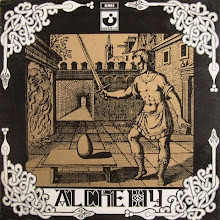
Where Mr. Barry Pilcherhas been all these years? Elusive character of the TEB story, just recently evokated by Rab Wilkie's memories in a interview that we'll publish here very soon, in these last years the Web has got him living alone in the isle of Inishfree (Ireland). In 2013 he came back to humans sharing a flat with his wife in Essex...
Here's two amazing articles taken from the Net that reveal that extraordinary person who is Barry, a perfect Third Ear Band's soul!
No Man Is An Island by Cathal McNaughton Reuters Edition U.S. May 3, 2012
For almost 20 years Barry Edgar Pilcher has lived alone on the island of Inishfree.
He is the sole permanent inhabitant of the tiny windswept island off the coast of Co Donegal in Ireland where he writes poetry and plays music. Once a week – weather permitting – Barry, 69, makes the 15 minute boat journey to Burtonport, where he does his weekly shopping in a petrol station. He posts letters and picks up the modest provisions he will need for the week and then it’s back to his ramshackle cottage where he lives and works in a single room.
Without basic sanitation, running water or a telephone and with a leaky roof and problems with dampness, Barry’s cottage is without any modern comforts. He has a peat-burning stove to provide warmth but he has to be frugal as any fuel has to be carried back from the mainland.
Barry spends his days corresponding by mail with other artists across the world – he is part of a mail art group whose members send each other drawings and pictures in the post. When the weather is warm he likes to ramble around the beautiful island playing his music – when I visit it’s a mild spring day and he takes me on a tour, stopping to play his saxophone on the beach. He tells me he takes inspiration from nature: “I’m playing a symphony to the shells today,” he says. His music is amazing and I am privileged to be at this exclusive concert for one.
Originally from south London, Barry moved to Inishfree in 1993 to ‘get away from the rat race.’ He bought this cottage from a member of a cult-like pagan group known locally as The Screamers, who had made Inishfree their base for several years. In his garden there is a stone circle left behind by the group who he tells me worshipped outdoors, screaming to release energy.
When he first arrived on the island there were a number of other people living there – one by one they have all left. “There is no school here for young people, no prospects, no future,” he explains. Later that day in his old fashioned kitchen Barry prepares a simple Vegan meal and surprises me by telling me he is thinking of moving back to the UK. “I miss going to gigs and visiting friends. I don’t think I’ll live here forever,” he says"."
MUSICIAN Barry Edgar Pilcher – once dubbed Ireland’s loneliest man - has put the remote Co Donegal island house he called home for 20 years on the market. The saxophonist who was the sole permanent resident of Inishfree island off the Burtonport coast, has put his ramshackle 'Raven Cottage' up for sale. The seventy-year old artist moved back to Essex, England, five months ago and has since been adapting to his new life in suburbia.
Saxophonist Barry Pilcher enjoying
his new life in Dagenham, Essex, with wife Eve.
After having checked the proofs of the booklet that will be included in the second Gonzo Multimedia's CD, where I've written some things about the first Italian TEB's tours, RobAyling confirms the second brand new TEB's album - with a digital rendition of "New forecasts from the Third Ear Almanac" - will be ready in a couple of months.
On April 7th, 2015 Rab Wilkie, a practicing astrologer for over 35 years and an anthropologist for about 20 years involved by chance with the beginning of the Third Ear Band,posted these very interesting lines about the origins of the TEB's name at the old page http://ghettoraga.blogspot.it/2010/07/origins-and-meanings-of-third-ear-band.html
"The naming of the band was very much the result of a group-think, everyone contributing an associated thought or three, and in the end Carolyn's seal of approval probably decided it, but my recollection is of my own strong advocacy for "Third Ear", and actually first suggesting it as an option. I suspect that I'd recently read "The Third Ear" by Lobsang Rampa and tied it in, mystically, with hearing divine sounds. Later that year (1967) I helped Steve Pank edit "Albion" and wrote the article about Tibetan monks, which appears with the TEB ad".
Little changing the sense of Carolyn's memory about it, Rab actually alludes to that very famous (a Sixties real cult book!) LobsangRampa's "The Third Eye", about the nature of a third mystical eye in the human mind. The complete original version of this book, first published in England in 1956, is available for free download at http://www.lobsangrampa.org/data/en/The-Third-Eye.pdf
"Published in 1956, T. Lobsang Rampa's book The Third Eye created a huge sensation", writes Dan Anon at "Tibeto-logic" Web site. "And for obvious reasons. I believe
that still today it is the all-time bestselling book about Tibet in any language. In chapter seven of the book, the young Tibetan acolyte (who would only in later Rampa books take over the body of the Englishman Cyril Hoskins), in the presence of his teacher, has a hole drilled into his forehead, through the skin, flesh and skull.
"A splinter of wood is placed there and left for some time before being removed. TLR's teacher Mingyar Dondup (which must be, in real Tibetan spelling Mi-'gyur-don-grub, a person who seems
otherwise unknown in the annals of Tibetan history) often told him that, “with the Third Eye open, I should be able to see people as they were.” In practice, as one may read in chapter fourteen, what having an open Third Eye meant for Lobsang Rampa was to be able to read the thoughts of other people more or less directly, but also to see their true feelings and intentions (and illnesses) by viewing the colors of their astral bodies. The Third Eye has a function which might at first seem to correspond to the 'intuitional' function of Plato’s
third eye, but in fact it is entirely oriented toward the realm of human action. It has no transcending function, no ability to intuit higher transworldly metaphysical truths of any kind".
They can be clear the possible connections with the Third Ear Band's idea of a third ear able to get the inner dimension of a person...
Edited by Luca Ferrari, the CD includes the National Balkan Ensemble's (pre-Third Ear Band) tracks published by Standard Music Library in 1970 (at last here in a official edition!), the wonderful unrealised "Raga in D" (from the very first "Alchemy" studio session) and "Raga n. 1" (from the Februry 1971 session for the never realised "The Dragon Wakes"); and "Water", "Eternityin D" and "Druid (one)" from a BBC "Sounds of '70's" radio broadcast (February 17th, 1971)... Well-known tracks to every serious TEB's fan, sure, but for the first time now in a great sound quality version!
Last year, on March 3rd, 2014, from the unscrutable waves of the Internet, Mrs Mary Hayes came out with this message to my personal e-mail:
Mrs Hayes in December 2011.
"Hello Dopachino.
Sometime ago, I saw your archive on the Third Ear Band. My name is Mary Hayes, and it has been on my mind for quite a few years that I should write to you in reference to Paul Minns, the oboist of the Third Ear Band.
I am not sure if you have the full biography details of Paul Minns personal life and family, and therefore, feel I should give you a brief background. I was Paul Minns first wife, Mary Minns, we were married in 1969, and we had three children, Matthew Minns, Tristram Minns and Amber Amber Minns.
We divorced in 1980 or thereabouts. Paul Minns later married Katherine, who is now deceased, they had no children, and therefore, Paul's children would be relevant to any biography details published in archive material or on line.
I remember, at the time of coming across your archive that you were going to carry out an interview with Caroline, Glen's partner, so you may already have this information.
The Third Ear Band Archive looks very good, and captures the essence of the Third Ear Bands character and music. The music was all improvised, Paul's oboe, being the central musical component of the bands musical expression.
Regards,
Mary Minns nee Mary Hayes".
It is obvious that I was really surprised of this, because I was ignoring Paul was married with another woman before his relationship with Kathryn Ade, his wife at the time when I knew him. Whem I met him in the '80's he never told me about this, even because I was not so involved into collecting informations about private biographies...
Tristram Minns
Anyway, from that day of March 2014, I've tried to have a proper interview with her, but for some reasons nothing happened.
Now we are still in contact and there are good chanches Ghettoraga Archive can collect another important testimony about the Band's history.
Here's the excerpt about the Third Ear Band taken from Antonello Cresti's last book titled "Solchi Sperimentali" (with kind permission of the publisher):
"It's difficult today, after so many years, to render the Power of Spreading Out made by the Third Ear Band. The impact of their first album, and, at-large of all their music, even if a non-mass heritage, can be defined as 'erupting'; it's not important which categories one can use to value it. If with a limited view we could consider this band just as the inventor of the world music, as the union of stimula coming from different times and places, we would appoint to these artists a very considerable place in the young music's history; but watching this closer, just considering the fact Rock world had started in a more or less calligraphic way to watch most of all to the East, we'd discover that in the Third Ear Band there's nothing of esotheric or descriptive. So their music is pure sound philosophy translated in action: here, their raga becomes a method for improvising, the conceptual universe is that syncretic of the more radical and educated English hippie movement. Even if integrally instrumental, TEB's music perfectly communicates a climax where interests for Eastern philosophies, pagan traditions recovered, countercultures, drugs... was welding together. It's a music of experience that the band plays in "Alchemy", where any details is functional for involving the listener in a different way to conceive the sound: Glen Sweeney & C. break the rock and folk tradition for watching to where? Surely it's not the jazz the landscape where they move, and it can be surely traced references to the contemporary music and the barbaric music, but we would hurt to the band's originality: their power was to go to the nucleus of the music communication.
Under this view, the tunes included in their first album (and even more in their second published in 1970) seem very hard to understand, but this is just an appearance because their aim is that to communicate beyond all limits of the aestethics and even the rational. From this point of view is hard to imagine a music can be more spiritual than this... Surely also the form, charaterised by an acoustic ensemble with strings, boe and percussion, and the severely circular form of compositions, or this capability to evoke dance movements in a so essential way, are traits that made the Third Ear Band music an unescapable reference for any record collection of 'Elsewhere'. But the more terrific thing about this music is the several meanings under of it.
Their first wonderful, apocalyptic album shows more caught up moments, while "Third Ear Band" is oriented to the suite with its four tunes dedicated to the natural elements. Maybe the only one "softening" is in the "MacBeth" music, composed for the Roman Polanski's movie (1972), where we can find more traditionally descriptive arrangements, reverberating medieval music with the use, even if moderate, of typical rock instruments.
One could hazard Third Ear Band's short existence was the most radical experience in the British underground: also in the period of their last reunion, happened between the end of '80's and the beginning of '90's, their music seemed to come from other depth of thought than the new age. Glen Sweeney, this minimalist of the percussive art, passed away around ten years ago, in silence, as like he had always lived. With him we have lost one of the greatest voice of the first British Esoteric Wave, that that was near to thinkers as John Michell and others...".
- an almost complete radio programme dedicated to the Thirds aired by Canadian CKCU on March, 8th 2015 (read here);
- a review about a record by Danish band Frisk Frugt with presumed references to TEB's music (catch it here);
- an interview with Legendary Pink Dots' Edward Ka-Spel with a reference to Our Holy Band ("that reminds me of Third Ear Band (a long term favourite of mine)…") just here;
- a well-done tribute to Mel Davis by Sammy Sten at "Something Else!" Web site (read it here).
Waiting for the new two CDs of the Ear Men, TEB is still on the Net!
Just today Gonzo Multimedia has sent me the proofing disks of the two new Third Ear Band albums! Thanks the great work of audio visual wizard Harold Houldershaw, they sounds really good and I'm sure they will be a great surprise for many TEB fans...
The records will be available very soon and they will document important experiences in the Band's story.
"Solchi Sperimentali. Una guida alle musiche altre" ("Experimental grooves. A guide to the other music") (Crac edizioni – 300 pages, € 22,00) is the new book written (in Italian) by Antonello Cresti.
It's an essay/compilation of reviews about around 300 albums recorded by alternative/experimental bands as Area, Claudio Rocchi, Terry Riley, Magma, Comus, Aktuala, Red Crayola... based on twenty years of passionate listening with a wide spectrum from the Sixties to nowadays.
As a big fan of the Third Ear Band (he has dedicated pages on his last books) he has written also pages on Glen Sweeney & C..
A peculiar idea of this book is that along with the reviews there's a QR code for listening the music on streaming while you're reading about it.
Cresti is an Italian composer, musician, writer and journalist. He works for newspapers/ magazines as "Il Manifesto", "Rockerilla", "Liberazioni", "Alias".
“We were just in London, clubbing, all those things people did in the ’60s in the middle of London,” British actor Francesca Annis recalls, in an interview on the new Criterion release of Macbeth, of “crossing paths” with director Roman Polanski in the days when the Polish-born director was launching his career in the West with the still-galvanizing thriller Repulsion. “Clubbing” in London in the ’60s arguably had more cultural significance than you find in contemporary nightlife. Nightclubs were also cultural laboratories of a sort, in which musicians and other performers, sometimes with psychedelic assistance, sought to expand the borders charted by the likes of the Beatles and the Stones. The scene at London’s UFO Club, for instance, yielded experimenters both obscure and, in some cases, eventually monumental, like Pink Floyd, the Soft Machine, and an aggregation that would eventually be known as Third Ear Band—which in 1971 would provide the score for Polanski’s chilling Macbeth.
The murder of Polanski’s wife, Sharon Tate, and their unborn child in the summer of 1969 was in fact the second traumatic loss Polanski had suffered that year; in April, his longtime friend and collaborator Krzysztof Komeda had died after sustaining head injuries several months earlier. Macbeth was the first film Polanski made after these tragedies, and only the second without Komeda’s participation. (American jazz musician Chico Hamilton’s score for Repulsion is often mistaken for Komeda’s work, which in itself says a little something about varieties of cultural cross-pollination.) Contemporary accounts claim that Polanski, back in Europe after a U.S. filmmaking sojourn that had seen him complete the remarkably successful Rosemary’s Baby, was told of the band by an acquaintance who had worked with them on their soundtrack for an obscure animated German television film, Abelard and Heloise.
Writing of Third Ear in his excellent account of British folk-rock in the ’60s, "Electric Eden: Unearthing Britain’s Visionary Music", Rob Young notes that the group “sculpted an esoteric chamber music from acoustic elements,” yielding “incantational songs—without words, a ritualistic consort music.” Ritualistic is a significant word here; in Polanski’s film, one of the most appalling and memorable set pieces is the witches’ sabbath, and the movie’s many murders are depicted almost as fever-dream rites. Young quotes founding member Glen Sweeney, the group’s percussionist (he played a variety of hand drums), thusly: “I called the music alchemical because it was produced by repetition.” For the recording of the music soundtrack, Sweeney and oboe/recorder player Paul Minns, another founding member, were joined by cellist/bassist Paul Buckmaster (a classically trained musician who was also doing string arrangements for Elton John in this period, and who would later collaborate with Miles Davis), violinist and electronics player Simon House(later of the sci-fi psychedelic madhouse Hawkwind), and guitarist Denim Bridges, and they improvised the score at London’s Air Studios while looking at black-and-white rushes of the film. The full results of their efforts are collected on the album "Music from Macbeth", a bracing record that presents an experience pointedly different from that of the film . . . but just as breathtaking and sometimes harrowing.
There’s a hypnotic effect created via the alchemical repetition: not just in the rhythms of Sweeney’s hand drumming but in the motifs Minns spins out on his wind instruments. In the early ’60s, the British guitarist Davey Graham had taken his interest in Moroccan music and applied it to a new guitar tuning that went on to influence such players as Bert Jansch and Jimmy Page. The repetitions inherent in some forms of Western modal music—old British folk songs, for instance—seemed to find an affinity in the drones of Indian ragas. The tonal limitations of early electronic instruments, such as the VCS3 synthesizer played by House on the Macbeth soundtrack, lend themselves to a certain form of musical minimalism. The consonances implicit in these musical forms that were largely considered culturally discrete give Third Ear Band’s music for Macbeth an uncannily old-world feel, in that it evokes an atmosphere in which certain ideas of “difference” had not yet been fully formed. This feeling of a kind of antiquity prevails even when the electronic instruments in the band’s array are foregrounded. Hence, nothing in the score for Polanski’s film seems overtly anachronistic: it all fits into the sometimes verdant, sometimes blighted, always eerie and enigmatic world where the filmmaker sets the bloody action.
But Polanski uses the music sparingly in the movie, and sometimes remixes it ruthlessly. For the scene in which Macbeth (Jon Finch) seems compelled by a floating dagger to undertake the murder of Duncan, Third Ear Band recorded a track (titled “Dagger and Death” on their album) on which a repeating single-stab guitar note (like something out of a slo-mo version of the psych-rock hit of a few years earlier “Pictures of Matchstick Men”) is underscored by moans from violin, recorder, and even what sounds like a bowed percussion instrument; two minutes into the track, Sweeney’s hand drum comes flurrying in, whipping up a small frenzy that drops out as suddenly as it began. For its use in the film, though, Polanski just about mutes all the instruments save the guitar, the stinging note synchronized to the floating dagger as it first tempts, and then leads, Macbeth, drawing him down the hall to commit his first foul deed. It is with the stabbing of Duncan that the hand-drum section of the piece is heard, to great effect. In other scenes, such as Macbeth’s consultation with Lady Macbeth at the well where they both ineffectually try to wash the blood from their hands, Polanski keeps the music at the brink of audibility. When Macbeth sees Banquo’s ghost, the violin swells from a larger piece of music are dropped into the soundtrack percussively.
In "Electric Eden", Young says that Third Ear Band’s “arcane, absorbing music stands as one of several unexplored lanes leading away from the psychedelic garden that remains neglected and overgrown.” It’s true that very few of the musicians who came in their wake attempted anything as ambitious as this group did. But they were influential. The soundtracks that the German group Popol Vuh created for Werner Herzog’s Aguirre: The Wrath Of God and Fitzcarraldo would be unimaginable without the precedent of what Third Ear Band did in Macbeth (and in fact, Herzog used a Third Ear song on the soundtrack of his Fata Morgana). Such works exerted considerable power over musicians such as Gary Lucas, the alchemical guitar wizard who co-composed Jeff Buckley’s “Grace” and “Mojo Pin” and who recently unveiled a new guitar score for James Whale’s 1931 Frankenstein. Lucas recalls visiting Glen Sweeney in London in 1973 and being presented a copy of the Macbeth script, the front page of which was embossed with a simulated-blood thumbprint! Sweeney himself passed away in 2005.
This six-minute track, “Overture/The Beach,” as it appears on Third Ear Band’s "Music from Macbeth", illustrates the atmospheric, improvisation-based method that gave Polanski a wide range of aural options to mix into the film’s actual audio track:
Here, Polanski uses the band’s percussive “stabs” on a guitar string to give hallucinatory dimension to the vision of a floating dagger that coaxes him to murder, which he does to a flurry of almost panicked-sounding hand drumming, discordant cello moans, and more pointed guitar shrieks.
When in 2009, after two tours managed and a book written about the Band, I decided to set GhettoRaga Archive my first aim was to celebrate the art of one of my favourite bands ever and honour the life of two great musicians and friends - Glen Sweeney and Paul Minns, founder of the group, sadly passed way.
Then other deaths came - Ben Cartland, Mike Marchant, Mel Davis...loosing an important part of the memory.
One of the first project I had in my mind was to realise a CD with some unrealised tracks taken from personal archives, BBC radio recordings and other old stuff. The project, titled "The Dragon Wakes", was inspired by the third TEB's album announced in 1970, recorded in 1971 but never realised (electric guitarist Denim Bridges has still all the original (wondeful!) recordings at home but he has never made anything from it (why Denny?).
Now, thanks English label GonzoMultimediaon next Spring TEB's fans shall have some recordings from the past (all the National Balkan Ensemble's recordings, some other never realised tracks, the complete concert played by the band in Sarzana in 1989, now a rare collector's item...) on two different albums with liner notes edited by me.
Here's a cover proof designed by Martin Cook who has thought to the project as a set of two similar covers with different colours:
So stay awake and... keep in touch with GhettoRaga!
Who is interested in reading the beautiful Dave Tomlin's book titled "India Song" (published in 2005 by Iconoclast Press, London), can start reading this excerpt from it on a recent output by International Times, the glorious Sixties magazine available on the Net (http://internationaltimes.it). Here's the text:
"I get my bowl filled with coffee at a local stall and take it back to my room. I place it on the grass mat covering the bed, climb on and tuck in the mosquito net. Taking out a small fragment of grass I crumble and roll it into a paper, the result is very thin since I only want to test its potency. I light up and take a few good pulls. At this point the buzzing from the neon tube becomes unbearable, the place is like a fish and chip shop. I get up, turn it off and light a candle.
"Kerala Grass" by Nick Victor.
The room is illuminated apart from this by a neon in the courtyard outside the window. It is now silent but for the low hum of the fan. I notice that the light from the courtyard passing through the frosted panes of the window creates a perfect illusion of strong moonlight, all it lacks is a spray of bamboo across the glass. The white net billows around me; it is a Bedouin tent, and, as Kumar had predicted trapdoors are opening in my head. I go over to the window, open it and look down. Far below the Thousand Lights Piazza is thronged with night life, Mushie sellers cry their wares and late shoppers rub shoulders with theatregoers bent upon an early dinner before the show. Across the sea of twinkling lights an occasional torch rises fiercely towards the stars from the spaceport on the outskirts of the city.
I look out across the park, Tassle will be waiting for me. I climb onto the low balustrade outside the window and leaning forward launch myself out. The movement arouses a few roosting birds which flap around me shrieking as I head for the park. I pass only a few other fliers and stay low to avoid recognition. The moonlight is intense. Crossing the park boundary I look down and see the trees below as pools of blackness on a silver ground. The place I am heading for is a deserted and overgrown area unfrequented even by day. A derelict fountain is at its centre which Tassle and I have been using as a trysting place and now I see it below, a faint whitish blur in the darkness among the trees. I come down silently and approach the fountain, its huge marble bowl now filled with the leaves of several autumns. Tassle is standing with her back to me, leaning gracefully against the fountain. I call softly to her and she turns; there is a strange look in her eyes and she is holding something in her arms. As I come closer I see that it is round and softly glowing with a faint pulse. I hold out my arms and she passes it to me. I notice that it has several appendages pointing like antenna outward from its centre. Examining it more closely I see that is not, as I had first thought, a solid sphere, but seems to be an arrangement of shimmering points of blue light connected by thin filaments of silver wire. The appendages, extending through the axis of the sphere, intercept as they do so the points of light. ‘Listen to it.’ Tassle speaks for the first time. I put my head closer and am astonished, for as my ear enters the vector between two of the appendages it is immediately as if I am seeing sound. In the enormous distance hangs a globular cluster of tones. Hovering together their pitches oscillate faintly, brightening and fading as the wavelengths coincide and depart. At intermediate intervals there appear other tones, some speeding across my field of view and gone like darting comets in a flash. Others smaller, move together in languid shoals. I see thousands upon thousands of minute and tiny sounds, each so small as to be undetectable. Now gathered together in a vast cloud they generate a deep bass hum. Out in the far, far distance I detect other faint sources, but I am able it seems to attune myself to any of these points. I focus upon one such source, a large and very distant sonic mass whose peculiar on-off pattern has been interesting me for some time. There is a sudden wrench… I am momentarily confused, I open my eyes to see Tassle standing before me, she has pulled the device from my hands. She laughs. ‘There are sixty-three other ways to view,’ she says. ‘That was only one of them.’ I am very, very interested. In fact I have already decided that I must have one of these instruments and tell her so. She laughs again. ‘There are only two others known to exist, they come from so far away that knowledge of their origin does not survive the journey.’ ‘What will you take for it?’ I ask. ‘I will have only one thing,’ she replies. ‘I will have your World Opener.’ Now it is my turn to laugh, does she seriously think I will exchange my precious World Opener for a toy? Then I remember that distant sonic sun, the remote constellations singing to me along the neurone paths of memory and I know I must again enter that world at any cost. Reluctantly I take out my World Opener and silently pass it to her. I will return to my room and explore the infinite possibilities of the device. But before I can claim my purchase, she steps back and activates the Opener, cutting sideways between my left side and a nearby tree. Then, before I realise what she is about, she cuts a swift loop around me and reconnects the edges from her side, excluding me from the world in the process… I am sitting on by bed; it is hours later, the candle has burned almost out. I look down; in the ashtray my joint of grass lies there, forgotten… I blow out the candle and retire".
"Someone else who posted here said they've learntmore about TEB in a fewhours here than in 30 years. I'd agree with that except inmy case it would be 44 years. An excellent archive for TEB fans and historians of the era. Thank you!" RACHAEL TYRELL
A TEB BOOK...
CLICK ON THE PICTURE TO BUY THE BOOK.
NEW TEB 3CDs BOX OUT NOW!
Click on the picture to get a copy.
"ALCHEMY" REMASTERED EDITION OUT NOW!
Click on the picture for buying the album.
WRITE TO GHETTORAGA
Search This Archive
New TEB remastered CD on sale!
Click on the picture to purchase the record.
NEW THIRD EAR BAND REMASTERED CD EDITION ON SALE!
Click on the picture to buy the record
Translate
Third Ear Band 1969: Paul Minns, Glen Sweeney and Richard Coff (photo: Ray Stevenson).
Luca Chino Ferrari (b. 1963) is an Italian music writer. Since 1985 he has written and translated books about folk and rock musicians as Third Ear Band, Robyn Hitchcock, Captain Beefheart, Tim Buckley, Nick Drake, Syd Barrett & the Pink Floyd for the main Italian publishers. He met Syd Barrett in 1986 and did contribute to the reunion of the Third Ear Band during the '80s. His latest books was published in 2020 for English ReR November Books, as a collection of stuff about the Third Ear Band, and in 2024 as a collection of writings about Syd Barrett (in Italian). He runs a personal Web site (in Italian/English) at https://chino6339.wixsite.com/gelatoaicorvi
TEB recording at Abbey Road Sudios in February 1971
Click on the picture to watch the video!
"Third Ear Band music is a reflection of the universe as magic play illusion simply because it could not possibly be anything else. Words cannot describe this ecstatic dance of sound, or explain the alchemical repetiton seeking and sometimes finding archetypal formes, elements and rhythms...".
(Glen Sweeney on "Alchemy", Harvest Records 1969)
Paul Buckmaster at Hyde Park (June 7th, 1969).
Total Pageviews
"ALCHEMY"
"Alchemy" (Harvest 1969)
Third Ear Band live at Hyde Park (June 7th,1969)
Click on the picture to watch the video!
Read "Necromancers of the drifting West"!!!
A book on the Third Ear Band edited by Luca Ferrari (published by Stampa Alternativa, Rome 1997). WITH THE FIRST ORIGINAL VERSION OF "ABELARD & HELOISE" SOUNDTRACK!
Third Ear Band at the Roundhouse (London, May 30th 1969).
As alike or unlike as blades of grass or clouds...
"The music is the music of the Druids, released from the unconscious by the alchemical process, orgasmic in its otherness, religious in its oneness communicating beauty and magic via abstract sounds whilst playing without ego enables the musicians to reach a trance-like stage, a "high" in which the music produces itself. Each piece is as alike or unalike as blades of grass or clouds".
(From the 1969 Isle of Wight concert programme)
TEB - "THE LOST BROADCASTS" DVD (Gonzo Multimedia, UK 2011)
Richard Coff at Isle of Wight Festival, August 1969 (photo: Barry Plummer).
Pseudo-mystical...
“The trouble is that you can't be mystical without being called pseudo-mystical, and it's the fault of our previous education. I'm at Glastonbury most of the time, but we're all completely honest about it. We'll even use it honestly to make money, because the ancient Egyptians who were into it all said that you had to be rich because only then can you resist temptation”.
(Glen Sweeney to Richard Williams, “Melody Maker” June 1970)
"Macbeth" by Roman Polanski (Playboy Production, UK 1971)
“I've always felt that music should be pure. If you have lyrics, you are preaching in a way. Somehow words are a block to communication. It's almost impossible for me to explain exactly how I feel about this, that's why I'm a musician. The only way to really understand what I mean, is to firstly listen to a pop group and then listen to us, and then I hope you will know what we're trying to say."
(Glen Sweeney to Muz Murray, 1969)
A Third Ear Band tribute
Roberto Musci - "Mosaic. A tribute to Third Ear Band" (CD - Gonzo Multimedia HST411, 2016)
TEB 1971: Sweeney, Minns, Bridges and Buckmaster (photo: Blackhill Enterprises).
NOTES FROM OVERGROUND
“No announcements, numbers lasting 15 to 20 minutes, art form or con?
This might be valid criticism of (A) Thunderstorm (B) a cricket (C) Third Ear Band.
Their approach to music is different because there is no duality, no conflict between the natural element of chance and the human element of control, did the moon ask to be reflected in the water? If it wasn’t for the trees would the wind know when it was blowing? Paul Minns says there are some very beautiful forests in Hyde Park, trying to put titles to music is rather like trying to answer the question where does my hand when it becomes my fist”.
(From the Al Stewart-Third Ear Band 1970 tour programme)
TEB 1970: Sweeney, Minns, Coff & Smith (photo: Blackhill Enterprises).
"The Centipede was happy, quite, until a Toad in fun said: "Pray, which leg goes after which?". This worked his mind to such a pitch, he lay distracted in a ditch considering how to run". (Third Ear Band, 1970)
TEB at Isle of Wight Festival, August 1969 (photo: Barry Plummer).
"Music from Macbeth" (Harvest 1972)
Third Ear Band - "Experiences" (Harvest 1976)
WEIRD SCENES
“We'd rather people called us a pop group. We do ragas, that aren't really ragas at all, and unless we get a turned on promoter, we get into some weird scenes. At Norwich once, when the promoter saw the audience sitting down and closing their eyes to our music, he accused us of putting them to sleep! Complete paranoia. So I imagine we wouldn't do too well on the Pop Proms”.
(Glen Sweeney interviewed by Chris Welch - “Melody Maker” July 12th, 1969)
Third Ear Band - "Fleance" (Odeon 1972) Japan single edition
Third Ear Band - "Live Ghosts" (Materiali Sonori 1988)
VERY MUCH UNDERGROUND
“It's just a question of advertising. We've stayed very much Underground - no photos - and I think this was necessary so people wouldn't put us in a bag. We'd rather the just came up and heard us without ANY preconceived ideas. I suppose it is a bit shattering to see violins and cellos”.
(Glen Sweeney interviewed by Chris Welch - “Melody Maker” July 12th, 1969)
Third Ear Band at a Druids ceremony in Glastonbury Tor (April 15th, 1970).
OTHER TEB RELEASES/APPEARANCES
"Picnic. A breath of fresh air" (2LPs - Harvest SHSS 1/2, UK 1970) various Harvest artists anthology
"Harvest Heritage. 20 Great" (LP - Harvest , UK 1977) various Harvest artists anthology
"The Harvest Story Vol. 1" (LP - Harvest EG 260097 1, UK 1984) various Harvest artists anthology
"All frontiers" (CD - Materiali Sonori MASO CD 90026, ITA 1991) various artists live compilation
"Sonora 2/91" (CD - Materiali Sonori, ITA 1991) various Materiali Sonori artists compilation
"Radio Session" (CD - Voiceprint VPR017, UK 1994) live album
"Materiali Sonori" (CD - Olis OM 0021, ITA 1996) various Materiali Sonori artists compilation
"Live" (CD - Voiceprint VP157CD, UK 1996) live album
Third Ear Band - "New Forecasts from the Third Ear Almanac" (ADN Records 1989)
90% improvisation...
"I'd say ninety per cent of our music is improvisation. It's not really Indian music, although we use a drone instead of the usual bass line riffs. The music draws from everywhere.
"I think our appeal is that audiences can draw their own thing from us. We make no announcements and none of the numbers have titles. People in colleges we play come up after and say they can get fantastic images in their mind when they listen. We can offer a complete dream. The old Celtic bards used to have the same ability".
(Glen Sweeney interviewed by Chris Welch - “Melody Maker” July 12th, 1969)
“Third Ear Band’s new album “Magic Music” isabout music as pure vibrations, as such it can be linked with colour because colour is vibration. It can even be linked to the music ofthe spheres which states that the vibrations of the planets can be heard with the third ear (silence). The free ragas that we play are modal, each note can be heard as a sound-colour that produces its own mood.Our rhythms come from all overthe world, and we use these ideasand many others to try to make a new world music”.
(Glen Sweeney, notes on the “Magic Music” inner cover, 1990)
SOLOS DISCOGRAPHIES
- GLEN SWEENEY -
Various Artists - "The greetings compact vol. 2" (CD - Materiali Sonori, 1990)
Rolling Stones - "Sticky fingers" (LP/CD - Rolling Stones Records, 1971)
Carly Simon - "Hotcakes" (LP/CD - Elektra, 1974)
Elton John - "Single man" (LP/CD - Rocket, 1978)
- NEIL BLACK (selection) -
UB40 - "Present Arms" (LP/CD - DEP, 1981)
Joan Armatrading - ""Track Record" (LP/CD - A&M, 1983)
Third Ear Band 1969: Minns, Sweeney and Coff at the Kensal Green Cemetery of London (photo: Ray Stevenson).
Third Ear Band - "Brain Waves" (Materiali Sonori 1993)
Eight drunk rugby players
"We once had eight drunk rugby players yelling dirty songs at us. We played quieter and quieter. In the end they seemed ashamed and shut up. But I still don't think they dug the music!".
(Glen Sweeney interviewed by Chris Welch - “Melody Maker” July 12th, 1969)
Third Ear Band, Vinci 1989: Allen, Sweeney, Dobson and Carter (photo: Lucia Baldini).
QUOTATIONS, COVERS, REMIXES, MANIPULATIONS OF THIRD EAR BAND MUSIC
Stone Breath - "A silver thread weave the seasons" (2CDs - Hand/Eye, USA 2008). A 'cover' of "Fleance".
Marco Lucchi - "Baby a" (ITA 1982). A composition with a sampler of "Stone Circle".
Radio Noisz Ensemble - "Yniverze" (CD - Garden of Delights 1982/2009). A 'folky' quotation of "Water".
Fabio Zuffanti - "Third Ear Band demixed" (CD-r - Spirals Records, ITA 2000). The four elements electronically manipulated.
Algarnas Tradgard - "Delayed" (CD - Silence Records, UK 2001). A quotations of "Water" recorded in 1973-1974 (!).
Lady Husk & The Good Ship Neotropic - "A monstrous psychedelic bubble exploding in your mind" (file MP3 - The New Worck, NL 2007). A remake of "No title" (?!).
I Monster - "The Art of Chill vol. 6 - Mixed by I Monster" (2CDs Platipus, UK 2009). A remix of "Fleance".
Vibes and Stuff - guest mix Coby Sey (MP3 - UK, 2010). A remix of "Water".
AA.VV. - "The Fruits de Mer Annual for 2011" (2x7" - Fruits de Mer Records, UK 2011). A cover of "Fleance" by the HI-Fiction Science.