Showing posts with label Antonello Cresti. Show all posts

April 11, 2015

Antonello Cresti on the Third Ear Band (from his latest book).


Here's the excerpt about the Third Ear Band taken from Antonello Cresti's last book titled "Solchi Sperimentali" (with kind permission of the publisher):


"It's difficult today, after so many years, to render the Power of Spreading Out made by the Third Ear Band. The impact of their first album, and, at-large of all their music, even if a non-mass heritage, can be defined as 'erupting'; it's not important which categories one can use to value it. If with a limited view we could consider this band just as the inventor of the world music, as the union of stimula coming from different times and places, we would appoint to these artists a very considerable place in the young music's history; but watching this closer, just considering the fact  Rock world had started  in a more or less calligraphic way to watch most of all to the East, we'd discover that in the Third Ear Band there's nothing of esotheric or descriptive. So their music is pure sound  philosophy translated in action: here, their raga becomes a method for improvising, the conceptual universe is that syncretic of the more radical and educated English hippie movement. Even if integrally instrumental, TEB's music perfectly communicates a climax where interests for Eastern philosophies, pagan traditions recovered, countercultures, drugs... was welding together. It's a music of experience that the band plays in "Alchemy", where any details is functional for involving the listener in a different way to conceive the sound: Glen Sweeney & C. break the rock and folk tradition for watching to where? Surely it's not the jazz the landscape where they move, and it can be surely traced references to the contemporary music and the barbaric music, but we would hurt to the band's originality: their power was to go to the nucleus of the music communication.
Under this view, the tunes included in their first album (and even more in their second published in 1970) seem very hard to understand, but this is just an appearance because their aim is that to communicate beyond all limits of the aestethics and even the rational. From this point of view is hard to imagine a music can be more spiritual than this... Surely also the form, charaterised by an acoustic ensemble with strings, boe and percussion, and the severely circular form of compositions, or this capability to evoke dance movements in a so essential way, are traits that made the Third Ear Band music an unescapable reference for any record collection of 'Elsewhere'. But the more terrific thing about this music is the several meanings under of it.

Their first wonderful, apocalyptic album shows more caught up moments, while "Third Ear Band" is oriented to the suite with its four tunes dedicated to the natural elements. Maybe the only one "softening" is in the "MacBeth" music, composed for the Roman Polanski's movie (1972), where we can find more traditionally descriptive arrangements, reverberating medieval music with the use, even if moderate, of typical rock instruments.

One could hazard Third Ear Band's short existence was the most radical experience in the British underground: also in the period of their last reunion, happened between the end of '80's and the beginning of '90's, their music seemed to come from other depth of thought than the new age.

Glen Sweeney, this minimalist of the percussive art, passed away around ten years ago, in silence, as like he had always lived. With him we have lost one of the greatest voice of the first  British Esoteric Wave, that that was near to thinkers as John Michell and others...".


A psychedelic Antonello Cresti with his new book.


(Italian version)
"E’ difficile resocontare oggi, a distanza di tanti anni, la Potenza della operazione di “spalancamento” operata dalla Third Ear Band. L’impatto del loro primo album, e, in generale, di tutta la loro musica, per quanto patrimonio non di massa, non può non essere definito come deflagrante, quali che siano le categorie che intendiamo utilizzare per compierne una valutazione; se, in maniera riduzionistica, ci limitassimo ad immaginare questo ensemble come inventore della world music, intesa come unione di una serie di stimoli provenienti da tempi e da spazi diverse, già affideremmo a questi artisti un posto di assoluto rilievo nella storia della musica giovane, ma a ben vedere, considerando che il mondo del rock già aveva cominciato a guardare in maniera più o meno calligrafica soprattutto ad Oriente, ci accorgeremo che nella Third Ear Band non c’è nulla che sia descrittivo, esotico. Ecco allora che la musica espressa da questa formazione è pura filosofia del suono tradotta in azione: il raga diviene un metodo di approccio per improvvisare, l’universo concettuale è quello sincretico dell’ala più colta e radicale del movimento hippie inglese. Anche se interamente strumentale la musica della Third Ear Band comunica perfettamente un clima in cui andavano saldandosi interesse per le filosofie orientali, recupero della tradizioni pagana autoctona, controcultura, droghe… E’ musica esperienziale quella di “Alchemy”, nella quale ogni dettaglio è funzionale a coinvolgere l’ascoltatore in una diverso modo di intendere la materia sonora: Glen Sweeney e compagni rompono apparentemente con la tradizione del rock e del folk per guardare dove? Non è certo il jazz il panorama sin troppo irreggimentato in cui si muovono e i riferimenti alla musica contemporanea, alla musica barbarica certamente possono esser rintracciati, ma ci sembrerebbe quasi di fare un torto alla originalità del gruppo la cui forza sta nell’arrivare intuitivamente al nucleo inscindibile della comunicazione musicale. In questo senso i brani che compongono il loro lavoro di esordio (e ancor più compiutamente quelli inseriti nell’omonimo album del 1970) appaiono difficili, ardui da comprendere, ma appunto si tratta solo di “apparenza” poiché l’intento è quello di comunicare fuori dalle gabbie dell’estetico o addirittura del razionale. Da questo punto di vista è difficile immaginare una musica che, nel suo andamento primigenio, sia più spirituale di questa… Certamente anche la forma, dall’organico in acustico suddiviso tra archi, oboe e percussioni, alla forma rigorosamente circolare delle composizioni, alla capacità di evocare movimenti di danza in maniera così essenziale, sono tutte caratteristiche che rendono la Third Ear Band un riferimento ineludibile per ogni discoteca dell’altrove, ma ciò che è ancora più terremotante è, come abbiamo detto, la lunga serie di significati che agiscono sotto la corteccia formale di questa musica.

L’esordio, bellissimo e apocalittico, predilige ancora episodi più conchiusi, mentre “Third Ear Band” guarda alla suite, con quattro brani dedicati agli elementi naturali. Unico “ammorbidimento”, forse, nelle musiche per il “Macbeth” filmico di Polanski (1972), in cui vengono accolti elementi di arrangiamento più tradizionalmente descrittivi, dal richiamo alla musica medievale, all’utilizzo, per quanto discreto, di strumenti cari al rock.

Verrebbe da azzardare che nella loro breve parabola la Third Ear Band è stata l’operazione più radicale emersa dall’underground britannico: anche al tempo della loro reunion, avvenuta tra la fine degli anni ottanta e i primi anni novanta, la loro arte, in piena epoca new age, sembravano provenire da altre profondità di pensiero.

Glen Sweeney, questo minimalista dell’arte percussiva, ci ha lasciati circa dieci anni fa, in silenzio, come sempre aveva vissuto. Con lui se ne è andata una delle grandi voci della prima ondata della Britannia Esoterica, quella affine a pensatori come John Michell e altri…".
(Riprodotto per gentile concessione dell'editore. Tutti i diritti riservati) 

no©2015 Luca Ferrari (unless you intend to make a profit. In which case, ask first)  

January 30, 2015

New book by Italian journalist Antonello Cresti with TEB quoted.


"Solchi Sperimentali. Una guida alle musiche altre" ("Experimental grooves. A guide to the other music") (Crac edizioni – 300 pages, € 22,00) is the new book written (in Italian) by Antonello Cresti
It's an essay/compilation of reviews about around 300 albums recorded by alternative/experimental bands as Area, Claudio Rocchi, Terry Riley, Magma, Comus, Aktuala, Red Crayola... based on twenty years of passionate listening with a wide spectrum from the Sixties to nowadays.
As a big fan of the Third Ear Band  (he has dedicated pages on his last books) he has written also pages on Glen Sweeney & C..
A peculiar idea of this book is that along with the reviews there's a QR code for listening the music on streaming while you're reading about it.
Cresti is an Italian composer, musician, writer and journalist. He works for newspapers/ magazines as "Il Manifesto", "Rockerilla", "Liberazioni", "Alias".

Edizioni Crac Web site:
http://edizionicrac.tumblr.com
Buy a copy of the book/Acquista una copia del libro:
http://edizionicrac.blogspot.it/2014/10/ordina-qui-il-nuovo-libro-di-antonello.html 
Cresti's promo video about the book (in Italian):  
https://www.youtube.com/watch?v=vc23S2qXoX0&x-yt-ts=1422579428&x-yt-cl=85114404
A live presentation of the book (in Italian):
https://www.youtube.com/watch?v=0A6mMtMdcwI
Other Cresti's books  on this Archive:
http://ghettoraga.blogspot.it/2011/03/third-ear-band-quoted-on-italian-book.html
http://ghettoraga.blogspot.it/2011/11/new-italian-book-about-english-folk.html

no©2015 Luca Ferrari (unless you intend to make a profit. In which case, ask first) 

February 19, 2012

"Alchemy": an esoteric record for initiates.


As a powerful musical/visual/conceptual device, “Alchemy” stands as a really unique work in the Popular Music history.

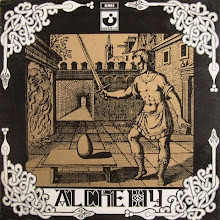
"Alchemy" CD booklet cover (Drop Out Records 1999)

As on a recent essay Italian writer, Antonello Cresti writes, “this album is full as ever of musical invitations (all the tracks are instrumental) to take a more deep and conscious form of spirituality up” (read at http://ghettoraga.blogspot.com/2012/01/tebs-cultural-sources-on-italian-book.html).

Absolutely right, but probably it’s much more.

Because if it’s quite easy to discover some elements of cultural suggestions just based on the tracks’ titles, linked to the feelings of its time (the epic Sixties…), in my opinion, “Alchemy” was thought as a strong summa for an alternative life. A philosophic (music) treatise for a New Age.
Also for this, this album seems to transcend its time…

I’ve already written about the “Egyptian Book of the Dead” in this archive (read at http://ghettoraga.blogspot.com/2011/08/tebs-egyptian-book-of-dead.html) as a piece of incredibly scary sounds intended for going with the dead through his death. Music composed to remember us our ephemeral life and the responsibility to live with an ethical approach to human things.
But what about the album's other tracks?

Druids painted by Charles Knight (1845)
It's easy to state that “Alchemy” (1969) is conceptually more complex than “Third Ear Band” (1970), even if for music critics the second is generally considered better than the first. Anyway, here we have a stone circle and a druid, surely alluding to the pagan druidic ancient tradition; the direct quotation of the ancient Book of the dead (Egyptian history related); the dragon lines, as Cresti explains in his book, “a clear musical transposition of pioneer theories of John Michell, who had transposed Chinese tradition of "Lung Mei" on English culture and told about "Dragon Paths". These "Lung Mei" (an expression we can in fact translate as "Dragon Paths") are energetic lines discovered by ancient Chinese; from the heart of a dragon, usually laid in a valley among the hills, springs of energy have radiated, as it occurs with the "Ley Lines"".

In "Alchemy" we have also Dave Tomlin's “Lark Rise(based on Flora Thompson’s book “Lark Rise to Candleford”) that celebrates a vanished bucolic utopia as documented elsewhere here (read at http://ghettoraga.blogspot.com/2012/01/dave-tomlins-lark-rise-origins-cultural.html).

Swinside stone circle (West of Broughton in Furness)

And we can listen also to three apparently more obscure tracks - “Ghetto Raga”, “Mosaic” and “Area Three” - all related to the idea of space: a space to protect (thanks to the snakes on the cover...), a ghetto, a place for Hermetics where to practice alchemy (the cover concept) and turn the poor metals in gold (Prima Materia).

 Asking Dave Tomlin about this idea of space (January 24th, 2012), he writes to me: "I could speculate a little. "Area three" comes I think from the film world. It is a forbidden place; maybe dedicated to government secret experiments on... humans? There is a place like that in the Russian film 'Stalker' - Tarkowski, I think -, which would tell you all.
I think they used "Ghetto Raga" just because it sounds good. Ghettos are run down areas where poor people, usually of the same race live (Jews etc.). So Ghetto gives a rough type image, and raga is another racy word, although it's doubtful if any of the band studied Indian music. So together the two words create an interesting effect. No more than that...".


Byzantine mosaic (Galla Placidia Mausoleum - Ravenna, Italy)

But a ghetto of raga, where religious musicians play ragas besieged by the (post) modern world, could be the same area three (three as the TEB musicians?), a place for (musical) alchemic experiments...

Thus a record as a clear powerful metaphor alluding to turn bad music in good music, a superficial/commercial listening to a deep one, a materialistic life to a spiritual one…
I think “Alchemy” is a coherent, integrated device of ideas related to a definite conception of life - very distant from the usual Sixties Egyptian ephemera of fashion.
The best work ever produced by the band and one of the best albums of its time (no Egyptian junk, please!).

Maybe an alchemic product itself!?

A detail of the egg (the Great alchemic Opera) from "Alchemy" front cover

As Glen Sweeney said about the TEB music, "the music is the music of the Druids, released from the unconscious by the alchemical process, orgasmic in its otherness, religious in its oneness communicating beauty and magic via abstract sounds whilst playing without ego enables the musicians to reach a trance-like stage, a "high" in which the music produces itself. Each piece is as alike or unlike as blades of grass or clouds" (from the original 1969 Isle of Wight concert programme).

And again, just around the period when "Alchemy" was recorded: "We are beginning to move into some strange musical areas, doing a piece we call Druid. Once or twice when we've played this thing, we've gone into a weird sort of experience we call a 'Time-shift'. Nobody really knows what it is. The whole Druid piece is repetitive and extremely hypnotic and yet you have some of the instruments doing far out things so that a fantastic tension is built up. It's like alchemy. The alchemical emphasis is on the endless repetition of experiments, doing the same thing over and over again, and waiting for some sort of X-factor to appear. This is more or less what we do when we play. And our X-factor is this time-shift thing".


"It happened once at the London Arts Lab, and as we played, it seemed as if time had slowed down and we had drifted into a completely different dimension. And when we finished, nobody moved at all. They were kind of stuck there. So I felt that perhaps it had happened to them too. So that's the thing we are trying to get into. Although it can be quite a strain during a public performance, like living on the edge of a cliff, since nobody knows what might happen. To be on stage and feel it happening can be quite frightening. You go out of yourself, and when you come to, you discover yourself on stage with hundreds of people staring at you. You get this split-second thought: 'Have I been playing? Have I ruined the whole thing?' In a way, it's very similar to meditation and mantra chanting, which is why I feel what we are doing has a very religious depth" (from "Gandalf's Garden" #4, 1969, interviewed by Muz Murray).

Tomlin clarifies me (January 30th, 2012) that "in the mid-Sixties, there were many different influences. One was the legend of King Arthur's Court. Another was the Aliens - flying-saucers - messages from the stars. Also Blake's "Jerusalem", the Ley-Lines, Ramana Maharishi. And the mysterious arts of Alchemy.
There was an Alchemical saying of the time: 'When the sound of the music changes the walls of the city shake', which the Third Ear used at one time. Glen was very much drawn to the Alchemical myth. In fact a few years before he died he kept an ex-WWII torpedo-boat on a north London canal. Its name was 'ALCHEMY', he and Carolyn used to roar around the canals in it and everyone had to get out of the way; they were the terror of the waterways. I sometimes visited them on the boat and when Glen died she took the compass from the boat and gave it to me (this compass came from Glen Sweeney's boat Alchemy)...".

As in the past, people used to write books for initiates, in modern times, musicians play records to open the mind and soul of people ("Happy new ears!" John Cage wrote): Third Ear Band has left us a beautiful, scary record of magic/esoteric/philosophic music for the everyday life & death... 
Also for this reason sometimes we return to it as a sort of breviary, listening to little drops of it as a thaumaturgical magic potion!

"Alchemy" CD back cover (Drop Out Records 1999)

no©2012 Luca Ferrari (unless you intend to make a profit. In which case, ask first)

January 08, 2012

TEB's cultural sources on the Italian book about esoteric English folk music written by Antonello Cresti.


As announced some months ago (read at http://ghettoraga.blogspot.com/2011/11/new-italian-book-about-english-folk.html), on the last new book about esoteric English folk music written by Italian researcher & journalist Antonello Cresti a place is also reserved to the Third Ear Band in the chapter  titled "The Sixties: light and shade of the "Age of Acquarius".
There are an interview with the editor of this archive (for the author, "after the Glen Sweeney's death, we think he's the authority to refer to" - surely a too generous appellative) and an essay on the TEB's music cultural sources edited by Cresti himself.

If through the interview with me I've tried to focalize some themes already exposed somewhere here (i.e. the files in the essay section of this archive...),  very interesting is the Cresti's recognization about the philosophical sources of TEB's music, probably the best and deepest attempt to propose a study about it.
He states: "(...) The name selected [for the band] is particularly pregnant and it lends itself to several interpretations, more or less all fascinating: if the great wizard-philosopher Paracelsus (1491/3-1541/44) referred to the Third Ear, there are several cultures that link it to insight and clairvoyance...".

"(...) So, to use this expression one could allude to new ways to listen, a ritual active interaction between musician and listener; to listen with the Third Ear can mean to inaugurate a new phase of musical consumption where you cannot measure a track using the traditional aesthetic criterion, but it's the sound by itself to take predominance, meant to independent medium of journey, transcendence and change". In Cresti's opinion, a way already choosen by Terry Riley with his masterwork "A rainbow in curved air" published in 1968.

Antonello Cresti (2011)
Analyzing the track's titles, the author writes: "This album ["Alchemy"] is full as ever of musical invitation (all the tracks are instrumental) to take a more deep and conscious form of spirituality up: (...) if "Druid" obviously alludes to Druidism, (...) more astonishing is a sequence of less attended allusions to their contemporary scene: "Stone Circle", probably the more extraordinary album's track, a sort of ecstatic circular dance lead by lines of oboe, it's a clear tribute to the mythical Albion lost in the mists of time, a scenario also evoked by "Dragon Lines", where gongs from Eastern tradition have
John Michell
 juxtapose with a climax evoking in some ways some Medieval profane music. It's a clear musical transposition of pioneer theories of John Michell, who had transposed Chinese tradition of "Lung Mei" on English culture and told about "Dragon Paths". These "Lung Mei" (an expression we can infact translate as "Dragon Paths") are energetic lines discovered by ancient Chinese; from the heart of a dragon, usually laid in a valley among the hills, springs of energy have radiated, as it occurs with the "Ley Lines"".

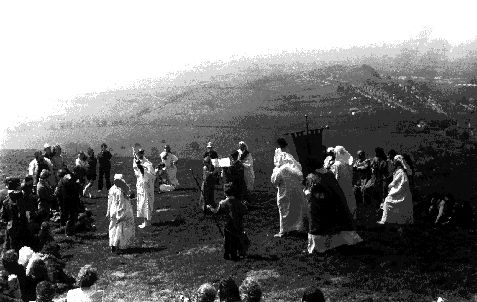
A rare picture of a Druid Initiation ceremony at Glastonbury Tor in 1967.


At this point Cresti writes a digression about the Druid tradition rooted in England from the end of 1700, stating that it was in the Sixties that it started to influence the English culture.

Ross Nichols
"In this process", he writes, "an important date is doubtless September 22th, 1964, when the "Order of Bards, Ovates and Druids" was constituted, probably the most important organization devoted to the diffusion of the ancient knowledge of Druids, born in England thank to Ross Nichols - poet, artist, historian (...) - one of the key figure of the Druidism...".
"Just while the Third Ear Band is publishing its first record, Nichols spread all over England a Jean-Baptiste Pitois's book titled "History and Practice of Magic", a text had a strong impact on youth in this period, above all for who was interested into the reading of Tarots...".

"The incredible cultural background of Sweeney & C. shows to be much more wide than one could imagine: for example, on "Lark Rise" the band tribute to one of the most influential character of pastoral revival, the composer Vaughan Williams, author of the legendary "The Lark Ascending"".

Writing about "Third Ear Band", the 1970 second album, Cresti states that the group "proposed a reference to one of the most influential tòpoi of the ancient Greek philosophy, from Thales onwards. To talk about the four elements as the unique constitutional principle of reality was expecially philosopher Empedocles (492-430 BC), who asserted the original elements, or "roots", of all things was four - fire, air, earth and water; they are unchangeable  and indivisible, they don't born and don't die, but  join together and divide each other, originating all things. (...) The birth is just the mixing of the elements, the death is their separation".


Heraclitus
Talking about the album's tracks, Cresti tries to set all the band's musical influences up: from "Air", in his opinion "probably the most harsh and unpredictable track of the album", near to contemporary avant-garde music of Penderecki and Lutoslawski; to "Earth", "the more 'earthly'", "even akin to the Stravinsky's "Rite of Spring"; references to the Heraclitus's norm of Panta rhei ("everything flows") are expecially on "Water": "reality is not something of static but a flow keeps trasforming".

Paracelsus by P. P. Rubens
After positive considerations about the last phase of the band's history, at the end Cresti admits that "even if English scene has been so fertile, it will have many problems to produce something of so blowing up and radical as Third Ear Band have done".

Anyway, apart the pages dedicated to the Third Ear Band, Antonello Cresti's book is a great and fasciating guide to the English underground/esoteric/mystical music produced in the last century. An important, esclusive contribute to the knowledge of just a rarely investigated area of interest (above all in Italy) with a lot of original stuffs (as, first of all, the interviews with important protagonist of the scene...).

Antonello Cresti - "Come to the Sabbat"
Tsunami Edizioni (pages 384, € 22,00)
 (http://www.tsunamiedizioni.com).
The author can be contacted on Facebook at:
http://it-it.facebook.com/antonellocresti.


SOME INTERESTING SOURCES IN THE NET TO KNOW MORE ABOUT SOME THEMES AND CHARACTERS QUOTED IN THIS FILE

Paracelsus
http://en.wikipedia.org/wiki/Paracelsus  (Wikipedia)
http://www.alchemylab.com/paracelsus.htm

Jean Bapriste Pitois
http://en.wikipedia.org/wiki/Jean_Baptiste_Pitois
http://www.tarotpedia.com/wiki/History_and_Practice_of_Magic 

John Michell
http://www.johnmichell.com/  (the official Website)
http://en.wikipedia.org/wiki/John_Michell_%28writer%29 (Wikipedia)
http://www.forteantimes.com/strangedays/obituaries/1692/john_michell.html(an obituary by Bob Rickard)
http://www.sevenpillarshouse.org/news/item/memorial_john_michell_1933_to_2009/

Ross Nichols
http://en.wikipedia.org/wiki/Ross_Nichols (Wikipedia)
http://www.druidry.org/obod/theorder/rossnicholsnuinn.html

Vaughan Williams
http://www.musicweb-international.com/Programme_Notes/rvw_thelark.htm (about "The Lark Ascending")


no©2012 Luca Ferrari (unless you intend to make a profit. In which case, ask first)

November 10, 2011

New Italian book about English folk with quotations on the Third Ear Band.


A new book about English folk music has been written by Italian journalist Antonello Cresti. Titled "Come to the Sabbat. I suoni e le idee della Britannia esoterica"["Sound and ideas of esoteric Britannia"] it's an essay on that kind of folk related to esoterism and occultism
It'll be out at the end of this month, published by Tsunami Edizioni (http://www.tsunamiedizioni.com).
Inside of it (pages 384, € 22,00) there are also quotations on the Third Ear Band and an interview with the editor of this archive, showing this peculiar renewed continual attention to the Glen Sweeney/Paul Minns' project.
The author can be contacted on Facebook at http://it-it.facebook.com/antonellocresti.

no©2011 Luca Ferrari (unless you intend to make a profit. In which case, ask first

March 14, 2011

Third Ear Band quoted on an Italian book about English electric folk music.


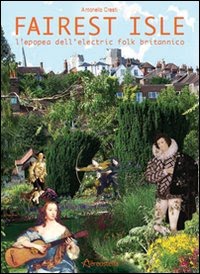
As reported some months ago at http://ghettoraga.blogspot.com/2010/02/new-italian-book-on-english-electric.html Italian writer/musician Antonello Cresti has written a book on "electric English folk" titled "Fairest Isle" (Aereostella, € 17.00) where a prominent position is reserved to the Third Ear Band. You can buy a copy through the Web site of the home publishing at http://www.aereostella.it/libri.php.

Apart some obvious well-known references to the band's history (mainly based on my book "Necromancers of the drifting West", 1997), the most important aspect of the book is the author's attempt to analyze his musical project.

On a chapter titled "Pariah" (= outcast), Cresti writes about the TEB as one of the band "more radically experimental", a "one-off and unique experience", "probably the most  remote and isolated outpost in all the epic of new English folk music", here  named "wyrd folk" from a definition coined in 1990 by American artist Tim Renner.
The author claims TEB music is deep-rooted in psychedelia (for cultural aptitude) and folk - for the use of acoustic instruments and above all "for the strong, almost sacral, bond with their place of origin, even if inexorably "elsewhere" as regards to the map of musical orthodoxys of yesterday and nowdays".
Summing up the main phases of the band's history, the writer attributes to Glen Sweeney the role of deus ex machina, "perfect and sincretic fruit of many urges and illusions of a generous age as that hippy generation".

Strangely scarce the list of musicians influenced by the TEB: apart the Italian Aktuala and Franco Battiato's "Sulle corde di Aries" albums, Cresti quotes just the Xenis Emputae Travelling Band and our Sedayne... ignoring other not less important experiences (documented in this archive at http://ghettoraga.blogspot.com/2010/02/italian-musician-fabio-zuffanti-demixed.html and http://ghettoraga.blogspot.com/2010/02/some-italian-tebs-little-nephews.html).

A specifc paragraph of the book is reserved to the analysis of the Elements album, with some interesting references to the links to the ancient celtic tradition of the cover lettering: "... infact it remembers the medieval Christian art and masterworks of miniature as that included on Lindisfarne's Gospels, works miniatured around 600 BC at the monastery founded by Saint Aidano on the wild isle of Lindisfarne, Northumberland...".

About the music on the album, Cresti underlines the relations with the ancient Greek philosophers (as Empedocle) and their idea of four elements as roots founding all the things.
“Sweeney and friends, with a tireless attempt of cultural hybridization, (…) pay their attention to a subject that, become famous thank to very wide speculations of Mediterranean world, it had appeared in many ancient civilizations all around the world: so the band’s holistic and pantheistic idea has contrasted to any materialistic and immanent conception of being ontology”.
Analyzing the four tracks, interesting the thinkings about "Earth" and "Water": on the first tune, Cresti claims "it's one of highest point reached by the band, even similar to the Igor Stravinsky's "The Rite of Spring"", with a "pure musicality, where the melodic element becomes primordial rhythm".
About "Water" (my favourite ever!), he states "it's the descriptive peak reached by the band: it starts with some naive sound effects, then the composition unravels on a brilliant counterpoint of strings that symbolize the conflicting current of water".

In short, for the author the album it's "the experimental top of wyrd folk, the work where different processes of cultural and stilistic hybridation, even if in a reference frame strongely Britannic, have raised to fertile state of the art".

An important contribution to the comprehension of the TEB's still  quite obscure epic, very rare in Italian music journalism.
Cresti is working now on a new book dedicated to the English "esoteric folk", with some new analysis about the Third Ear Band (and maybe also an interview with myself about the cultural sources...).
Of course, I'll try  to document it for your esclusive pleasure...

no©2011 Luca Ferrari