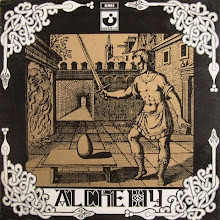
About the new TEB DVD titled "The Lost Broadcasts" recently announced at the page http://ghettoraga.blogspot.com/2011/09/lost-teb-video-brodcasts-out-in-october.html you can contact GONZO MULTIMEDIA (http://www.gonzomultimedia.co.uk)
October 25, 2011
Third Ear Band music on You Tube: the perfect soundtrack of creativity!
You Tube is not just the slavish useless revival of the TEB's tracks right taken from the original albums, but it's most of all the place where TEB wonderful music can meet the Arts, becoming a very suggestive soundtrack of pictures, homemade videos, paintings, drawings... ideas.
Here is a list of videos where TEB music shows its brilliant vocation to become the perfect soundtrack!
"The Cat's Eyes" by Moebius-Jodorowsky ("Ghetto Raga").
"Totentanz" by Dino Battaglia ("Abelard & Heloise" pt. 6).
"A Midsummer's Night Dream" by W. Shakespeare. Drawings by Cristina Breccia, words by Norberto Buscaglia. Music by The Third Ear Band ("Abelard & Heloise" pt. 2 & 3).
Homemade video with TEB's "Eternity in D" as a soundtrack.
A monologue talked in Italian based on a poem titled "Ho perso la testa per Salomè" ("I've lost my head for Salomè") written by S. Giovanni Battista on 32 A.C. The music is "Earth" by the Third Ear Band.
Illustrations from the rare "Mutus Liber" edited on 1677 by such Altus. The TEB track used for this video is "The Cauldron" from "Music from Macbeth".
"Les Songes Drolatiques de Pantagruel" painted in 1973 by Salvator Dalì. Music from TEB's first album ("Dragon Lines").
"The Mantegna's Tarots" with TEB's "Groom's Dances".
"The Magic Calendar", lithographs by Manuel Orazi printed in 1896. The soundtrack is the wonderful "Druid One".
"Waldkammer", the art of Madeline Von Foerster. The music here is "Abelard & Heloise" part 2.
"The Garden of Earthly Delights" by 'psychedelic' doped Dutch painter Hieronymus Bosch. With the music of the Third Ear Band as a perfect soundtrack (excerpts from "Macbeth").
"Lark Rise" played by the Thirds as a musical comment for "Alchimie des Philosophes" painted by Salvador Dalì.
The incredible Hopi Dolls painted in 1969 by American Homer H. Boelter with the beautiful TEB's "Stone Circle".
A tribute to Don Cherry, Michael Hurley and the Third Ear Band (some quotations of "Eternity in D"...) by the genial post-folk-warrior Sedayne with references to the great Snock (the title of this track is infact "Snock Mandala").
no©2011 Luca Ferrari (unless you intend to make a profit. In which case, ask first)
Tags:
Third Ear Band,
You Tube
October 20, 2011
Italian harpist VINCENZO ZITELLO tells his fascination for the Third Ear Band music...
Vincenzo Zitello (http://www.vincenzozitello.it) is a very famous Italian harpist. Composer and concert artist, he started studying music at a very early age, playing the transverse flute and the viola. The first person to spread and pioneer the Celtic harp in Italy, from 1976, he dedicates himself to his musical studies, taking part in Breton cultural and musical seminars held at the “Ti Kendalc'h” with Dominig Bouchaud and Mariannig Larc’hantec. In 1978 he forms the harp and oboe duet with Roberto Mazza, author on 1991 of the wonderful TEBish private cassette titled "Scoprire le orme". On 1980 he specialised in the bardic harp and Celtic singing with the monster Alan Stivell. From 1986 he has recorded eight albums and had important collaborations with some of the most known popular music (Ivano Fossati, Pooh, Alice...) and folk Italian artists (Peppe Barra, Lou Dalfin, La Sedon Salvadie...).
Just this year he has recorded a brand new record, "Talismano" [Talisman], another important work about the Holy Land of the Harp.
Among his records, "Atlas", recorded in 2007, is directly inspired by the Third Ear Band's music, one of the favourite band ever of Zitello. You can listen some tracks of it on Zitello's Myspace at http://www.myspace.com/zitellovincenzo or buy the album on Itunes.
Starting from this evidence, I've asked him some questions about his connections with the Third Ear...
How did you compose "Atlas", the record you've admitted it's been inspired by the TEB's music?
“I’ve composed "Atlas" between 2006 and 2007. It’s a work I’ve thought about since the Seventies. On 1973, when I discovered the Third Ear Band, my music wasn‘t the same anymore, also the way to conceive it. For years I’ve considered them my masters of sound perception.
With the musician with whom I was playing at the time [Roberto Mazza], I was really conditioned by them – both of us we loved really much their style and in some ways we imited them or, better, we was on the same track, for us they was an huge benchmark.
"At that time I wasn’t playing harp, I played the violin, and listening to a band like them that was handling classical music in a contemporary creative way – but with such out of the way improvisational freedom, at the same time extremely alchemical and magic – where so many memories was converging, for myself it was a really innovative philosophical state of music. Most of all, it was completely out of the usual Rock soppiness of that time: it seemed to me something that aim to our soul, a dream...
"On that days I was listening to very few music, I just consumed all the TEB’s records. Of course now I’ve got all their CD’s.
Then the time brings you to other countries, but at that time I was so young, just 18, and very hardliner and obviously naïve about things. Now I’m 55 but I’ve never forgotten them…
So all these impressions was the fuel to compose “Atlas”, a comeback to my origins in a more conscious way.
For years I was thinking of doing a record inspired by the Third Ear Band's music, I wanted to do it in a contemporary and personal way, I’ve always looking in my composing spirit their magic, their colours. The instruments I use to play lend myself to it, and the peculiar mutation of the TEB music... Their track titles struck me. In my opinion they was an extraordinary thing, then and now...".
“I’ve composed "Atlas" between 2006 and 2007. It’s a work I’ve thought about since the Seventies. On 1973, when I discovered the Third Ear Band, my music wasn‘t the same anymore, also the way to conceive it. For years I’ve considered them my masters of sound perception.
With the musician with whom I was playing at the time [Roberto Mazza], I was really conditioned by them – both of us we loved really much their style and in some ways we imited them or, better, we was on the same track, for us they was an huge benchmark.
"At that time I wasn’t playing harp, I played the violin, and listening to a band like them that was handling classical music in a contemporary creative way – but with such out of the way improvisational freedom, at the same time extremely alchemical and magic – where so many memories was converging, for myself it was a really innovative philosophical state of music. Most of all, it was completely out of the usual Rock soppiness of that time: it seemed to me something that aim to our soul, a dream...
"On that days I was listening to very few music, I just consumed all the TEB’s records. Of course now I’ve got all their CD’s.
Then the time brings you to other countries, but at that time I was so young, just 18, and very hardliner and obviously naïve about things. Now I’m 55 but I’ve never forgotten them…
So all these impressions was the fuel to compose “Atlas”, a comeback to my origins in a more conscious way.
For years I was thinking of doing a record inspired by the Third Ear Band's music, I wanted to do it in a contemporary and personal way, I’ve always looking in my composing spirit their magic, their colours. The instruments I use to play lend myself to it, and the peculiar mutation of the TEB music... Their track titles struck me. In my opinion they was an extraordinary thing, then and now...".
Which tracks composed by you are inspired by the TEB's music?
"It's more easy for me to tell you which tracks aren’t inspired by the Third Ear Band. No one!!!"
When have you met the Band?
"The person who let me know the TEB was Roberto Mazza. A great oboe player, with a wonderful sound. I suggest to music fans to listen to all his works. I think he’s the player who better has got the Paul Minns’ inheritance. We’ve played together for many years, until 1982."
Which are the main elements you've taken from their experience for putting in your music?
"Their sound becoming, the continuous mutations, the full and the melody that opens constantly to deep images, also their way to use strings and most of all their spirit: while I was composing some orchestrations I was thinking about that TEB music aura...".
Vincenzo Zitello - "Celtic Raga".
Do you think they are still up-to-date? Why?
"I think their spirit is very relevant, indeed not much it's been done to spread them. Contemporary music needs new perspectives, in some way TEB music has been out of styles and fashions, but it contains a view that music needs. After rock, jazz and folk we need now a brand new music away from the trite styles, and I found in the TEB music excellent and still authoritative culture and inspiration for the present time, at least until the album titled "Prophecies"...".
Are you still listening to their records?
“Yes, of course. I prefer most of all “Third Ear Band”, but “Alchemy” is that enraptures me”.
How would you describe the TEB's music?
"I would describe it as a sound intuition, something that expands counsciousness in a magical way, and in the same time it is perfectly rooted in the European cultural memory. Eastern contaminations are the same of Western medieval music... TEB music has a wonder one can found in the Reinassance alchemical experimentations; a research that collect the collective memory of an organic freedom almost lost in Europe. Their sounds are real, they haven't temporal masks as like their perceptions that communicate. You can love it or you can detest it, because you don't understand it...".
Which is your favourite TEB's tracks? Why?
“My favourites are “Air”, “Water”, “Fire”, “Earth”, really amazing. Then “Ghetto Raga”, “Druid One” and “Stone Circle”.
"Their sound becoming, the continuous mutations, the full and the melody that opens constantly to deep images, also their way to use strings and most of all their spirit: while I was composing some orchestrations I was thinking about that TEB music aura...".
"I think their spirit is very relevant, indeed not much it's been done to spread them. Contemporary music needs new perspectives, in some way TEB music has been out of styles and fashions, but it contains a view that music needs. After rock, jazz and folk we need now a brand new music away from the trite styles, and I found in the TEB music excellent and still authoritative culture and inspiration for the present time, at least until the album titled "Prophecies"...".
Are you still listening to their records?
“Yes, of course. I prefer most of all “Third Ear Band”, but “Alchemy” is that enraptures me”.
How would you describe the TEB's music?
"I would describe it as a sound intuition, something that expands counsciousness in a magical way, and in the same time it is perfectly rooted in the European cultural memory. Eastern contaminations are the same of Western medieval music... TEB music has a wonder one can found in the Reinassance alchemical experimentations; a research that collect the collective memory of an organic freedom almost lost in Europe. Their sounds are real, they haven't temporal masks as like their perceptions that communicate. You can love it or you can detest it, because you don't understand it...".
Which is your favourite TEB's tracks? Why?
“My favourites are “Air”, “Water”, “Fire”, “Earth”, really amazing. Then “Ghetto Raga”, “Druid One” and “Stone Circle”.
no©2011 Luca Ferrari (unless you intend to make a profit. In which case, ask first)
October 15, 2011
New Third Ear Band DVD update.
About the new TEB DVD titled "The Lost Broadcasts" recently announced at the page http://ghettoraga.blogspot.com/2011/09/lost-teb-video-brodcasts-out-in-october.html you can contact GONZO MULTIMEDIA (http://www.gonzomultimedia.co.uk)
at the address below:
by e-mail:
info@gonzomultimedia.co.uk (for general non-order related enquiries)
by post:
Gonzo Distribution Ltd.
c/o Brooks City,
6th Floor New Baltic House
65 Fenchurch Street,
London EC3M 4BE
Fax: +44 (0)191 5121104
Tel: +44 (0) 191 5849144
International Numbers:
Germany:
Freephone 08000 825 699
USA:
Freephone 18666 747 289
English Gonzo Multimedia has in its catalogue many other interesting videos with rare broadcasts of Incredible String Band, David Allen & Gong, The Byrds, Edgar Broughton Band, Hawkwind...
no©2011 Luca Ferrari (unless you intend to make a profit. In which case, ask first)
Tags:
DVD,
Gonzo,
Third Ear Band
October 10, 2011
TEB quoted on the wonderful Rob Young's essay on English folk 'visionary' music.
On the wonderful monumental "Electric Eden. Unearthing Britain's visionary music" (Faber & Faber, London 2010), an essay on folk music written by Rob Young, editor of famous English magazine "The Wire", a little place is dedicated to the Third Ear Band (with a generous quotation of this archive).
Here's the excerpt:
"(...) Harvest was also the home to the Third Ear Band, who pursued a rarefied version of Pink Floyd's abstract music of this period. They were a loose conglomerate of occult-minded instrumentalists that had its origins in The Giant Sun Trolley, one of the many acts appearing at the 14 Hour Technicolour Dream. Percussionist Glen Sweeney, the group's one constant member, began his career by seizing the bandstand in London's Hyde Park with several freaky friends, and playing even after the police informed them that music was banned from the park. (They politely asked wheather the rule applied to the birds.) After Sweeney and oboist Paul Minns took part in a December 1968 multimedia event at the Royal Albert Hall called The Alchemical Wedding - at which John Lennon and Yoko Ono conducted a forty-five minutes bag in - The Third Ear Band sculpted an esoteric chamber music from acoustic elements; their first album was duly titled Alchemy. With track titles such as 'Druid One', "Stone Circle', 'Dragon Lines' and 'Egyptian Book of the Dead', these were incantational songs-without-words, a ritualistic consort music whose atonal tinctures sometimes recalled the European folk-chamber music of Béla Bartok and the terse reductionism of Anton Webern, sometimes the free play of John Steven's Spontaneous Music Ensemble. John Peel even turned up to play Jew's harp on 'Area Three'. 'I call the music alchemical because it was produced by repetition', explained Sweeney, whose muted battery of hand drums shaped hypnotic hymns to the fearful symmetry of the elements and the heavenly rotations. This was not cultish window dressing, though: the group made connections with Druid orders and accompanied their dawn solstice ceremonies. Third Ear Band (1970), often referred to as Elements because its four lenghty improvisations 'Air', 'Earth', 'Fire' and 'Water', found the group - now a quartet with the addition of Ursula Smith (cello) and Richard Coff (violin, viola) - propagating a fungal acoustic music with spores of pan-European folk, Early Music and oriental drone dynamics. Their meditational medievalism found its way into two film soundtracks they created in 1970 and 1971: for a German television film about Abelard and Heloise, and for Roman Polanski's dark-age rendering of Macbeth. The Third Ear Band's arcane, absorbing music stands as one of several unexplored lanes leading away from the psychedelic garden that remains neglected and 0vergrown".
(Rob Young, "Electric Garden", pages 472-473)
"(...) Harvest was also the home to the Third Ear Band, who pursued a rarefied version of Pink Floyd's abstract music of this period. They were a loose conglomerate of occult-minded instrumentalists that had its origins in The Giant Sun Trolley, one of the many acts appearing at the 14 Hour Technicolour Dream. Percussionist Glen Sweeney, the group's one constant member, began his career by seizing the bandstand in London's Hyde Park with several freaky friends, and playing even after the police informed them that music was banned from the park. (They politely asked wheather the rule applied to the birds.) After Sweeney and oboist Paul Minns took part in a December 1968 multimedia event at the Royal Albert Hall called The Alchemical Wedding - at which John Lennon and Yoko Ono conducted a forty-five minutes bag in - The Third Ear Band sculpted an esoteric chamber music from acoustic elements; their first album was duly titled Alchemy. With track titles such as 'Druid One', "Stone Circle', 'Dragon Lines' and 'Egyptian Book of the Dead', these were incantational songs-without-words, a ritualistic consort music whose atonal tinctures sometimes recalled the European folk-chamber music of Béla Bartok and the terse reductionism of Anton Webern, sometimes the free play of John Steven's Spontaneous Music Ensemble. John Peel even turned up to play Jew's harp on 'Area Three'. 'I call the music alchemical because it was produced by repetition', explained Sweeney, whose muted battery of hand drums shaped hypnotic hymns to the fearful symmetry of the elements and the heavenly rotations. This was not cultish window dressing, though: the group made connections with Druid orders and accompanied their dawn solstice ceremonies. Third Ear Band (1970), often referred to as Elements because its four lenghty improvisations 'Air', 'Earth', 'Fire' and 'Water', found the group - now a quartet with the addition of Ursula Smith (cello) and Richard Coff (violin, viola) - propagating a fungal acoustic music with spores of pan-European folk, Early Music and oriental drone dynamics. Their meditational medievalism found its way into two film soundtracks they created in 1970 and 1971: for a German television film about Abelard and Heloise, and for Roman Polanski's dark-age rendering of Macbeth. The Third Ear Band's arcane, absorbing music stands as one of several unexplored lanes leading away from the psychedelic garden that remains neglected and 0vergrown".
(Rob Young, "Electric Garden", pages 472-473)
Read the synopsis of the book at the Faber & Faber Web site:
http://www.faber.co.uk/work/electric-eden/9780571237524/
Visit Rob Young's blog on folk music at http://www.electriceden.net
no©2011 Luca Ferrari (unless you intend to make a profit. In which case, ask first)
Tags:
Electric Music,
Rob Young,
Third Ear Band
October 04, 2011
Maybe an interview with Chief Druid David Loxley?
Just in the first days of October, Steve Pank has sent me the photo below, portraying David Loxley (Chief Druid) during the druid ceremony of the Spring equinox in Tower Hill (London) on 2010. Just behind him Carolyn Looker, Glen Sweeney's missus.
As you know, David Loxley was very close to the TEB from the beginning, involved with Druids and drawing TEB's first concert posters.
Thank to Steve, maybe one day we'll have an interview with him about that years and the band's connections with the Druids...
Steve Pank ©2010
no©2011 Luca Ferrari (unless you intend to make a profit. In which case, ask first)
October 03, 2011
Third Ear Band being almost reincarnated...
ChrispH, musician of Norwegian avant-garde band Famlende Forsok, has answered me about the file published in this archive some weeks ago at the page http://ghettoraga.blogspot.com/2011/08/norwegian-band-famlende-forsok-quoted.html
"Hi,
I think maybe even our latest project also has references to TEB. We are about to finish an album as a result of three concerts we held during the last three years loosely based on drones/electronics/acoustics/poetry. I think this live piece also proves this to be a bit influenced to TEB in bringing "the oriental" into experimental western (unscholared "rock") music. http://www.youtube.com/watch?v=klf-x0X745w Sound quality is a bit poor. Plain old video recorder I guess. ChrispH (playing that lously Akai pseudo-shenai)".
Watch and listen to the track below: after three minutes of electronic carpet, infact, TEB seems almost to be reincarnated here & now!
Famlende Forsok live October 1oth, 2009
no©2011 Luca Ferrari (unless you intend to make a profit. In which case, ask first)
Tags:
ChrispH,
Famlende Forsok,
Third Ear Band
September 28, 2011
"The apprentice and the sorcerer" (part two). An old Italian article on the Third Ear Band.
Here's the second part of the rare Italian stuff on the Thirds written by journalist Maurizio Baiata and published on "Ciao 2001" magazine on December 24th, 1973.
Thanx researcher Daniele Briganti (read him at http://stampamusicale.altervista.org/) we can read what one of the best (at that time) underground Italian music magazine wrote about the band, with common places, gross infos, cheap philosophy and some brilliant insights...
"(...) Black misterious pages, a draw full of strange and gelid signs, a music as a viaticum to the acoustic Hell: this is the Third Ear Band of "Alchemy", first record experience, first album thrown out in whirpools of the unknown in music, nothing of "dark" or the classic gastronomic flavour as like as Black Sabbath or Black Widow: strange stories of past and cruel times open in the grooves, collocation of historical order let you know how the group mainly persue a right rediscovery of the English and Scottish black folk music, with temporal movements limited to XI and XII century, with the rhythmic outstretched to rediscovery of cults dear to Ossian, then sung by William Blake and the other sepulcher poets. But there's a background mood that seem to miss: with the coldness of music contents something of indefinable is leaping in front of eyes, maybe that love for nature, that frantic order that rules human things.
"Alchemy" is a complex and difficult work, complete. (...) The basic sound has its rise in a monodic pulse most of the time created by the percussions, then it enriches with the strings and oboe, both played on patterns of an haunting and perfect iteration of rhythms: the picture will seem more clear if compared to Terry Riley's compositions, where the sound carpet, build with one or more incessantly repeated notes, is coloured with continuous superimpositions of synth and organ...
After some very strong (and sharable) observations about the Italian music at that time, Baiata analyzes TEB's second album, described as "the high point of their melodic and modal issue... obsessive, vitalistic, the sublimation of static and monodic music thrown on the lines of highest multiformity, the more charming and medieval rhythmic arcaism ever listened to.
For the author, "Earth" is "the mythical canto of joy, of creation's beauty, of human beasts and not, of the horse that neigh, of the rhythm of flower's growth, so misterious, and we have, with the Third Ear Band, an interpretation, an all European translation in harmonic terms - easy, linear, very sweet.
Among group's writings, these are the best lines, an absolutely supernatural composition, where also Riley bows...".
About "Macbeth", Baiata states that "it's not the work of ripeness, it's not the logical end of contacts with the band's extrasensorial music, but another little step along the road gotten to exceed the pattern of normal tonality, to destroy criteria of symmetry and geometry in force in England since the age of the Beatles ".
He claims the record, born under the soundtrack ambiguity, "has many static moments, even if played by first order musicians".
On the band's split, "happened just after "Macbeth" (but we know Sweeney and Minns played until 1975...), Baiata says "Third Ear Band's music existed just time before to be created, it was on the air, into the dreams of who came before, into the nightmares of every clever man, on the artistic measure of Self and on his power of theatrical performance of life's things".
"(...) Black misterious pages, a draw full of strange and gelid signs, a music as a viaticum to the acoustic Hell: this is the Third Ear Band of "Alchemy", first record experience, first album thrown out in whirpools of the unknown in music, nothing of "dark" or the classic gastronomic flavour as like as Black Sabbath or Black Widow: strange stories of past and cruel times open in the grooves, collocation of historical order let you know how the group mainly persue a right rediscovery of the English and Scottish black folk music, with temporal movements limited to XI and XII century, with the rhythmic outstretched to rediscovery of cults dear to Ossian, then sung by William Blake and the other sepulcher poets. But there's a background mood that seem to miss: with the coldness of music contents something of indefinable is leaping in front of eyes, maybe that love for nature, that frantic order that rules human things.
"Alchemy" is a complex and difficult work, complete. (...) The basic sound has its rise in a monodic pulse most of the time created by the percussions, then it enriches with the strings and oboe, both played on patterns of an haunting and perfect iteration of rhythms: the picture will seem more clear if compared to Terry Riley's compositions, where the sound carpet, build with one or more incessantly repeated notes, is coloured with continuous superimpositions of synth and organ...
After some very strong (and sharable) observations about the Italian music at that time, Baiata analyzes TEB's second album, described as "the high point of their melodic and modal issue... obsessive, vitalistic, the sublimation of static and monodic music thrown on the lines of highest multiformity, the more charming and medieval rhythmic arcaism ever listened to.
For the author, "Earth" is "the mythical canto of joy, of creation's beauty, of human beasts and not, of the horse that neigh, of the rhythm of flower's growth, so misterious, and we have, with the Third Ear Band, an interpretation, an all European translation in harmonic terms - easy, linear, very sweet.
Among group's writings, these are the best lines, an absolutely supernatural composition, where also Riley bows...".
He claims the record, born under the soundtrack ambiguity, "has many static moments, even if played by first order musicians".
On the band's split, "happened just after "Macbeth" (but we know Sweeney and Minns played until 1975...), Baiata says "Third Ear Band's music existed just time before to be created, it was on the air, into the dreams of who came before, into the nightmares of every clever man, on the artistic measure of Self and on his power of theatrical performance of life's things".
Note for the Italian readers:
if you're interested to read the original Italian article please contact me through my e-mail dopachino@tiscali.it to receive a copy in PDF format.
no©2011 Luca Ferrari (unless you intend to make a profit. In which case, ask first)
September 22, 2011
THANKS! THANKS! THANKS! THANKS! THANKS!
Just yesterday this archive, born by chance on December 1st, 2009, has reached
50.000 pages
opened!
September 18, 2011
Lost TEB video broadcasts out in October!
Lost Third Ear Band video broadcasts from 1970 will be distributed on DVD next October 3rd. The only one known circulating in those years was "Hyde Park Raga", included on a "Beat Club" compilation (read at http://ghettoraga.blogspot.com/2009/12/hyde-park-third-ear-band-tv-video_09.html).
Titled "Third Ear Band. The Lost Broadcasts" is produced by Gonzo (catalogue number HST069DVD) and it will cost around ten pounds (11-12 euros)...
This is the commercial published on some Web sites:
"The Lost Broadcasts are a series of DVDs featuring performances that have rarely been seen since the original transmission on German television, in some cases more than forty years ago. Some of the artists featured within the series are legendary and these “Lost” performances will be a fine addition to any music fans collection. The series covers a number of styles and genres however all of the performances are of a high calibre. (...)
At the time of these performances which were recorded from September 1970, the band consisted of Glen Sweeney, Paul Minns, Denim Bridges and Paul Buckmaster, who would go onto work with Elton John amongst many other high profile artists. Three pieces were filmed on the 11th of September including the unreleased ‘Hyde Park’. The other two tracks were ‘David Grocking’ and ‘In D’, which is thought to be ‘Raga in D’. ‘Druid Grocking’ was played during a John Peel Top Gear session in the summer of 1969 and is an extended workout of the song ‘Druid One’ from the ‘Alchemy’ album. ‘In D’ is a piece originally recorded at the sessions for the debut album ‘Alchemy’.
The band returned to the studio to film once more on the 26th of September and this time performed another slightly shorter version of ‘Hyde Park’. Third Ear Band would go on to record a very famous soundtrack in 1972 for the Roman Polanski film ‘Macbeth’...".
Just a doubt about this project is related to the TEB line-up, because we know that on "Hyde Park Raga" ("Beat Club" TV programme) was involved also Benjamin Cartland...
But anyway we will see...
[Thanx for this signalling to Ed P.]
no©2011 Luca Ferrari (unless you intend to make a profit. In which case, ask first)
Tags:
Gonzo,
Hyde Park Raga,
Third Ear Band
September 17, 2011
"The apprentice and the sorcerer" (part one). An old Italian article on the Third Ear Band.
Thanks to the Italian researcher Daniele Briganti (read him at http://stampamusicale.altervista.org/) we have here a very rare article on the Third Ear Band published on the Italian magazine "Ciao 2001" issue 51 in late 1973 (December 24th).
Titled "L'apprendista e lo stregone" ["The apprentice and the sorcerer"] and written by Maurizio Baiata, it feels the effect of the times and the lack of informations press had in those days - between myth and fantasies... but with some brilliant insights.
This is the part one of a two-parts file.
Titled "L'apprendista e lo stregone" ["The apprentice and the sorcerer"] and written by Maurizio Baiata, it feels the effect of the times and the lack of informations press had in those days - between myth and fantasies... but with some brilliant insights.
This is the part one of a two-parts file.
For Baiata Third Ear Band's music is "greatly interior", a music that "finds a bigger reason to be in Eastern land, the world of notes and harmonies, and colours, and breaths, and delirious, all Western things that are simply the epidermic semplification of an inconscious and forgotten reality kept in life by the impenetrable Eastern world. But Third Ear Band doesn't play music as like as Quintessence or the Mahavishnu. We are here on a totally different level: where it does exist a preconceived and gratified harmony by epidermic European and American canons, the group reaches to dissolve it in virtue of an approach to that measures of preconceived music in the natural order of life's animated things - plants, men, thoughts or trees".
"The third ear
About the categorization of human psychic opportunities, Western culture shows very far from that Eastern's one: where medical, psychological and introspective techniques can define just a little portion of a very huge and mysterious area of knowledge, Chineses, Japanes, Indians show exactly (with cryptic ways) the contact points with the Known and the Unknown.
The five senses find a total universalization, signification deeply linked with the mind, with religion, with the man's intrinsic spirituality; and spatial and time dimensions loose their basic incomprehensibility connected to the scientifically correct study of nature. In the meanwhile the development and evolution of the Eastern sound tecniques show us clearly the opportunity of an interpenetration of art and spirit...(...)"
"First complete example of externalization of these principles about musical studies made in Europe is the Third Ear Band, where the etymology of "third ear" goes to discover an absolutely unknown sound dimension - interior and occult - filtered through the study of the human and the sound expression.
Of course the third ear is that unseen, hidden who knows where, but real and present in us: it is the organ with that we perceive sound vibration, we enjoy the music, we get it, we get inside it, we totally penetrate it; for this reason band's music leaves very few to spectacular and epidermic side, it unrelentingly get inside to meanders of "unknown in music", touching so the vertex of a sound great gestures...".
"(...) Third Ear Band is a group "sui generis" at all. It's beyond comparision, even if related to the English folk revival - an extraordinary brainchild...".
At this point the author analizes TEB records (talking about "Egyptian tablas" about Sweeney's instrument...), quoting the "Alchemy" album notes, and reporting a statement of Paul Buckmaster (with no quotation of the source): "When the band was formed, I was following some specific forms of contemporary music very near to the electro-acoustic TEB's line-up was doing, but at the end I joined the band just as a friend of Sweeney because I didn't like some their things. Music was origined from occult pratices, nowdays very popular in England: of course they wasn't black masses or other kind of oddities, just a deep study of the esoteric and fantastic history of the world, something of serious, almost religious and scientific that the musicians of the band was living in their lifes and into the music, but that I wasn't involved into: most of all I was interested to the monstrous technique of the guys, their furious eagerness of research and experiment, their courage, while to live they was forced to teach and to play often in tiny clubs and for audience full of freaks, spiritualists, disciples of various philosophy of occult".
(end of part one)
Note for the Italian readers:
if you're interested to read the original Italian article please contact me through my e-mail dopachino@tiscali.it to receive a copy in PDF format.
no©2011 Luca Ferrari
September 07, 2011
Italian composer STEFANO GIANNOTTI talks about Third Ear Band's music...
Stefano Giannotti (born 1963) is an Italian composer, author, director, guitarist and performer. He studied composition with Pietro Rigacci and he has been the assistant of the famous Alvin Curran on “Crystal Psalms" and "Tufo Muto". Between 1983 and 1990 he performed in several European countries with the chamber music group Trio Chitarristico Lucchese (an acoustic guitar trio) and formed his first group called Ensemble Il Teatro del Faro. In 1997 he started a collaboration with the Italian choreographer Roberto Castello and between 1998 and 1999 he lived in Berlin. On 2000 he has been guest of the Kuenstlerhaus Schloss Wiepersdorf in Brandeburg and on 2002 he has been invited in Worpswede by the Ministerium of the Niedersachsen. The same year he has won the Karl-Sczuka-Preis (SWR, Baden-Baden) with his work "Il tempo cambia" and on 2007 he has got for the second time the Karl-Sczuka-Preis for his radio-piece "Gealogica".
On the present day he's playing with a new group, OTEME (Osservatorio delle Terre Emerse).
His repertoire ranges from performance, radio-art, dance theatre to chamber music, orchestral scores and songs.
Landscape, memory, life cycles, voices of people, languages are some of the main themes developed in Giannotti's work. His compositions have been performed in festivals, theatres, museums around the world and his collaborations included works for radios and TVs.
With one of his groups, Vaga Orchestra, he played a new arranged version of TEB’s “Water” from their 1970 second studio album.
From the Eighties he declares his deep appreciation for the Third Ear Band's music.
His repertoire ranges from performance, radio-art, dance theatre to chamber music, orchestral scores and songs.
Landscape, memory, life cycles, voices of people, languages are some of the main themes developed in Giannotti's work. His compositions have been performed in festivals, theatres, museums around the world and his collaborations included works for radios and TVs.
With one of his groups, Vaga Orchestra, he played a new arranged version of TEB’s “Water” from their 1970 second studio album.
From the Eighties he declares his deep appreciation for the Third Ear Band's music.
We knew 25 years ago at the time of the Ensemble Il Teatro del Faro, when I was involved with the management of the reformed TEB. You declared your great interest for their music: can you tell us how it's happened your encounter with the TEB's music?
"I've known TEB's music when I was 17 at the secondary school. In my classroom there was some friends of mine not studying music so deeply as I did but they had musical knowledge much more than me - they knew bands and artists I didn't know - I never heard about them. At that time I was listening to Genesis, David Bowie, Gong, Tangerine Dream, Van Der Graaf Generator and Mike Oldfield. They told me about Zappa (I didn't love him at the time), Soft Machine (the same), Henry Cow, Hatfield & The North, they made me know Robert Wyatt - a group of depth artists they was probably reading on some music magazines. Among these meetings there was also Brian Eno, Philip Glass and the Third Ear Band.At the beginning, as for all these kind of music, they bored me, but after all through my personal peregrinations I've already bumped into La Monte Young and Igor Stravinski...
The Third Ear Band was a great discovering, I liked very much their approach to a kind of music that remembered me the Tangerine Dream and in the same time the popular theatre: I loved much the oboe, the ancestry of their proposal, maybe I was bored by the lenght and the repetitiveness of their compositions, but I got use to it quite soon.
Of course I had some disputes with my classroom mates about their music: I loved more "Macbeth", but the critics stated the other two albums was better, so my mates liked more that records.
There was also the pleasure for reasearching the records: infact in those days it was very difficult to find their albums in a record shop, and for that reason we did lend ourself one of two of them and we take them for many months..."
Beyond to have included TEB music on some of your repertories, how much of their experience has gone in your music, about the sound research and the art of composition?
"The Third Ear Band has caratherized the sound of many works composed by me between 1991 and 1999. The Ensemble Il Teatro del Faro was made up with oboe/English horn, cello and electric guitar, with some other instruments as Indian organ, pan flute, ocarina, objects and toys. The music we played was quite different from the Third Ear Band's, but sometimes it contained the same spirit of improvisation and the love for that kind of sounds; maybe it was less similar about the hestetics, because, even if it was charaterized by improvisations, the most of my works is composed, not improvised".
Which are your compositions directly influenced by the TEB sound?
"The tune more directly influenced by it could be "La recita" [The play] from the suite titled "Ritratti, pagine e improvvisazioni su Amleto" [Portraits, pages, improvisations on Hamlet]. In this tune, electric guitar and English horn make a rhytmic sequence quite similar to the Sweeney's hand drums, and the cello sounds a melody, on a viola's extention, and at the end it improvises. Maybe it can recall "The Egyptian Book of The Dead", maybe more "Macbeth". Another tune surely is "Tema dei campi" [Fields' theme] that at last, after 20 years and a lot of different versions, this year it'll be recorded on a CD by my new group OTEME. On this composition the teponatzli, a percussion instrument similar to an ethnic marimba, play the continuous rhytmn, the oboe makes the melody, the clarinet does a rhytmic/melodic contracpuntual to the oboe and sometimes piccolo's phrases insert on it; the harmony is build by synth and electric bass. One of the first versions of the track (maybe composed in 1990) sounded as "Achemy", but globally my tune is more complex, because more contrapuntal.
There are some influences here and there on other compositions I've written: the last one is from 2010, an experimental video I made in Poland ("The Walbrzych Notebook": see at http://www.stefanogiannotti.com/thewalbrzychnotebook.html): on a sequence of the soundtrack electric guitar is played with a bow, and I remember just before to compose this tune I used for the film the "Abelard & Heloise" soundtrack.
I liked so much the combination that I stopped immediately to listen to it to avoid the risk to become prisoner of it and don't be able to compose some of mine. But at the end I composed a tune that remember in some way the Third Ear Band atmosphere."
I can't labelled TEB music as psichedelia or etno-music, or minimal, because at the end none of this genres sounds as they play..."
There are some influences here and there on other compositions I've written: the last one is from 2010, an experimental video I made in Poland ("The Walbrzych Notebook": see at http://www.stefanogiannotti.com/thewalbrzychnotebook.html): on a sequence of the soundtrack electric guitar is played with a bow, and I remember just before to compose this tune I used for the film the "Abelard & Heloise" soundtrack.
I liked so much the combination that I stopped immediately to listen to it to avoid the risk to become prisoner of it and don't be able to compose some of mine. But at the end I composed a tune that remember in some way the Third Ear Band atmosphere."
Stefano Giannotti - "Corali III-IV"
How would you describe TEB music from a composer point of view?
"A music out of time and out of any label. As the music composed by Giacinto Scelsi, John Cage and Morton Feldman. These composers are very up-to-date in any age because they don't belong to a specific time, they are out of format. I've been so impressed to listening the TEB again after a very long time and compare them with other bands using the ethnic element in their work - as the Oregon, for example... TEB is unique, they don't smell of ECM or World Music, their semplicity is so disarming that one cannot apply the same critical categories as to a specific school of thought. It would be as lump everything together.How would you describe TEB music from a composer point of view?
I can't labelled TEB music as psichedelia or etno-music, or minimal, because at the end none of this genres sounds as they play..."
Observing the condition of contemporary music (I mean his level of development), do you think TEB music is still up-to-date? Why?
Surely it's a music still very up-to-date, and it's shame (I'm polemic here!) you can hardly convince some young homo-sapiens to stop just for five minutes and listen to it (generally as for all sophisticated music). Periodically I do workshop about guide to listen to contemporary music and the Third Ear Band has a place of honour there. A lot of contemporary ethno-jazz is so predictable until the first notes... it's not the same with the Third Ear Band, maybe because the musicians wasn't so great virtuous, never rivers of notes as Paco De Lucia, but power of concentration, breath and sound. In some ways, as I stated, I find a parallelism with Feldman, Cage and above all Scelsi.Sure, if you avoid any labels you bore the society and fatally you sink into oblivion.
Years ago I tried to arrange "Water" for Vaga Orchestra, an ensemble of students of music. The band was composed by two flutes, tenor sax, violin, keyboards, four guitars, Indian organ, bass and drums. Arranging the tune, I decided to round up for semitone every descending or growing note of Ursula Smith's cello. The harmonic result has been very interesting: a continuous stream of consonant and discordant chords perfectly tied to each other, creating a speech with sense in a harmonic point of view, never ordinary, that obliges you to listen the music until the end of the track. I never thought the cello was improvised on "Water", and I'm not still completely persuaded of it".
Visit Stefano Giannotti's Web site at:
http://www.stefanogiannotti.com
OTEME - "Palude del Diavolo"
no©2011 Luca Ferrari
August 31, 2011
Norwegian band Famlende Forsok has quoted TEB as the main reference for one of its album.
One of the great things of the Web is that one can discover little music treasures recorded by obscure bands around the world.
Famlende Forsok is a Norwegian band recording avant-garde music from the Eighties, known in the underground for interesting albums related to medieval folk, progressive, kraut rock, industrial... all strictly 'post'.
On a recent interview (read at http://www.lunakafe.com/moon180/no180.php), talking about their tribute album to the works of American gothic witer H.P. Lovecraft ("One night I had a frightful dream", Gurls Records 2003), the musicians quoted Third Ear Band as one of the main influential bands (with Popul Vhu) during the making of the record.
Asks the interviewer: "One night... stands out compared to your other works, not only because of the language and lyrics used, taken from HP's original texts. The music also seems a bit different, at times more old-fashioned with several acoustic instruments and more discreet use of electronics. Why?"
Brt: "We had loose atmosphere in the background, wanting to arrange came from Lump. We wanted a Third Ear Band-feel, or Univers Zero".
Chrisph: "We wanted initially the music to be directly inspired by our subjective understanding of the meaning of the words... This would possibly make it even more like effect-fuelled film music than earlier works. Next, on the other hand, there was also an effort to make more traditional tunes in there. This I guess is much due to the fact that the years before this release, Lump was much into his other band The Smell of Incense, which was/is very much folk/psych oriented. At the start the landscapes were much more ambient and lacking themes based on regular harmonies. So in the end One Night... probably is a bit of this and that. Some radio-theatrical, some film-like and some like the Third Ear Band...".
Over the disputable Web/social networks logic of the "if-you-like-this-listen-this", it can be interesting to verify the idea of the group about its music sources because, even on a superficial listening, tracks as "The festival", "The shadow over innsmouth", "Nyarlathotep" or "At the mountains of madness" have unequivocally a TEB's flavour, attesting once more the Band is still influential on contemporary music.
So download and listen to the Famlende Forsok's record at:
http://www.megaupload.com/?d=ZNXC8QTW
(thanks the great blog Mutant Sounds!)
A review of the record by Luna Kafé e-zine at:
http://www.lunakafe.com/moon82/no82b.php
no©2011 Luca Ferrari
August 24, 2011
Brief interview with Barry Plummer, English photographer took pictures of the TEB at the Isle of Wight Festival
Barry Plummer is a well-known English photographer from the Sixties. He has taken hundred photos of famous and less famous musicians (check it at his Web site at http://barryplummer.moonfruit.com/) and he's an important witness of that age.
Because he took some photos of the TEB at the legendary 1969 Isle of Wight festival (read a report at http://www.ukrockfestivals.com/iow1969.html) I've contacted and asked him some questions.
![]() |
| Barry Plummer on 2010 with his wine and winners cup. |
"I was photographing the festival for Disc & Music Magazine, a music weekly, to get the island is about 30 minute ferry ride from the mainland and then a bus ride to the other end of the island for the festival site. I think the mood was everyone waiting for Bob Dylan to play, when it was time for him to go on stage they filled the press area with chairs to seat the VIPS such as John Lennon, Ringo Starr, George Harrison and wives /girl friends. I also saw Keith Richards at sometime in the audience watching Fairport Convention".
2. How many photos of the TEB you took that day? Are still available? Where? How much it costs?
"I only took 5 photos B/W. Just in case any one would ask for a picture in the future, I am sending 2 pics for you to use on the website no charge (if you want to send me something maybe a tee shirt or baseball cap something Italian as the cost of cashing small cheques !!)".
![]() |
| Richard Coff on stage (photo: Barry Plummer). |
3. Where the picture have been published?
"As far as I can remember they have only been recently used on the cd by Mooncrest Records "Hymn to the Sphynx" a few years back 2001. They may have been used before, but out of the thousands publications I have had of all the bands I've photographed...".
4. Do you remember something about the concert the band played? Any particular memories on the band? In the backstage? After the concert?
"I don't have any memories. I just took about 6 photos of all the folk acts on that afternoon and audience pics outside the arena".
![]() |
| TEB photographed that day by Barry Plummer. |
5. Did (do) you like their music? What kind of music did you enjoy at that time? And now?
"I have never listened to their music not being a folk type, musical taste would Zepp, Floyd, Free, Fleetwood Mac, Eagles and now still listen to the old 70s music! A modern band I like is Muse...".
no©2011 Luca Ferrari
Subscribe to:
Posts (Atom)