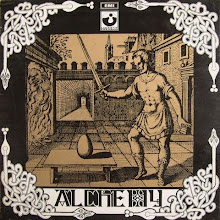
Here is another miraculous discovery from the web, a new live radio set by TEB from February 15, 1970, taken from a John Peel's Sunday Show that seemed lost forever.
The episode (approximately 40 minutes long) featured performances by the Third Ear Band and the Edgar Broughton Band, both on the Blackhill and Harvest Records roster, who often performed together live.
The TEB played only two tracks: "Mosaic," from the first album, and "Water" (here, unfortunately, incomplete), from the (forthcoming) second one, wrongly announced by Peel as "TheSea," displaying, as I have written countless times, a prodigious interplay.
It's interesting to note that, compared to the version later released on the second album, here "Water" has a darker, more sinister feel, as if a threat were looming.
Here's a brilliant review on "Druid One - Live at Essen Pop and Blues Festival 1970" by my friend Italian musician and music writer ALESSANDRO MONTI (https://unfolkam.wordpress.com/) a very big fan and expert of Our Holy Band.
"Where do we come from?
All we know is that we are born on this planet, we live, we walk, we play, we work and then we leave leaving traces of our passage without knowing what will happen to those traces, and without paying the slightest attention to who will follow or collect them.
I have often asked myself these questions while listening to magnificent recordings like this one, in which half the members of the group are now elsewhere, entities of pure spirit beyond this material world without knowing that their improvised music was so intense as to take root in the planet and be rediscovered at unthinkable moments... or maybe they knew?
Curious to think that the other half of the group continues to make music: a classical cellist and a violin teacher disinterested in his past: that's life. But to many of us this music still communicates a unique and unrepeatable emotion, a ritual that is renewed with every listen as if it did not belong to any era... perhaps because it belongs to ALL eras?
The answer blows in the wind with this music taken from a concert in 1970, recorded impeccably by German radio at the time of the second album based on the four elements, it is no coincidence that two of them appear: water at the beginning and at the end, after an alchemical sonic journey, the dance of the earth.
There was a time when we literally had to work miracles to find live recordings of our favorite bands, then the doors of the cosmic archives opened and we listened to all sorts of things. Today the release of a new TEB album seems almost normal, in reality all this is miraculous, especially if we think about the time spent on the dusty shelves of some archives. The music speaks for itself and no comment (let alone "critical") could add something sensible... just a few technical aspects to note:
side A of this album starts in fade in, certainly after the performance has already begun, while side B ends with a fade out while the group seems to be able to continue endlessly, this makes me think (like Luca wrote) that perhaps it is not a complete tape, but the unrepeatable magic fully justifies its publication with the rare quote from Abelard & Heloise to seal the set: a surprise too good to be true."
Avant-garde folk musician, TEB expert and friend Sean Breadin points me to this YouTube (audio) post in which the Third Ear Band plays at BBC Radio 1 "Sunday Show" on January 17th, 1971.
Only three tracks ("Water", "Eternity In D" and "Druid") but of extraordinary charm and high intensity.
About the new Esoteric Recordings/Cherry Red release "Mosaics", nothing can be said about the wonderful 3CDs clamshell box packaging (with the brilliant idea of a box containing the three original Harvest albums reproduced in their splendid replica sleeves)... maybe much about the quality of my writing (a cut & paste taken from the previous enhanced CD booklets) but... hold on...
what about the big mistake to invert again the titles of "Fire" and "Water" on the second album track-list?
I warned Mark Powell with a mail in May to remember him to correct that oversight on the 3CDs enhanced edition of "Third Ear Band", released in 2018...
Dammit! Another missed opportunity to do a perfect (at least philologically) job!
Stefano Giannotti is an Italian avant-garde musician/composer/arranger/conductor since the beginning of 80's. He's playing and arranging also TEB tunes. I had an interview with him in 2011, you can read about his long career and his ideas about music and the TEB here.
After a first arrangement of "Water" in 2005 with Vaga Orchestra, in
2019 he arranged a new version of it and he conducted (playing
with) a young ensemble called SMS who performed it live. Here's the
really exciting performance:
Confirming the love for the TEB music, this important event induced me to contact him again for a new interview about his work on the tune. This is our conversation...
.How did you come up with the idea of forming the SMS Orchestra? The SMS Orchestra is a modular group of students born around 2014 at the School of Music Symphony of Lucca, with the name of Laboratorio OTEME; because it could be confused with OTEME (the ensemble I manage since 2010) we changed the name: SMS means School of Symphony Music. The former idea was to form a group of students playing the guitar and other instruments with voices, which if necessary, as then sometimes is happened, could join OTEME. The problem of training nowadays is more and more urgently felt, since especially in Italy there is little space for contemporary music, let alone experiments of hybridization between rock, avant-garde and contemporary music! Previously, at another school of music, I had conducted a similar experience with the Vaga Orchestra. Over the years many members have changed, but for some time a stable nucleus has been created: it must be said that many of them started from very young, from the middle school, grewing up together within this experience. Today the SMS Orchestra is around 13/14 musicians ranging from 15 to 40 years old. At the same time, some composers were born in the band and their compositions were included in our repertoire. The SMS Orchestra performs mostly arrangements of experimental rock music or similar: we play Residents, Tuxedomoon, Third Ear Band, Battisti/Velezia, Sylvian, but also Bruno Lauzi, Bowie, Baroque and Renaissance music, Battiato's Aries, Peter Gabriel, etc.
Stefano Giannotti nel 2019.
.Why did you decide to arrange and perform TEB’s "Water" again, after your first adaption in 2005? "Water" is one of my all-time favourite tunes. I think it is nice to allow young people to discover tunes like this, which I knew when I was 17. If teachers don't let them know this music, hardly nowadays young people will reach it alone.
.How did you wade into the original version? What are the motivations related to the form/structure of the music that led you to rethink it in this way? I think the most interesting thing about "Water" is the bass. It’s definitely the Third Ear Band's tune that seems more "composed" and less improvised. I find really amazing how the melody leans on the cello; basically, the melody is built by a single cell that is repeated throughout the song at different heights, sometimes with alterations of some intervals. The various mutations of the cell are connected by free parts, very short so that the theme becomes really omnipresent. The bass line creates moments of tension and relaxation, above all the turns of the chords are used intelligently, in particular the first respondent. Then, on the third chord of the melody, there is a FA# played by the oboe on the natural FA of the cello - like a punch in the ear - which melts immediately into a wonderful consonance on the fourth. The real prominent role in the piece, in my opinion, is just the cello that acts as a "fixed song", as in the original counterpoint and the oboe is "opposed" to it. My basic idea was to interpret that cello "false notes", those microtones originated from an oriental mink, as they were semitones: so if a note stands between a LA and a descending LA, I assume it as a SOL#. Being on the bass this SOL# creates a new chord, which was perceived in the TEB's tune and in this version becomes clear. The great thing is that it sounds very similar to the original, despite having forced several chords. Well, I hope I didn’t say things that were too complicated!
.What do you think about the original composition? Do you think it was written or it was a work in progress in the recording studio? I think it’s in between. I think there is a theme that was born from improvisation, then step by step it was built inside the group, especially by Minns and Smith; but who knows... surely they did not try it once, as it could have happened to other tunes played by them.
School of Music Symphony in 2020.
.Which elements of the TEB form are inscribed in your music? The oboe! I fell in love with the oboe thank to them. For many years I conducted a trio/quartet, the Ensemble Il Teatro del Faro, formed by oboe/English horn, electric guitar and cello, plus various objects, tapes and electronics. Our work was more experimental and moved in totally different fields (musical theatre, radio-art, performance), but occasionally opened to phrasing and atmospheres influenced by the Third Ear Band.
.Do you think there is still room today for experiences such as that of TEB?
Sometimes you hear world music, rock-ethnic and similar genres, but the Third Ear Band remains a unique case in the history of music. I think the difference lies in their simplicity and - forgive me - not professionalism as instrumentalists. Today the world-music bands are made by very competent musicians, TEB players were little more than amateurs, but that’s what makes them unique and indescribably magic. They didn’t have to show anything to anyone, no kind of virtuosity, they just start with sound, they create circles that slowly widen and you find yourself wrapped in a total sensory experience. Many ethnic-folk groups sound very stereotyped and corny. Not the Third Ear Band, for some mysterious reason their music force you to listen to them finding new dimensions: think of "Egyptian Book of the Dead", but also of pieces like "Live Ghosts"... this kind of music always opens new worlds. I don’t know if there’s room today, but I think there’s room for everything, the thing you need is just to have a little more imagination.
.What kind of music do you listen to these days? I love Bach's Cantatas, Frank Zappa, especially his orchestral pieces, David Sylvian, Battisti/Panella, Robert Wyatt, David Bedford, the Third Ear Band (although I don’t listen to it often), Alvin Curran, Steve Reich, Tuxedomoon, Gong and Daevid Allen, Ravel’s Bolero... I can hardly stand the contemporary music, although I admire the ideas... the ones I like most are John Cage and Karlheinz Stockhausen.
.What's about your future plans? I am finishing a radio-drama for the German national radio SWR, I will go to produce it in their studios in Baden-Baden in February 2021, if the COVID pandemic will allow us. Last summer I've published "A Greeting to the Clouds", the new OTEME CD, so I’m promoting it. I also have other projects in Poland and Germany, but it will depend on the pandemic situation. With the SMS Orchestra, we will start again in November, maybe with a project between folk and sound experimentation.
the recent wonderful 3 CDs remasterededition with the original "Elements" album shows a big, incredible misunderstanding: on side One, the track n. 6 is not "The Sea" ("Fire") as printed on the cover but actually "Water".
This rough error was due to the fact I couldn't listen to the unrealised tracks and Cherry Red told me just that title because it was printed on the original reel box.
For the future, I asked them to let me listen to all the unrealised tracks before to write the booklet. In fact, for "Macbeth" Cherry Red firstly told me the unrealised tracks was five: three from a studio session at Trident Studios recorded in December 1970 and two from a radio programme recorded in January 1972 by a 'strange' line-up including Buckmaster, Bridges, House and Pavli.
Just listening to the tracks I realized the radio programme was older because all the instruments were acoustic and I identified Ursula Smith's violin and probably a viola played by Richard Coff. Also, the tunes were three and not two as stated.
Thus I suggested to cut the tracks off for using them on the remastered edition of "Alchemy"...
The anthology, among tracks by Pink Floyd, Deep Purple, Syd Barrett, Edgar Broughton Band, Roy Harper..., includes "Water" played by the Third Ear Band taken from the "Elements" album.
I'm particularly close to this record because when in 1976 I bought it in a little record shop of the smalltown where I lived I could listen for the first time to the Third Ear Band. Just then I decided to find all the records the band had produced.So in some ways "Picnic" was the beginning of all: the researches on the TEB, the first attempts to contact Glen to convince him to reform the band, the following management of the group for the Italian tours/records, finally this Archive with many unexpected contacts and discoveries...
In these last years the vinyl edition (Harvest SHSS 1/2), not too hard to find, is a collector's item valued around 15-20 euros. In 2007 E.M.I. edited also a 3CDs with similar title ("A Breath of Fresh Air") but a different (enhanced) tracks selection: Third Ear Band is included here with two tunes - "Druid One" (from "Alchemy") and "Overture", from the 1972 "Macbeth" film soundtrack.
Stefano Giannotti(born 1963) is an Italian composer, author, director, guitarist and performer. He studied composition with Pietro Rigacci and he has been the assistant of the famous Alvin Curran on “Crystal Psalms" and "Tufo Muto". Between 1983 and 1990 he performed in several European countries with the chamber music group Trio Chitarristico Lucchese (an acoustic guitar trio) and formed his first group called Ensemble Il Teatro del Faro. In 1997 he started a collaboration with the Italian choreographer Roberto Castello and between 1998 and 1999 he lived in Berlin. On 2000 he has been guest of the Kuenstlerhaus Schloss Wiepersdorf in Brandeburg and on 2002 he has been invited in Worpswede by the Ministerium of the Niedersachsen. The same year he has won the Karl-Sczuka-Preis (SWR, Baden-Baden) with his work "Il tempo cambia" and on 2007 he has got for the second time the Karl-Sczuka-Preis for his radio-piece "Gealogica".
On the present day he's playing with a new group, OTEME (Osservatorio delle Terre Emerse). His repertoire ranges from performance, radio-art, dance theatre to chamber music, orchestral scores and songs. Landscape, memory, life cycles, voices of people, languages are some of the main themes developed in Giannotti's work. His compositions have been performed in festivals, theatres, museums around the world and his collaborations included works for radios and TVs. With one of his groups, Vaga Orchestra, he played a new arranged version of TEB’s “Water” from their 1970 second studio album. From the Eighties he declares his deep appreciation for the Third Ear Band's music.
We knew 25 years ago at the time of the Ensemble Il Teatro del Faro, when I was involved with the management of the reformed TEB. You declared your great interest for their music: can you tell us how it's happened your encounter with the TEB's music?
"I've known TEB's music when I was 17 at the secondary school. In my classroom there was some friends of mine not studying music so deeply as I did but they had musical knowledge much more than me - they knew bands and artists I didn't know - I never heard about them. At that time I was listening to Genesis, David Bowie, Gong, Tangerine Dream, Van Der Graaf Generator and Mike Oldfield. They told me about Zappa (I didn't love him at the time), Soft Machine (the same), Henry Cow, Hatfield & The North, they made me know Robert Wyatt - a group of depth artists they was probably reading on some music magazines. Among these meetings there was also Brian Eno, Philip Glass and the Third Ear Band. At the beginning, as for all these kind of music, they bored me, but after all through my personal peregrinations I've already bumped into La Monte Young and Igor Stravinski... The Third Ear Band was a great discovering, I liked very much their approach to a kind of music that remembered me the Tangerine Dream and in the same time the popular theatre: I loved much the oboe, the ancestry of their proposal, maybe I was bored by the lenght and the repetitiveness of their compositions, but I got use to it quite soon. Of course I had some disputes with my classroom mates about their music: I loved more "Macbeth", but the critics stated the other two albums was better, so my mates liked more that records. There was also the pleasure for reasearching the records: infact in those days it was very difficult to find their albums in a record shop, and for that reason we did lend ourself one of two of them and we take them for many months..."
OTEME -"I was a mill"/CadutaMassi
Beyond to have included TEB music on some of your repertories, how much of their experience has gone in your music, about the sound research and the art of composition?
"The Third Ear Band has caratherized the sound of many works composed by me between 1991 and 1999. The Ensemble Il Teatro del Faro was made up with oboe/English horn, cello and electric guitar, with some other instruments as Indian organ, pan flute, ocarina, objects and toys. The music we played was quite different from the Third Ear Band's, but sometimes it contained the same spirit of improvisation and the love for that kind of sounds; maybe it was less similar about the hestetics, because, even if it was charaterized by improvisations, the most of my works is composed, not improvised".
Which are your compositions directly influenced by the TEB sound?
"The tune more directly influenced by it could be "La recita" [The play] from the suite titled "Ritratti, pagine e improvvisazioni su Amleto" [Portraits, pages, improvisations on Hamlet]. In this tune, electric guitar and English horn make a rhytmic sequence quite similar to the Sweeney's hand drums, and the cello sounds a melody, on a viola's extention, and at the end it improvises. Maybe it can recall "The Egyptian Book of The Dead", maybe more "Macbeth". Another tune surely is "Tema dei campi" [Fields' theme] that at last, after 20 years and a lot of different versions, this year it'll be recorded on a CD by my new group OTEME. On this composition the teponatzli, a percussion instrument similar to an ethnic marimba, play the continuous rhytmn, the oboe makes the melody, the clarinet does a rhytmic/melodic contracpuntual to the oboe and sometimes piccolo's phrases insert on it; the harmony is build by synth and electric bass. One of the first versions of the track (maybe composed in 1990) sounded as "Achemy", but globally my tune is more complex, because more contrapuntal. There are some influences here and there on other compositions I've written: the last one is from 2010, an experimental video I made in Poland ("The Walbrzych Notebook": see at http://www.stefanogiannotti.com/thewalbrzychnotebook.html): on a sequence of the soundtrack electric guitar is played with a bow, and I remember just before to compose this tune I used for the film the "Abelard & Heloise" soundtrack. I liked so much the combination that I stopped immediately to listen to it to avoid the risk to become prisoner of it and don't be able to compose some of mine. But at the end I composed a tune that remember in some way the Third Ear Band atmosphere."
Stefano Giannotti - "Corali III-IV"
How would you describe TEB music from a composer point of view?
"A music out of time and out of any label. As the music composed by Giacinto Scelsi, John Cage and Morton Feldman. These composers are very up-to-date in any age because they don't belong to a specific time, they are out of format. I've been so impressed to listening the TEB again after a very long time and compare them with other bands using the ethnic element in their work - as the Oregon, for example... TEB is unique, they don't smell of ECM or World Music, their semplicity is so disarming that one cannot apply the same critical categories as to a specific school of thought. It would be as lump everything together. I can't labelled TEB music as psichedelia or etno-music, or minimal, because at the end none of this genres sounds as they play..."
Observing the condition of contemporary music (I mean his level of development), do you think TEB music is still up-to-date? Why?
Surely it's a music still very up-to-date, and it's shame (I'm polemic here!) you can hardly convince some young homo-sapiens to stop just for five minutes and listen to it (generally as for all sophisticated music). Periodically I do workshop about guide to listen to contemporary music and the Third Ear Band has a place of honour there. A lot of contemporary ethno-jazz is so predictable until the first notes... it's not the same with the Third Ear Band, maybe because the musicians wasn't so great virtuous, never rivers of notes as Paco De Lucia, but power of concentration, breath and sound. In some ways, as I stated, I find a parallelism with Feldman, Cage and above all Scelsi.
Giacinto Scelsi - "Trio for strings I-IV"
Sure, if you avoid any labels you bore the societyand fatally you sink into oblivion. Years ago I tried to arrange "Water" for Vaga Orchestra, an ensemble of students of music. The band was composed by two flutes, tenor sax, violin, keyboards, four guitars, Indian organ, bass and drums. Arranging the tune, I decided to round up for semitone every descending or growing note of Ursula Smith's cello. The harmonic result has been very interesting: a continuous stream of consonant and discordant chords perfectly tied to each other, creating a speech with sense in a harmonic point of view, never ordinary, that obliges you to listen the music until the end of the track. I never thought the cello was improvised on "Water", and I'm not still completely persuaded of it".
One of the great things of the Web is that one can discover little music treasures recorded by obscure bands around the world.
Famlende Forsok is a Norwegian band recording avant-garde music from the Eighties, known in the underground for interesting albums related to medieval folk, progressive, kraut rock, industrial... all strictly 'post'.
On a recent interview (read at http://www.lunakafe.com/moon180/no180.php), talking about their tribute album to the works of American gothic witer H.P. Lovecraft ("One night I had a frightful dream", Gurls Records 2003), the musicians quoted Third Ear Band as one of the main influential bands (with Popul Vhu) during the making of the record.
Asks the interviewer: "One night... stands out compared to your other works, not only because of the language and lyrics used, taken from HP's original texts. The music also seems a bit different, at times more old-fashioned with several acoustic instruments and more discreet use of electronics. Why?"
Brt: "We had loose atmosphere in the background, wanting to arrange came from Lump. We wanted a Third Ear Band-feel, or Univers Zero".
Chrisph: "We wanted initially the music to be directly inspired by our subjective understanding of the meaning of the words... This would possibly make it even more like effect-fuelled film music than earlier works. Next, on the other hand, there was also an effort to make more traditional tunes in there. This I guess is much due to the fact that the years before this release, Lump was much into his other band The Smell of Incense, which was/is very much folk/psych oriented. At the start the landscapes were much more ambient and lacking themes based on regular harmonies. So in the end One Night... probably is a bit of this and that. Some radio-theatrical, some film-like and some like the Third Ear Band...".
Famlende Forsok in 2007.
Over the disputable Web/social networks logic of the "if-you-like-this-listen-this", it can be interesting to verify the idea of the group about its music sources because, even on a superficial listening, tracks as "The festival", "The shadow over innsmouth", "Nyarlathotep" or "At the mountains of madness" have unequivocally a TEB's flavour, attesting once more the Band is still influential on contemporary music.
American musician Elliot Knapp, on his personal blog at http://www.elliotknapp.com/2011/02/third-ear-band-third-ear-band.html, has reviewed TEB's second album, the seminal "Third Ear Band". Frequently on the Web fans and journalists use to write on the band, testifing the great interest for the TEB is not expired, and this review is particularly smart...
"Third Ear Band's second album, 1970's self-titled (now sometimes retroactively titled "Elements") builds on the oboe melody-led excursions of "Alchemy" by assigning each of its four songs to an element. While the instrumentation is still basically the same as the debut, the songs are considerably more identifiable from each other.
Every time I listen to this album I'm amazed at how fun a listen it is without being particularly melodic: the opener, "Air" gently coalesces out of the ether based on a repetitive tabla beat and some probing oboe and cello/violin groans and fails to present any melody except for an occasionally repeated violin riff. And yet, its smoky mystery is utterly compelling and lushly gorgeous, especially considering how few instruments produce the music. "Earth" shifts gears completely, with the strings playing pizzicato over a much more minstrel-like beat from the drums. Dual oboes improvise gently, probing Eastern-scales, while the tempo subtly gathers pace. All of a sudden it's an ecstatic frenzy, then just as suddenly the tension disappears, the rhythmic pattern slightly shifts, and the process starts again. Despite the general mood and ever-present tonal center of the music, there's no real melody to speak of - clear and quite listenable evidence that melody needn't reign supreme as the only musical element worthy of close attention.
"Someone else who posted here said they've learntmore about TEB in a fewhours here than in 30 years. I'd agree with that except inmy case it would be 44 years. An excellent archive for TEB fans and historians of the era. Thank you!" RACHAEL TYRELL
A TEB BOOK...
CLICK ON THE PICTURE TO BUY THE BOOK.
NEW TEB 3CDs BOX OUT NOW!
Click on the picture to get a copy.
"ALCHEMY" REMASTERED EDITION OUT NOW!
Click on the picture for buying the album.
WRITE TO GHETTORAGA
Search This Archive
New TEB remastered CD on sale!
Click on the picture to purchase the record.
NEW THIRD EAR BAND REMASTERED CD EDITION ON SALE!
Click on the picture to buy the record
Translate
Third Ear Band 1969: Paul Minns, Glen Sweeney and Richard Coff (photo: Ray Stevenson).
Luca Chino Ferrari (b. 1963) is an Italian music writer. Since 1985 he has written and translated books about folk and rock musicians as Third Ear Band, Robyn Hitchcock, Captain Beefheart, Tim Buckley, Nick Drake, Syd Barrett & the Pink Floyd for the main Italian publishers. He met Syd Barrett in 1986 and did contribute to the reunion of the Third Ear Band during the '80s. His latest books was published in 2020 for English ReR November Books, as a collection of stuff about the Third Ear Band, and in 2024 as a collection of writings about Syd Barrett (in Italian). He runs a personal Web site (in Italian/English) at https://chino6339.wixsite.com/gelatoaicorvi
TEB recording at Abbey Road Sudios in February 1971
Click on the picture to watch the video!
"Third Ear Band music is a reflection of the universe as magic play illusion simply because it could not possibly be anything else. Words cannot describe this ecstatic dance of sound, or explain the alchemical repetiton seeking and sometimes finding archetypal formes, elements and rhythms...".
(Glen Sweeney on "Alchemy", Harvest Records 1969)
Paul Buckmaster at Hyde Park (June 7th, 1969).
Total Pageviews
"ALCHEMY"
"Alchemy" (Harvest 1969)
Third Ear Band live at Hyde Park (June 7th,1969)
Click on the picture to watch the video!
Read "Necromancers of the drifting West"!!!
A book on the Third Ear Band edited by Luca Ferrari (published by Stampa Alternativa, Rome 1997). WITH THE FIRST ORIGINAL VERSION OF "ABELARD & HELOISE" SOUNDTRACK!
Third Ear Band at the Roundhouse (London, May 30th 1969).
As alike or unlike as blades of grass or clouds...
"The music is the music of the Druids, released from the unconscious by the alchemical process, orgasmic in its otherness, religious in its oneness communicating beauty and magic via abstract sounds whilst playing without ego enables the musicians to reach a trance-like stage, a "high" in which the music produces itself. Each piece is as alike or unalike as blades of grass or clouds".
(From the 1969 Isle of Wight concert programme)
TEB - "THE LOST BROADCASTS" DVD (Gonzo Multimedia, UK 2011)
Richard Coff at Isle of Wight Festival, August 1969 (photo: Barry Plummer).
Pseudo-mystical...
“The trouble is that you can't be mystical without being called pseudo-mystical, and it's the fault of our previous education. I'm at Glastonbury most of the time, but we're all completely honest about it. We'll even use it honestly to make money, because the ancient Egyptians who were into it all said that you had to be rich because only then can you resist temptation”.
(Glen Sweeney to Richard Williams, “Melody Maker” June 1970)
"Macbeth" by Roman Polanski (Playboy Production, UK 1971)
“I've always felt that music should be pure. If you have lyrics, you are preaching in a way. Somehow words are a block to communication. It's almost impossible for me to explain exactly how I feel about this, that's why I'm a musician. The only way to really understand what I mean, is to firstly listen to a pop group and then listen to us, and then I hope you will know what we're trying to say."
(Glen Sweeney to Muz Murray, 1969)
A Third Ear Band tribute
Roberto Musci - "Mosaic. A tribute to Third Ear Band" (CD - Gonzo Multimedia HST411, 2016)
TEB 1971: Sweeney, Minns, Bridges and Buckmaster (photo: Blackhill Enterprises).
NOTES FROM OVERGROUND
“No announcements, numbers lasting 15 to 20 minutes, art form or con?
This might be valid criticism of (A) Thunderstorm (B) a cricket (C) Third Ear Band.
Their approach to music is different because there is no duality, no conflict between the natural element of chance and the human element of control, did the moon ask to be reflected in the water? If it wasn’t for the trees would the wind know when it was blowing? Paul Minns says there are some very beautiful forests in Hyde Park, trying to put titles to music is rather like trying to answer the question where does my hand when it becomes my fist”.
(From the Al Stewart-Third Ear Band 1970 tour programme)
TEB 1970: Sweeney, Minns, Coff & Smith (photo: Blackhill Enterprises).
"The Centipede was happy, quite, until a Toad in fun said: "Pray, which leg goes after which?". This worked his mind to such a pitch, he lay distracted in a ditch considering how to run". (Third Ear Band, 1970)
TEB at Isle of Wight Festival, August 1969 (photo: Barry Plummer).
"Music from Macbeth" (Harvest 1972)
Third Ear Band - "Experiences" (Harvest 1976)
WEIRD SCENES
“We'd rather people called us a pop group. We do ragas, that aren't really ragas at all, and unless we get a turned on promoter, we get into some weird scenes. At Norwich once, when the promoter saw the audience sitting down and closing their eyes to our music, he accused us of putting them to sleep! Complete paranoia. So I imagine we wouldn't do too well on the Pop Proms”.
(Glen Sweeney interviewed by Chris Welch - “Melody Maker” July 12th, 1969)
Third Ear Band - "Fleance" (Odeon 1972) Japan single edition
Third Ear Band - "Live Ghosts" (Materiali Sonori 1988)
VERY MUCH UNDERGROUND
“It's just a question of advertising. We've stayed very much Underground - no photos - and I think this was necessary so people wouldn't put us in a bag. We'd rather the just came up and heard us without ANY preconceived ideas. I suppose it is a bit shattering to see violins and cellos”.
(Glen Sweeney interviewed by Chris Welch - “Melody Maker” July 12th, 1969)
Third Ear Band at a Druids ceremony in Glastonbury Tor (April 15th, 1970).
OTHER TEB RELEASES/APPEARANCES
"Picnic. A breath of fresh air" (2LPs - Harvest SHSS 1/2, UK 1970) various Harvest artists anthology
"Harvest Heritage. 20 Great" (LP - Harvest , UK 1977) various Harvest artists anthology
"The Harvest Story Vol. 1" (LP - Harvest EG 260097 1, UK 1984) various Harvest artists anthology
"All frontiers" (CD - Materiali Sonori MASO CD 90026, ITA 1991) various artists live compilation
"Sonora 2/91" (CD - Materiali Sonori, ITA 1991) various Materiali Sonori artists compilation
"Radio Session" (CD - Voiceprint VPR017, UK 1994) live album
"Materiali Sonori" (CD - Olis OM 0021, ITA 1996) various Materiali Sonori artists compilation
"Live" (CD - Voiceprint VP157CD, UK 1996) live album
Third Ear Band - "New Forecasts from the Third Ear Almanac" (ADN Records 1989)
90% improvisation...
"I'd say ninety per cent of our music is improvisation. It's not really Indian music, although we use a drone instead of the usual bass line riffs. The music draws from everywhere.
"I think our appeal is that audiences can draw their own thing from us. We make no announcements and none of the numbers have titles. People in colleges we play come up after and say they can get fantastic images in their mind when they listen. We can offer a complete dream. The old Celtic bards used to have the same ability".
(Glen Sweeney interviewed by Chris Welch - “Melody Maker” July 12th, 1969)
“Third Ear Band’s new album “Magic Music” isabout music as pure vibrations, as such it can be linked with colour because colour is vibration. It can even be linked to the music ofthe spheres which states that the vibrations of the planets can be heard with the third ear (silence). The free ragas that we play are modal, each note can be heard as a sound-colour that produces its own mood.Our rhythms come from all overthe world, and we use these ideasand many others to try to make a new world music”.
(Glen Sweeney, notes on the “Magic Music” inner cover, 1990)
SOLOS DISCOGRAPHIES
- GLEN SWEENEY -
Various Artists - "The greetings compact vol. 2" (CD - Materiali Sonori, 1990)
Rolling Stones - "Sticky fingers" (LP/CD - Rolling Stones Records, 1971)
Carly Simon - "Hotcakes" (LP/CD - Elektra, 1974)
Elton John - "Single man" (LP/CD - Rocket, 1978)
- NEIL BLACK (selection) -
UB40 - "Present Arms" (LP/CD - DEP, 1981)
Joan Armatrading - ""Track Record" (LP/CD - A&M, 1983)
Third Ear Band 1969: Minns, Sweeney and Coff at the Kensal Green Cemetery of London (photo: Ray Stevenson).
Third Ear Band - "Brain Waves" (Materiali Sonori 1993)
Eight drunk rugby players
"We once had eight drunk rugby players yelling dirty songs at us. We played quieter and quieter. In the end they seemed ashamed and shut up. But I still don't think they dug the music!".
(Glen Sweeney interviewed by Chris Welch - “Melody Maker” July 12th, 1969)
Third Ear Band, Vinci 1989: Allen, Sweeney, Dobson and Carter (photo: Lucia Baldini).
QUOTATIONS, COVERS, REMIXES, MANIPULATIONS OF THIRD EAR BAND MUSIC
Stone Breath - "A silver thread weave the seasons" (2CDs - Hand/Eye, USA 2008). A 'cover' of "Fleance".
Marco Lucchi - "Baby a" (ITA 1982). A composition with a sampler of "Stone Circle".
Radio Noisz Ensemble - "Yniverze" (CD - Garden of Delights 1982/2009). A 'folky' quotation of "Water".
Fabio Zuffanti - "Third Ear Band demixed" (CD-r - Spirals Records, ITA 2000). The four elements electronically manipulated.
Algarnas Tradgard - "Delayed" (CD - Silence Records, UK 2001). A quotations of "Water" recorded in 1973-1974 (!).
Lady Husk & The Good Ship Neotropic - "A monstrous psychedelic bubble exploding in your mind" (file MP3 - The New Worck, NL 2007). A remake of "No title" (?!).
I Monster - "The Art of Chill vol. 6 - Mixed by I Monster" (2CDs Platipus, UK 2009). A remix of "Fleance".
Vibes and Stuff - guest mix Coby Sey (MP3 - UK, 2010). A remix of "Water".
AA.VV. - "The Fruits de Mer Annual for 2011" (2x7" - Fruits de Mer Records, UK 2011). A cover of "Fleance" by the HI-Fiction Science.