June 01, 2019

A Denim Bridges' solo LP discography.


Who knows Denny Bridges was a sound engineer in Brian Eno's "Here come the warm jets"? Or in Jeff Beck's "Blow By Blow" produced by Sir George Martin?

Just after the involvement with the Third Ear Band, thanks to a tied friendship with Paul Buckmaster, Denny had the chance to work at the London Air Studios as a sound engineer.

He told to me: "I was closer to Paul Buckmaster than any of the other members. He was always a mentor to me. He was responsible for introducing me to most of the music that was to influence me within the scope of The Third Ear Band and he encouraged me greatly. We also got on very well on a personal level and occasionally saw each other outside of the band. Post TEB I had the opportunity to engineer sessions at Air Studios for him when, for example, he had arranged for the orchestra. I was always thrilled to work with him again in that different capacity."

Here below you have the full Denim Bridges' solo album discography penned by himself (with some integrations by me) in chronological order:

1972
Carly Simon - "No Secrets" (Elektra) sound engineer  
T. Rex - "The Slider" (T. REX) assistant sound engineer

1973
Paul McCartney & Wings - "Band on the run" (Apple) sound engineer 
The Electric Light Orchestra - "ELO 2" (Harvest) sound engineer 
Brian Ferry - "These foolish things" (Island) sound engineer
Kiki Dee - "Loving & Free" (The Rocket Record Company) assistant sound engineer
Roxy Music - "For your pleasure" (Island) assistant sound engineer
Roxy Music - "Stranded" (Island) assistant sound engineer
T. Rex - "Tanx" (T. REX) assistant sound engineer
John Williams - "My Heights Below" (Cube Records) assistant sound engineer

1974
The Electric Light Orchestra - "Eldorado" (Warner Bros) sound engineer 
Sparks - "Kimono my house" (Island) assistant sound engineer
Roxy Music - "Country Life" (Island) assistant sound engineer
Badfinger - "Badfinger" (Warner Bros) assistant sound engineer
ELP - "Welcome back my friends" (Manticore) assistant sound engineer

1975
Jeff Beck - "Blow by blow" (Epic) sound engineer 
Birth Control - "Plastic People" (CBS) sound engineer
Fripp & Eno - "Evening Star" (Island)  sound engineer
Bobby Vince Paunetto - "Bottle the Edge" co-producer

1976
Quantum Jump - "Quantum Jump" (The Electric Record Company) mixing 
Jeff Beck - "Wired" (Epic) sound engineer
Stackridge - "Mr Mick" (The Rocket Record Company) sound engineer
Joe Cocker - "Live in   L.A." (Cube Records) sound engineer
Cleo Laine - "Born in a Friday" (RCA Victor) sound engineer
Philip Goodhand-Tait - "Oceans Away" (Crysalis) recording engineer

1977
Elkie Brooks - "Two Days Away" (A&M Records) recording engineer

1978
The Strawbs - "Deadlines" (Arista) sound engineer

1983
Rick Wakeman - "G'olè!" (Charisma)  sound engineer & producer 

1985
Ryudogumi - "Gaia" (Epic) sound engineer

1988
Shakin' Stevens - "A Whole Lotta Shaky" (Epic) sound engineer
TM Network-Tetsuya Komuro - "Seven Days War" (Epic) recorded and mixed

1989
Annie Haslam - "Annie Haslam" (Epic) sound engineer & mixing

1991
Soul Engines - "Ghost on a Landscape" (Not on Label) producer
Band of Blutus - "Tiny" (???) co-producer

1994
Annie Haslam's Renaissance - "Blessing in disguise" (One Way Records) sound engineer& backing vocals on one track

1995
Bar Scott - "Confession" (JSR) co-producer

1997
Annie Haslam - "Live under Brazilian skies" (Transatlantic) sound engineer and producer

2005
Bobby Vince Painetto - "Composer in public" (RSVP) co-producer

2010
Annie Haslam - "Live in Philadelphia 1997" (Floating World) sound engineer


Other artists Bridges worked with include

Apple Mosaic - Beat - Wild Swans - P.P.(Pat) Arnold - Harry Nilsson - Paul Young - Aztec Camera - The Babys - Orange Juice - Gene Pitney - Julia Downes - Rod Edwards - Rupert Hine - Pamela Moore - Babylon Sound - Livingston Taylor - Matt Sevier - Tom Rush - David Wilcox - Poker Face.

Denny today posing with his guitar.

no©2019 Luca Chino Ferrari (unless you intend to make a profit. In which case, ask first)

May 19, 2019

"How important are cultural mash-ups?" An old very interesting review about TEB's second album.


An interesting review about the TEB's second album is available in the Web at https://www.lottavo.it/2017/11/third-ear-band-quanto-sono-importanti-le-fusioni-culturali/ where Francesco Cerica wrote in 2017 some clever considerations about the syncretic soul of TEB's peculiar sound.
The text, written in Italian, is a good example as a journalist (or just a fan) can write something of really interesting about the musical forms and the meaning of some unique experiences in the popular music... 
"L'Ottavo" is a digital magazine of Literature linked to a publisher in Viterbo, "Edizioni Sette Città". 

No©2019 Luca Chino Ferrari (unless you intend to make a profit. In which case, ask first)

May 18, 2019

Found in a book the xilography by Mario Balestreri.


Found in a book a few days ago, this is a postcard reproducing the original Mario Balestreri's xylography I used for the cover of "New Forecasts from the Third Ear Almanac", released in 1989 by A.D.N. of Milan.
Born in 1918 and passed away in 2006, Balestreri was a well-known artist in my town, Cremona, as a painter, incisor and writer.
Here below you can see two works by him and a picture of him in his studio:


From 1989 the original xilography, along with Balestreri's other ones, is hanging on my kitchen.


No©2019 Luca Chino Ferrari (unless you intend to make a profit. In which case, ask first)

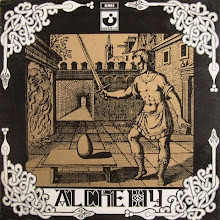
A long review in the Net on "Alchemy".


On the curious Web site "We are Cult", C.J. Newman ("CJ Newman combines a lifelong love of music, science fiction and cult movies with his alter-ego, as an academic writer on space exploration. He can be found on twitter as @kosmickris") writes a very long review about the remastered and expanded "Alchemy" full of positive opinions on the Esoteric's edition:


“Alike or Unlike as Trees”: Third Ear Band – ‘Alchemy’
“Alchemy constantly challenges the listener and demands both constant attention and interpretation. There is a free-form, improvised feel across the piece.”

One of the great joys of dipping into the progressive music of the late sixties and early seventies is the sheer eclecticism of some of the collectives. The progressive movement drew in creative artists from folk, rock, blues and jazz traditions. The release, by the always excellent Esoteric Records of Alchemy, the debut album by Third Ear Band, provides an exemplar of the fruits of such inclusive collaborations and the difficulties of trying to categorise work from this period. 

Third Ear Band has its roots firmly located within the underground creative scene of mid-1960s London. Founder Glen Sweeney took part in free-form jazz sessions at the almost mythical UFO club where he jammed with a wide range of artists. Although these collaborations were short-lived, the seeds of these relationships bore longer term fruit. In 1968, oboe and recorder player, Paul Mimms, and violinist Richard Coff coalesced around Sweeney to form Third Ear Band. This first incarnation of the band (like so many collectives of the time, membership was somewhat fluid) also saw Mel Davis (from The People Band) join in on Celle and Dave Tomlin violin play with the band on his own track Lark Rise.
 

Of course, this potted summary does not do the origin of the Third Ear Band any real justice. The true musical journey is captured in a wonderfully illustrated booklet contained within this special edition CD. One of the consistently wonderful aspects of releases by Esoteric is the provision of these detailed and insightful essays. As well as the comprehensive booklet, this release has the debut album, 24-bit digitally remastered, and ten bonus tracks which comprise unreleased recordings and John Peel BBC ‘Top Gear’ sessions. (Peel was a fierce advocate and supporter of the band, promoting the debut album and even contributing on the Jaw Harp for one of the album tracks, Area Three).

As a breakthrough piece for Third Ear Band, Alchemy truly lives up to the promise of its title. The instrumental sound of cello, violin, reed and percussion provides a unique and stark tapestry of sound with Eastern themes set against the obvious psychedelic influences of the time. Uncoupled from conventional approaches and rooted in the improvised tradition of the underground scene, the album provides an often discordant and unsettling journey into a very British mysticism interwoven with an Indian raga sound.
 
This release by Esoteric Records, as well as being beautifully packaged, is wonderfully remastered. Each instrument has a penetrating clarity and the recording now sounds crystal clear. Nowhere is this more apparent than on the first track, Mosaic, which provides an uncompromising opening. Coff’s harsh, staccato violin plays alongside the oboe of Paul Minns to provide a stark primer for the forthcoming tracks. All the while, the drumming of Glen Sweeney gives the piece a primal and dangerous feel. This is an overture filled with portent and a clear statement of intent: this is not a casual listen or a disposable moment.
 
Indeed, the whole album is not a musical safe space; Alchemy constantly challenges the listener and demands both constant attention and interpretation. There is a free-form, improvised feel across the piece. If any part of the work can be called accessible, it is the second track Ghetto Raga in which the tabla playing of Sweeney provides a clearly Eastern influence underneath the almost hypnotic violin rhythms and exotic sounding wind instruments. Stone Circle similarly provides a bucolic yet slightly forbidding undercurrent. The sound is evocative of ancient rituals and one can almost smell the wild garlic and pungent incense of a pagan rite as the unnatural and slightly discordant recorder ratchets up the tension.
 
When asked about the album, Sweeney once replied that the songs are ‘as alike or unlike as trees’ and that captures the essence of the work perfectly. The natural, organic feel to the music produces unpredictable and not always pleasing results. “If it walks like a duck, swims like a duck and quacks like a duck, then it probably is a duck”, so goes the famous abductive reasoning test. Yet it is almost impossible to say fully what this album is, and no amount of inference can assist in categorising Alchemy. It is experimental, it is innovative and not immediately accessible: the work has a harsh edge to it. There are clear nods to chamber music, and this is a truly distinctive piece of work that rewards the persistent listener. The starkness of the music and the simplicity of the instrumentation means that the work has an ageless quality.
 
As an album, therefore, Alchemy is both the perfect period piece and a template for the future of the band. It is, above all else, a perfect illustration of the way in which a collective of musicians, each rooted in their own distinct tradition, can come together and produce something of rare interest and significance. Sometimes, the need to engage in a logical categorisation of music must yield to the art itself. Alchemy defies categorisation and provides a beautiful, chaotic and discordant introduction to one of the great experimental collectives of the progressive era."

(Read the digital version here)

No©2019 Luca Chino Ferrari (unless you intend to make a profit. In which case, ask first)

May 14, 2019

“Alchemy” remastered edition: a critical review.


Just a few words for analyzing the remastered and expanded edition of the TEB’s first album.

The title
As for the second album, I suggested Esoteric Recordings to title “Alchemy” as “Alchemies 1968-1969” suggesting the idea of a project consisting in an audio excursus of the band’s first stage. They preferred the original “Alchemy”, not so coherent with the spirit of these reissues.

The packaging

I really like too much the choice to have this 2CDs digipack edition with great reproductions of the front and back cover, the original Glen’s liner note, the Ray Stevenson’s original b/w picture taken at Kensal Green Cemetery, the discs with alchemical iconography on… So, a great visual impact! 


The booklet and the liner note
As for the first two remastered albums, Esoteric asked me to write the notes with a historical approach to the TEB’s experience. For some reasons, Esoteric cut off some parts of my text, especially the one about the symbolic/esoteric meanings of the cover Chief druid David Loxley told me in an interview. A controversial decision, because I think the meanings of the "Alchemy" cover are very important for understanding the full project...

Also, I don’t like the way they assembled the original posters and having published the Ray Stevenson’ original contact sleeve with folk singer Bridget St. John on is nonsense… 


Also, as for “Elements 1970-1971”, the notes don’t include all the line-ups involved but only the one who recorded “Alchemy”. Even if the listener can easily deduce them from the booklet, it would be better to print them on the cover.

The music
As I wrote somewhere on this Archive (read here), for myself this is an esoteric album for initiates. Even if recorded just in a weekend, this music sounds very cohesive and coherent, fully related to some underground Sixties beliefs of the age (i.e. "Gandalf's Garden" and "Albion"), a unique piece of art where music, symbols (images) and meanings are wonderfully integrated.
No words, just sounds
Sounds coming from the Western deep consciousness of a drifted World, so alien from the surrounding music of the post-psychedelic rock scene...

The original masters sound brilliant and sometimes it's a very emotional discover to listen again to some tracks with "new ears", i.e. this astonishing "Dragon Lines"! 

Also, considering the unrealised tracks included in this edition ("Unity", "Hyde Park Raga"...), we have the clear proof of a very mature band exploring new territories of acoustics, a fluid place where classical meets folk, avant-garde and minimalism in a dynamic of rigid structures (English folk, Indian Raga) and modal improvisation.
A big surprise for me was to listen to "The Sea", a.k.a. "Water", maybe the first attempt to record in the studio the following album: in my opinion, this track is the key to deconstructing the first structured compositions and imagine a more open form of music. Also, the rendition of "Druid" recorded on September 12th, 1969 by the new line-up is a clear example of the path our band took for creating the second album.


A little final curiosity
Rightly, Esoteric Recordings leaves on the cover the original dedication by the band: 

""Ghetto Raga" is for Pete, Sumi, John, Steve, all the cats in the Grove and elsewhere who gave us the energy and created the karma that put it all together".

Apart from the jazz slang word "cats" to indicate all the friends of the band (a typical Glen saying), the most living in the Grove (the area around Ladbroke Grove W10); Pete was the manager/producer Peter Jenner, Sumi was his wife, John was cult DJ/producer, John Peel, and Steve was Steve Pank, first TEB manager and roadie, promoter and writer (he run "Albion"...).
 

no©2019 Luca Chino Ferrari (unless you intend to make a profit. In which case, ask first)

May 11, 2019

Spain's "God is Love" truly reminds you of the Third Ear Band?


In January 2019 Italian journalist Eddy Cilia, reviewing Spain's last album "Mandala Brush" (Dangerbirds Records), wrote about a track titled "God is Love" that the music recalls him Popul Vuh and the Third Ear Band (read his review in Italian here).
Listen to it and get an idea about: in my opinion this great music has a sort of 'kraut'/space-rock identity, it's more Popul Vuh than TEB; in fact, the music has a powerful rhythmic impact, it's focused on a widespread improvisation, with an electric/electronic core, but maybe all in all as their label says Spain's music is "indie pop slowcore Americana free jazz.”

                                                                                                
no©2019 Luca Chino Ferrari (unless you intend to make a profit. In which case, ask first)

May 07, 2019

An old TEB gig poster sold at English auction house.


This old TEB concert poster was recently sold by Omega Autions for 140 pounds.
This is the seller's description:

"THIRD EAR BAND PRESTON 1970s POSTER. A rarely seen original poster for a Third Ear Band concert circa 1970 at Preston's Harris College. The poster is printed onto thin paper stock and has been mounted to a thicker card for preservation. Poster measures 15 x 20'' and could likely be removed from card with some care. Some wear and creasing, with tape to bottom edge."

Please note that actually the gig was played by the band on January 27th, 1969 at the Preston "Harris College" (just after the recording sessions at the EMI Studios for "Unity" and "Raga n. 1") and not in 1970...

(Read the digital version here)

no©2019 Luca Chino Ferrari (unless you intend to make a profit. In which case, ask first)

May 02, 2019

Some rare pictures for remembering the great late Paul Minns.


Maybe Ghettoraga Archive didn't give the right tribute to the late great PAUL MINNS, one of the best and most influential oboe player of the popular music, but the scarce information circulating about him, his proverbial prudery, the very few interviews he did, his tragic shocking end (22 years ago), was not useful to do the right thing.
Through the years, apart his soulful contributes to a critical view of the TEB's historiography (read here and here), his former wife Mary Haynes gave me two interesting interviews (read here and here), focusing the first steps of his career; but we still have few elements for having a satisfying portrait of the man. 
So the only thing I can do is to share with you some rare, never seen pictures from Paul's family album sent to me by Mary, remembering his unique contribution to the wonderful experience of the Third Ear Band.

Paul and Mary's wedding.
A young Mary.
Mary with her sons.
                                                
no©2019 Luca Chino Ferrari (unless you intend to make a profit. In which case, ask first)

April 27, 2019

Another review on "Music from Macbeth" on the Web.


ZACHARY NATHANSON runs an interesting blog dedicated to the "progressive rock, jazz rock, and heavy metal" titled "MUSIC FROM THE OTHER SIDE OF THE ROOM" at https://zacharynathanson.blogspot.com/ 
On March 15th, 2019 he wrote this long review about "Music from Macbeth" remastered edition:

"My first discovery of reading about the Third Ear Band was back when I was a student at Houston Community College when I got a special issue of Classic Rock Magazine covering the story of Prog Rock in 2007. They were selected along with Greenslade, Jonesy, and Fruupp as The Best Prog Bands You’ve Never Heard by Malcolm Dome. Their music was so hard to find and I nearly gave up on trying to buy their albums. Until either last year or this year when Esoteric Recordings were going to do the Third Ear Band’s music.


And so my ears told me to go ahead and jump into the bandwagon of the Third Ear Band’s music. They originally started out as a psychedelic band from Canterbury called The Giant Sun Trolley and then changing their names in to the Hydrogen Jukebox. But then they decided to move away from that scene into something that was a combination between Medieval, Classical, Avant-Garde, Raga, World, and Indian music.
 
Championed by the late great John Peel who played jaw harp on their first album Alchemy in 1969, when he first heard them in late 1968 at a concert in Guildford at a projected arts lab in which he wrote about them in an article of IT (International Times) issue 45 on November 29, 1968. After the releases of their previous albums including a score for a German TV special based on one of the most passionate true romantic love stories of the 12th century Abelard & Heloise in 1970, Richard Coff and Ursula Smith left the band.
 
Enter Paul Buckmaster (David Bowie, Elton John, Harry Nilsson) on Cello and Bass Guitar and Denim Bridges on Guitar. One of the Esoteric reissues that made me want to listen to again and again was their score for Roman Polanski’s film of Shakespeare’s The Tragedy of Macbeth. It is perhaps one of the scariest, nightmarish, surreal, and intensive scores I’ve listened to from start to finish.
 
Music from Macbeth is not for the faint of heart, but for me, it was a challenge. It showed that the Third Ear Band’s idea to crack those doors open wider with textures of aleatoric music, folk, and some of the early structures of what would later be known as the Rock In Opposition movement (RIO). And with a little help from High Tide and Hawkwind’s Simon House on Violin and VCS3 after being recruited by the late great Glen Sweeney, it can make your skin crawl.
 
With Ambush/Banquo's Ghost, you get these sounds of chaotic noises of guitars, Minns’ Oboe, Sweeney’s percussion, and Buckmaster’s Bass, it goes into this crackling falling down structure by going into those rolling hills and channeling the minds of Captain Beefheart’s Trout Mask Replica. The Beach have these sound effects of seagulls and the waves before Simon’s violin screeches to make this noise of giving both the listener and the audience of what is to come in Shakespeare’s play.
 
The Overture has these aspects of between the early beginnings of Univers Zero and Present. You can imagine Roger Trigaux was listening to the band’s music to follow in their footsteps as if he wanted to make sure to honor them in Univers Zero’s music and breaking all the rules. Blaring guitars, bass lines, percussion, and Oboe’s that crawl through various corners of one room to another.
 
Fleance, sung by the late Keith Chegwin who was 12 years old at the time, brings this beauty and folk-like structures in the form of a waltz. It has these Acid Folk-sque sound as the son of Banquo sings to Duncan as he enjoys his feast with Macbeth before being killed. Simon’s VCS3 and Violin on The Cauldron sets up the witches potion that Macbeth drinks. The droning sounds from the violin, cello, and oboe sets up these alarming noises from the bubbling synths with some percussion and wah-wah guitars going back and forth.
 
Dagger and Death goes into this experimental approach for the Third Ear Band as they channel the Krautrock genre and honoring the styles of CAN’s early years to give Buckmaster a bit of a chance to channel the essence of Michael Karoli. The three bonus tracks contains the first versions of Court Dance, Groom Dance, and Fleance which were recorded at Trident Studios on December 5, 1970. Also in the reissue contains a 16-page booklet containing liner notes by Luca Chino Ferrari.
 
Ferrari is not only an underground writer covering folk/rock musicians including Captain Beefheart, Syd Barrett, Tim Buckley, and Robyn Hitchock, but also an official archivist and biographer on the Third Ear Band’s music. He also contributed the reunion for them in the 1980s. He also runs an incredible website covering the band’s history entitled Ghettoraga Archive (http://ghettoraga.blogspot.com).
 
Also in the booklet, it contains the original sleeve text, biography, Japanese promo of the band, snapshot of the band’s appearance in the film, and a picture of Roman Polanski during the making of the movie who at the time in 1970 before it came out in 1971, was going through depression because of the way the media handled the incident from the loss of his second wife, Sharon Tate who was brutally murdered by members of the Manson family on August 9, 1969.
 
When The Tragedy of Macbeth was released in 1971, it premiered on January 31st at the Plaza cinema in London after receiving some excellent stasis from Movie Critics including the late great Roger Ebert who gave it four stars in his article on the first of January that same year in the Chicago Sun-Times by calling it, “the most pessimistic films ever made.”
 
But when it was released in the States, it tanked after losing $3.5 million dollars at the box office. The soundtrack however was very positive from the music press and even was nominated for the 1972 performance awards. The award went to Nino Rota for his score to the 1972 classic, The Godfather.
 
After listening to Music from Macbeth, my ears were intrigued from start to finish. It was like searching for the lost and hidden treasure that Long John Silver had hidden for many, many years. And I hope to discover more adventures to Third Ear Band’s music to come from Esoteric Recordings to see and hear what I was missing for many years."

(Read the digital version here

no©2019 Luca Chino Ferrari (unless you intend to make a profit. In which case, ask first)