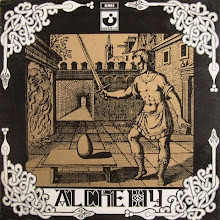
"Egyptian Book of the Dead" is one of the most popular TEB tracks. The band played the tune from the very first beginning of its career (the first documented performance is from "Night Ride" BBC radio programme on January 1st, 1969) and it was played constantly through the years until the last Italian tour in 1992 even if with different titles (i.e. "Live Ghosts" on the live from Bergamo or "Necromanticus" in a new studio rendition) and outcomes.
Composed by Sweeney, Coff and Minns almost surely in the second half of 1968, it was included at the beginning of the second side of "Alchemy", the first album published by Harvest Records on May 1969. It lasts 6:48, while on the last period, performed just at the end of the gig as a sort of seal, it could last also around 12:00.
Being so lucky to listening to the band playing live (even if after the '80's), my personal memories bring me to the concert in Gorizia (November 24th, 1989), during the third Italian tour: you can listen to the performance on some records (i.e. "Live", published by Voiceprint in 1996), but if you wasn't there that night you cannot feel on your spine that undescribable hanging atmosphere of gelid, sinister terror. As Italian journalist Piero Bielli wrote on the gig ("Auditorium" n. 4, 1990): "(...) "The Book of the Dead", another fantastic piece, has ended the gig with an anguish crescendo, so that the frailest minds feel confused as after a peyotl".
What kind of power has this incredible track?
From a musical point of view, "Egyptian Book of the Dead" (studio album version) has a simple structure: basically it is a hand drums drone with tonal/atonal improvisations of violin and oboe. One of the last version of the track, "Necromanticus" (as bonus track on "Live Ghosts" CD reissue) is a powerful crescendo, based on a progressive accumulation of instruments (bells - hand drums - oboe - violin - electronic effects) that picks up speed culminating in a very strong cacophony just before to stop abruptly.
SOURCES & INSPIRATION
About the sources of inspiration, we know the band took it from the original ancient "Egyptian book of the dead" (the papirus of Ani, 24o BC), circulating in those years also inside the English undergound culture (an edition of the first version edited by E.A. Wallis Budge in 1895 was published in England also in 1967). The book was not a single text but a compilation of spells and instructionsdesigned to guide the deceased through the dangers of the underworld, ultimately ensuring eternal life, and comprised a collection of hymns, spells to allow the deceased to pass through obstacles in the afterlife. The Book of the Dead was most commonly written on a papyrus scroll and placed in the coffin or burial chamber of the deceased.
It could be considered very superficial and quite semplicistic imagine that Sweeney intended the track as a soundtrack of the main rite included in the book, one of the most terrific sequence of the book: the weighing of the heart. But I think it can be very plausible. If it were so, we'd have an attractive appliance to imagine the atmosphere of the ritual and the structure of the track could be interpreted in a brand new way.
WHAT IT HAPPENS TO THE DECEASED
As Wikipedia states, "the path to the afterlife as laid out in the Book of the Dead was a difficult one. The deceased was required to pass a series of gates, caverns and mounds guarded by supernatural creatures. These terrifying entities were armed with enormous knives and are illustrated in grotesque forms, typically as human figures with the heads of animals or combinations of different ferocious beasts. Their names—for instance, "He who lives on snakes" or "He who dances in blood"—are equally grotesque. These creatures had to be pacified by reciting the appropriate spells included in the Book of the Dead; once pacified they posed no further threat, and could even extend their protection to the dead person. Another breed of supernatural creatures was 'slaughterers' who killed the unrighteous on behalf of Osiris; the Book of the Dead equipped its owner to escape their attentions. As well as these supernatural entities, there were also threats from natural or supernatural animals, including crocodiles, snakes, and beetles".
The TEB's "Experiences" (Harvest 1975) retro cover with clear references to the rite.
THE WEIGHING OF THE HEART Again from Wikipedia: "If all the obstacles of the Duat could be negotiated, the deceased would be judged in the Weighing of the Heartritual, depicted in Spell 125. The deceased was led by the god Anubis into the presence of Osiris. There, the dead person swore that he had not committed any sin from a liste of 42 reciting a text known as the "Negative Confession".
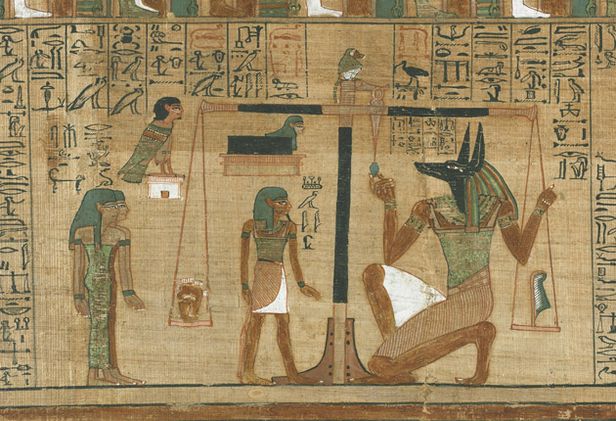
The weighing of the heart.
Then the dead person's heart was weighed on a pair of scales, against the goddess Ma'at, who embodied truth and justice. Ma'at was often represented by an ostrich feather, the hieroglyphic sign for her name. At this point, there was a risk that the deceased's heart would bear witness, owning up to sins committed in life; Spell 30B guarded against this eventuality. If the scales balanced, this meant the deceased had led a good life. Anubis would take them to Osiris and they would find their place in the afterlife, becoming maa-kheru, meaning "vindicated" or "true of voice". If the heart was out of balance with Ma'at, then another fearsome beast called Ammit, the Devourer, stood ready to eat it and put the dead person's afterlife to an early and unpleasant end".
Section of the Book of the Dead depicting the Weighing of the Heart.
AN INTERPRETATION OF THE THIRD EAR BAND'S TRACK
The beginning of the track, a suggestive (Stravinskian) prelude with wind chimes and a dreaming (Debussian) oboe is marked by the violin low notes in an incessant incisive contracpuntual pattern, until the hand drums start to play on a metronomical rhythm never changed. Oboe and violin improvising on the bordone with progression of notes by the violin and oboe scales. Here the deceased is going through the path of the afterlife and you can understand the journey is not so easy for him at all... Around the minute 6:00 violin accords as ghosts flying around and high oboe notes, while at the 8:48 the tracks is stopped with a quiet almost relaxed end (an ironic Paul Minns about the track's coda in 1996: "I remember nothing of the production except that a few unnecessary effects were introduced, the worst at the end of "Egyptian Book of the Dead" sounding like a pyramid's bathroom..."). On "Necromanticus", after the first quite similar part, around 6:00 you can listen to a sort of interlude just before the track has a clear acceleration of the hand drums. Listening to this version, around 7:25, the deceased is in front of Ma'at for the weighting of the heart and the pathos here is at its highest level on awaiting the result.
At 8:49 the music stops but the result is not so clear...
Other versions, as like that played at Gorizia (one of my favourite ever!), are even more direct and powerful because the progression is clear and very speedy and the music stops abruptly leaving the listener absolutely shocked.
There, at 8:55, after a very long sequence of Carter's electronic effects, when Sweeney's hand drums start to beat his invariable pattern, you can listen a wall of sound of noise, electronics, strong electric guitar chords, Dobson's soprano free jazz improvisations build itself before you and you can just see the deceased terrified on awaiting the verdict.
Another excerpt with the weighing of the heart.
Anyway, as in the original studio version, TEB seems doesn't want to tell us what will happen to the deceased: the verdict is open to all interpretations because it seems more important to focalize that specific momentum, the state of consciousness where everyone knows inside himself if he lies or not...
A POSSIBLE MEANING FOR THE BAND
The Weighing of the Heart step is one of the few parts of the Book of the Dead with an explicit moral content. The judgement of the deceased and the Negative Confession were a representation of the conventional moral code which governed Egyptian society. When Sweeney dead, I'm sure it wasn't a simple casuality or just an eccentricity his wife Carolyn decided to read excerpts from the Egyptian ancient text at the funeral. She wrote me on September 2005 about it: "(...) It was a beautiful ceremony rather than a conventional funeral, Steve Pank read from the "Egyptian Book of the Dead" and tracks from "Alchemy" were played, incense was burning, Glen was in a raffia coffin with sunflowers on top. Everyone said what a wonderful experience it was and some were reminded of being at an early Third Ear Band concert. I'm sure Glen would have approved".
I'm persuaded "Egyptian Book of the Dead" was the sign the TEB play to advise the people of their responsability into the life. No words, just sounds and emotions. As a pagan, earthly prayer.
"Alchemy" (LP/CD - Harvest Records, UK 1969-2004) "Live Ghosts" (LP/CD - Materiali Sonori, ITA 1987 live) as "Live Ghosts" "Live Ghosts" (LP/CD - Materiali Sonori, ITA 1990 live/studio) as "Live Ghosts" and "Necromanticus" (studio bonus track) "New Forecasts from the third ear almanac" (cassette - ADN Records, ITA 1989 live) "Live"(CD - Voiceprint, UK 1996 live)
"Hymn to the Sphynx" (2CD - Mooncrest Records, UK 2001 live/studio M) "Raga Live" (2LPs - Turning Point, ITA 2002 live)
TEB's "EGYPTIAN BOOK OF THE DEAD" RADIO PERFORMANCES BBC "Night Ride" (January 1st, 1969)
A great book, really, that one written by Gino Dal Soler, Italian writer and journalist of "Blow Up" magazine. Theproblem it is that it's written only in Italian.
More exhaustive than the recent good book of Cresti rewieved here (read at http://ghettoraga.blogspot.com/2011/03/third-ear-band-quoted-on-italian-book.html), more handbook than essay, with "The Circle is Unbroken" Dal Soler traces the long fascinating epic history of that kind of music (most of all, English and American) defied weird folk, starting from the recognised fathers of the revival (in UK Davy Graham, Shirley and Dolly Collins, Anne Briggs...) to the more recent musicians, even if he's conscious that is "a story still open", "a still unexplored universe by an essay writing level" (and the huge work made by Rob Young published in UK by Faber & Faber as "Electric Eden. Unhearting Britain's visionary music"(read at http://www.electriceden.net/) - 664 pages - proves it...).
Shirley Collins and Davy Graham
Among a very lot of known and unknown artists - believe me, a true map also for expert listeners! - few pages are dedicated to the Third Ear Band, a group Dal Soler knows very well from the '70's, when, as he writes, "for ourself it meant mysterious looks, records mainly impossible to find, a pure fragment of the English underground scene or maybe just universal one". On the paragraph titled "The Third Ear Band magical esoterism", describing the music of "Alchemy", he considers "Lark Rise" "an autentic folk gem included just to reaffirm the primary roots of a sound that has taste of earth and "wilderness"".
About "Third Ear Band", "an absolute masterpiece", Del Soler writes the music "bordered on the sublime, perfect in its ciclic evolve" and, describing "Earth", he admits that "it's impossible to tell the beauty of that circular vertigo as like to evoke with simply words the impressive vertical power of "Fire": the flames and the explosive energy of the element are delineated by a relentless and wild movement of percussion, strings and oboe gone mad, literally the peak reached by the Third Ear Band as to power, dynamism and alchemy of sound".
The second English edition of the record.
And if for the author "Abelard & Heloise" is "still full of charm and mystery", "Music for Macbeth" has "an ever more folk oriented bent". "Many people, by the gloomy and dramatic atmosphere that permeated the whole record, caught the presage of decline". From the reunion of the band in '80's and '90's, Del Soler takes "Magic Music" as his favourite, "where the band seems to come back to the far esoteric splendour despite the almost totally new line-up". The tracks "try again to tell the ancient lost legends and the druids around Glostonbury Tor, highlighting that happy and very peculiar free folk and improvised music have influenced so much the "weird-wild folks" generation in Europe as in America. Music from the spheres, modal ragas, primitive and tribal dances run into distill a quintessence that was psychedelic and visionary, terrible and sublime".
What do you remember about the mood of the time, when the name of the TEB was circulating for the first time among fans? Did you get their albums at the time? How?
"The discover of the TEB for myself it was a sort of epiphany. I remember when I bought firstly the second album, the so-called "The Elements Album", it was almost a revelation for whom just few months before like progressive music... It happened in Brescia (where I was studying) at the very beginning of '70's, in a record shop selling imported albums (there I bought also Popol Vuh's "Hosianna Mantra" and Tangerine Dream's "Atem"...).
The book was published on 1973.
Until that time on the TEB I had read only an inspiring piece on "Pop Story", a book written by the Italian rock journalist Riccardo Bertoncelli, and that thing was enough to persuade me to looking for the records. It wasn't so easy in that period, infact I found "Alchemy" with some difficulties just one year after... I listened them with a religious transport in certain hours of the day, savouring with care and let to listen to my friends that visited me as they was sort of precious pearls, but not for all... From that period I've never stopped to listen the first two albums. Sometimes I prefer the first one ("Ghetto Raga", "Stone Circle", divine...) but when I listen to "Air Earth Fire and Water" is as a dance that repeat itself every time. I think it would be very difficult to choice just one of them if I were forced to do it..."
Did you have friends to share TEB music with or it was just a solo experience?
"Both of things...".
Which do you think are the real connections of the TEB music and the folk Sixties/Seventies scene? Do you think it is effective or just ideal?
"I just think so, even if the band's uniqueness made them a separate world - it wasn't properly folk and it wasn't free jazz... Avant-garde music 0r etnomagic music? Who knows, you can tag them in any way, but for myself those so arcane and mysterious sounds evoked me other worlds where to look at and for that I've stopped to worry to define them...
The original Dal Soler's writing published on "Re Nudo".
About the TEB I wrote one of my first stuff on music on the magazine "Re Nudo", I think around 1979, when the band was split by then and for many people they was just a distant (but unforgettable) memory... I remember also that the editorial staff decided to publish it as like I had typewritten it with all my corrections and drawings, on the central pages of the magazine...".
Which is your favourite TEB track and why?
"Re Nudo" stuff pt. 2
"I think I've still suggested it in my previous answers, but here are my favourite tracks: "Earth" (one of the most pretty and whirling dance related to the element); "Stone Circle", just very few minutes of pure magic... "Fire", the panic ecstasy burning and dissolving... The misteries of "Egyptian Book ofthe Dead"... and then their vision of the Raga hither and thither disseminated on all their records...".
Did you follow their reunion in the '80's and '90's? What do you think about it?
"Of couse and I'll never stop to thank you for it... Your personal contribution in that sense cannot be discussed... And "Magic Music" is still a great album!" What do you think about their music being so unique? "The originality, the state of grace...".
Yes, dear inveterate TEB fans, at last we have got the announced interview with Ursula Smith, the legendary great cello/violin player of the Third Ear Band! As she writes me from his home in Norwich, "(...) Sorry this has taken so long. I hope it is of some use/interest. Life takes so much time!".
Right. Here's the interview...
Ursula Smith at the end of a concert with the Norwich Philarmonic Orchestra (2011)
What kind of musical training have you got?
"I started piano lessons at the age of eight and
took up the cello at 13, I had lessons on the cello at school but the
teacher was never there for the lessons, I have an idea that he didn’t
think girls should learn the cello. I taught myself from what I had
learned on the piano. Later I had lessons from a Polish gentleman who
was a professional cellist . He helped me with the audition for the
Royal Academy of Music".
As every serious TEB fan knows you met Glen and the other guys after a concert in a prison... What do you remember about it? Why did you decide to join the band?
"I left the Royal Academy in 1966 and did a year teaching. I didn’t enjoy the teaching much and left at the end of the year. I then took a job as a cleaner in a pub. At the time I joined a folk duo with singer songwriter guitarist Mike Deagan. We did some bookings in a folk club called Les Cousins in Soho (London) and it was there that we met folk singer Bridget St John. She was a friend of the DJ and broadcaster John Peel and one day she asked us if we would do a free concert for the remand prisoners in Holloway Prison. On the day we arranged to meet with the other performers John Peels flat. John wasn’t there at the time but that was where I first met with the Third Ear Band. The only person I recognised was the cellist Paul Buckmaster who I knew fom the Royal Academy, as we had had the same professor. I remember we were playing to an audience of about 90 mostly young girls in a courtyard. . Around the yard were tall concrete walls with small cell windows in them , at the end of each number all these hands came out of the cell windows and waved. One girl spoke to me in the interval and told me that she had been in the Arts Lab near Covent Garden, and she was on an acid trip, when the police came in and the the Arts Lab was raided. She was arrested and now she was on remand in Holloway. It came as a complete surprise to me at the end of the concert when Glen came up to me and asked me to join the Third Ear Band and I accepted. I learned later that the reason I was asked was that there had been several gigs that Paul Buckmaster was not able to do".
TEB 1970 (L-R): Minns, Sweeney, Coff and Smith (photo by Blackhill Enterprises)
Which are your feelings about the two years you played with the original TEB? Any particular memory about concerts, events, some anedocts...?
"The band was on tour around the country. We played gigs in Scotland, in Wales, in Manchester - in a club called the Magic Village run by Roger Eagle - and some in a club in Birmingham called Mothers which was rumoured to be run by gangsters. One of the early bookings I did was the first Isle of Wight festival with Bob Dylan on the bill. We arrived on the island by ferry and then drove to the venue field. The day before had been the rock and roll night headlined by the Who. We were on in the afternoon with folk artists like Tom Paxton, Richie Havens and Julie Felix, and in the evening was the comeback concert of Bob Dylan backed by the Band. When I walked out on the stage there were people as far as I could see. I sat down and when the amplification was set up, I drew my bow across the strings and and I heard this great roaring sound, through the giant sound system and the monitors. The other band members got set up and as we started to play the music came together.
TEB on stage at Isle of Wight Festival (August 1969) with Ursula on cello (on right)
We did some broadcasts mostly for John Peel, sometimes with an audience and sometimes just as recording sessions. The album "Earth Air Fire and Water" was recorded in Abbey Road Studios. Abroad we did the Paradiso in Amsterdam, where most of the audience were lying on the floor, and we did several festivals in a giant sports stadiums in Germany. There was a festival in an Aircraft hangar at Le Bourget airport in Paris, where the Pink Floyd were playing with a whole range of other bands. I remember we stayed at the Paris Hilton and we did a TV show in Belgium. We did two concerts in the Queen Elizabeth Hall on London’s South Bank - the first one was called "The Crab and the Crescent Moon": this was shortly after the moon landing and the title was based on a dream that Glen had had. Dave Loxley did a poster for the concert which was based on a tarot card.
The music was accompanied by a light show by Tina Keane and there was a guest appearance by sitar player Sam Hutt. Later Sam Hutt became famous as the country singer Hank Wangford. We were booked to do a national tour with folk singer AlStewart. Glen wanted to call the tour "Atlantis Rising", myself and Steve [Pank, her husband and road manager of the TEB] were detailed to go and see Al to ask him if he would accept that title. He was a bit doubtful about it and said he would be just as happy if the tour was called ‘Ham and Eggs’.
However he accepted the title and during the concert we shared with him at the Queen Elizabeth Hall he gave a short speech about how Nostradamus had predicted the assassination of the Kennedy brothers. He then sang a song about Nostradamus. Later when he toured America his tour was called ‘The year of the Cat’. The Third Ear Band played for two Druid ceremonies, the midsummer one on Glastonbury Tor and the Dawn Equinox ceremony at Parliament Hill in London. We had been in Germany playing at couple of festivals and recording the soundtrack for a German TV production of Abelard and Eloise. On that, we first watched the movie though on a TV screen and then it was played in front of us while we improvised the music. When we arrived back in London having had virtually no sleep we were immediately rushed into the back of a van and driven to Glastonbury Tor. We climbed the Tor carrying the instruments. Luckily it was beautiful day. My cello was the heaviest and the biggest. The person having the most problem was the Chief Druid who looked like he might have heart attack at any moment. He had to keep stopping to have a rest. When we all reached the top I found that there was nothing for me to sit on, so I sat on the side of the Hill. After the Druids performed their ceremony, we played to the people and to the Sun.
TEB playing for Druids in 1970: Ursula on left with Glean on tablas and Coff on violin
The dawn ceremony for the equinox was on Parliament Hill in Hampstead. We processed with the druids and formed a circle, and the druids started the ceremony. Paul was asked to play to announce the rising of the sun. The Chief Druid got the time wrong and Paul had to keep playing for ages till the correct moment of the sun rise. We were honoured to be asked to take part in these ancient ceremonies, it was a unique experience for the band. We also did a concert in the Royal Festival shared with a French avante garde music group...".
Why did you decide to leave the band with Richard Coff? What did happen to the Cosmic Overdose (?) project?
"After Steve left the band as driver, we were doing a tour of Belgium when Richard called me and Paul together, and Richard started a discussion saying he was not happy with the way the band's finances were being run. He said he had decided to leave and asked me to go with him. That was when I left the band.
Richard and I did some rehearsing and got some ideas together. Richard rang the "Melody Maker" music paper and got an interview, but we had not got equipment or management or agency. We were busking near Speaker's Corner Hyde Park when this South African guy came up to chat to us, and said he knew a guy who ran an equipment shop and he could get us some equipment there. We went to the shop and Richard spoke to the manager who told us that this person was an intelligence agent for the South African government and that we should be very wary of him. After that Richard rejoined the Third Ear Band and so did Paul Buckmaster. Soon after that the Third Ear Band got signed for doing the music for Polanski’s "Macbeth"...".
What have you done just after the split with Coff?
"I got interested in traditional folk music and in 1970 I went to a traditional folk festival in Ireland and took up the fiddle. I used to go down to sessions at Cecil Sharp House [English folk song and dance society] and joined in with the folk dance band there.
Later I played with a ceilidh band called Ginger Beer Shindig with some people who l later formed the band Blowzabella. I did a recording session for Clive Palmer on his first Album. I remember the comic actor John Cleese coming into the studio.
I moved to Norwich with Steve in 1971 and our son was born there in the Autumn of that year. By then Steve was playing the guitar and bass guitar and we formed a folk dance band called the Haymakers. We played at dances, clubs, festivals and fairs until the early 1980s. On one occasion I depped for Dave Swarbrick of the Fairport Convention. I did the arrangements for a live production of Peter Bellamy’s "The Transports" and recorded [on cello] with the comedy folk duo The KipperFamilyas part of The New Trunch Coronation Band.
A rare VHS from YouTube with a Bellamy rehearsal: note Ursula with her cello on right
How Glen contacted you for playing with the reformed TEB?
"After that period I was playing fiddle in bluegrass and country bands until I started teaching music in a school in Suffolk. Around that time Glen asked me to rejoin The Third Ear Band playing fiddle for a tour of Italy..".
Lyn Dobson and Ursula at "Psycho Club" (Genova) on January 1989 (photo by L. Ferrari)
What are you doing now?
"More recently I have returned to playing classical music on the cello. Currently I am the principal cellist with the Norwich Philharmonic Orchestra [read at http://www.norwichphil.org.uk/index.htm] and I do freelance work for local choral societies and occasional chamber concerts and string quartet concerts".
Ursula on cello during a rehearsal at St Andrew's Hall (Norwich) on 5th December 2008
Ursula on November 6th, 2010 at St Andrew's Hall Mahler rehearsal
(An attempt of) An Ursula Smith discography
Third Ear Band
"Third Ear Band" (LP/CD - Harvest SHVL 773, UK 1970)
Third Ear Band
"Abelard & Heloise" (CD - Stampa Alternativa SB, ITA 1970/1997)
C.O.B. (Clive's Original Band)
"Spirit of love" (LP/CD - CBS, UK 1971)
Third Ear Band
"Experiences" (LP - Harvest SHSM 2007, UK 1976) anthology
The Kipper Family (with the New Trunch Coronation Band)
"The Ever Decreasing Circle" (LP/CD - Dambuster Records, UK 1985/2005)
Gino Dal Soler, Italian journalist of "Blow Up" magazine, is the author of another book about acid/psychedelic folk music titled "The Circle is Unbroken: forty years of psychedelic and visionary folk" printed on January 2011 by Tutte Edizioni (235 pages, € 16,00. You can get a copy writing at http://www.blowupmagazine.com/prod/the-circle-is-unbroken.asp).
Soon an interview with the writer to deepen his point of view about the band...
Asking by mail to Denim Bridges about some news on the projected new TEB album with the tracks from the Balham sessions (February 1971), this is his kind (& very interesting) answer:
"Hi Luca, good to hear from you. I regret I have not been able to spend anytime on TEB. I have needed to concentrate on recording CDs for Fiona Frensche and promoting my album ("Go For Gold" by The Bevans) through iTunes, Amazon and Zunes:
The samples are shortened versions of the whole song not just the first 30 secs.
I am going to be touring as the sound engineer for Renaissance this summer. There is talk of a tour of Italy next year. I hope to get time to dedicate to TEB in the autumn/ fall.
I saw about the cover of "Fleance"'s song. I'd like to hear it. Glen and Paul hated that track because it didn't fit in with TEB concept. It was composed for the movie and it was composed by me alone. The words were provided to me so I, of course, just wrote the melody and chords. The turn around where I repeat the line as a sort of refrain was my trick that I often use(d) and using the minor chord was cool I think. The rest of the band improvised the arrangement in TEB style as best we could within the ridged structure. Anyway that song was the start of my demise with TEB as that's the way I wanted TEB to go.Finally a spelling correction - it's "Groom's Dance" not "Groam's Dance".
My memory is going. As I said I was the 'songwriter' in TEB and we have ascertained the "Mistress To The Sun" had been lost. I am also confused regarding "I The Key". For me to have played it on Peel's show I must have written it but I don't remember it. But, I didn't remember the song from Hamburg until you showed me the video. When I get to a computer instead of my iPhone I might be able to access some links.
Zuffanti is playing & recording music from 1994, solo and with some other bands, producing an huge amount of interesting music (check at his site http://www.zuffantiprojects.com/).
Because this Archive intend to document all the things related to the Third Ear Band, we think it's important to interview him about that experience, investigating on the process of 'demixing' that old wonderful tracks.
Fabio Zuffanti (2011)
When (and how) your interest for the Third Ear Band is born?
"My knowledge of music comes from my brother's records collection and dates back to my childhood. Among the records I remember a copy of "Music from Macbeth". Sure, I was too young at that time, but I remembered that music afterward as something of strange and magic, fixed in my mind even in my teen years. In that period, around the end of '80's, I remember I read a beautiful retrospective about the TEB on "Rockerilla" (an Italian rock magazine) and from there I wished to deepen the knowledge of the group. In those days reissues of old albums was circulating in the shops and I bought a copy of "Third Ear Band" being enchanted. At that point I got all their (scant) discography. Frankly, I wasn't interested into the band reunion, happening just in that period, because I was totally involved in their arcane works recorded in the Sixties/Seventies. Anyway, after that I've listened to all the new recordings and the archive stuffs too".
What about the idea to "demix" the "Elements" album?
"It was just a very impulsive thing, without counts. One day, while I was listening to the "Elements" album, I wished to go deep into the music and try to get his core for expanding some traits of it. I wanted to build from that tunes something more dilated that started from the elements to achieve something more wide and visionary. I feel TEB compositions as tied to something of very hearthly, as it's normal for a description of elements characterizing our existence on this planet. I've tried to do it much more abstract, making such as a mix between the sciamanic TEB world and my artistic 'Enonian' (i.e. Brian Eno music) influence...".
The album recorded in 200
Can you explain us the concept of "demixed"? What do you mean exactly?
"I told you it before. It means to go deep in a tune. I like to think about a white hot core and from there to expand everything to outside, making it to grow and picking out some aspects rather than others. While for 'remix' I mean a different disposition of tracks, for 'demix' I mean something more emotional and specific. It goes to the core of creation, explodes it and then reconnects all the pieces...".
Which is the technical process of it?
"I did the work 11 years ago and I didn't have so much technology at the time - just a programme called Cool Edit. Using it I've imported all the four tracks from the original CD and sometimes I've expanded and delayed the tunes with the time stretch, making everything became slower, out-of-focus and foggy; in some cases I've selected one element that it seemed to me topical for about the composition and I've rebuild the tune using just that kind of fragment. On everything I used a wide amount of delay, reverberations and echoes because I was interested, as I told before, to lend to the music a state of trance, more abstract as regards the original TEB tunes".
What do you think about the TEB work? How did it contribute to your musical research?
"As a listener of the band I just think all the best. TEB is a really magical and alchemical group and it reflects into the music some medieval depictions where alchemy tried to reveal an inner and fantastic side of reality. For myself, this visual element is very very important; all the artists I love are those let me imagine arcane and timeless world. On the level of my musical research, apart that experiment to 'demix' their music, I don't think to have ever take back in my compositions all the love I feel for the TEB atmosphere. Maybe because I've always worked on more 'rational' areas of composition and I've never worked on open structures and based on improvisation as Sweeney & co. did".
Is it possible you'll work on other TEB compositions in the future? "I don't think at the moment, but I've got an old dream, to form an ensemble for playing a kind of music between TEB and "Hosianna Mantra"'s Popol Vuh. I know one day I'll do it, but I don't know when...".
His second album has been published at the beginning of last April. Urf Ivarrson, a Sweden musician played with bands as the great Hedningarma, has a great "jazz/dub intense electro funk" album (a quotation from his record company)with some explicit reference to European avantgarde music and the Third Ear Band, recorded by his own band Beat Under Control.
Urf Ivarrson
As it's stated on his label's Web site Magnatune, "this philosophy is explored with often stunning results on Ulf's second Beat Under Control album, "Cosmic Repackage", a colossal aural menagerie of space-jazz brass themes and solo flights, subterranean pulses and dark-hued banks of strings which dart between European avant textures to late 60s hypno-drone alchemists the Third Ear Band... it's a heady brew, ranging from the nocturnal back alley jazz of neighbourterror blues to the intense freeform scattershots and coruscating atmospherics of "departure... if dub's shadow looms over the album, notably on tracks like the bottomless fizz-bombs of interruption, it steps out and flashes its glorious sonic stiffie on the alien skank of subversion dub, albeit lashed with dissonance and howling winds...".
The bad "I The Key", taken from the rather ugly posthumous TEB's album "The Magus" (published by Angel Air in 2004), has been included on a new Angel Air compilation titled "Ventis secundis, tene cursum. This is Progressive Rock!" (Angel Air SJPCD348) realised on January 2011.
Other bands included, Atomic Rooster, Affinity, Greenslade and Warhorse.
The album has been edited by the writer/reviewer James McCarraherthat in his Web site (http://www.jamesmccarraher.com), about the TEB, writes: "Third Ear Band emerged in a haze of hashish onto the alternative music scene in the late Sixties and produced a series of strong albums. They epitomised the title of this collection with their spontaneity and experimentation, working with raga, folk and classical music. Despite a rolling line-up, they achieved a lot in a short period, including the recording of the soundtrack to Polanski's 'Macbeth', which was also released as an album. The final recordings from 1972 failed to see the light of day for over thirty years, the tapes being stored away carefully by producer, Ron Kort. Kort took the tapes to Angel Air in 2004 and they duly released them as 'The Magus' (magician). Sadly, Ron died before the album went to the pressing plant. He would have been thrilled at the reception it received. Classic Rock Society described it as “...an atmospheric and ambient album, this is the point where electronic music, classical music and ambient music meet in an otherworldly journey through music...a superb album.” The track featured here is 'The key', which is respectfully dedicated to the memory of Ron Kort".
Among the reviews published in the Net, Steven Reid on Rocktopia claims "I could personally have done without the spacey snake charming of Third Ear Band, or the jazz meets Ozric Tentacles of Mouse, but neither song is particularly awful"; while such Claudia A, on Music-News.com tells that "‘The Key’ by The Third Ear Band is a product of the hazy and psychedelic 60’s, with a sound that’s throws folk and raga elements in the blender, with a dash of classic. Not much rock here and also not a track that stood the test of time too well, more like one to chill out to or get stoned to".
I'm sure Glen and Paul would be horrified now by this thing (It seems to me to hear Glen say: "Bad news, Baby!"...). But... biz is biz, baby. Isn't it so?
Except for few tracks, TEB compositions have been only instrumental. As we know, they used to title tracks with some references (sometimes obscure) to philosophy, religion, science, culture... One track, apparently mysterious, is titled "Groan's Dance" and was performed by the band at the BBC programme "Drummond" on March 21th, 1972 .
Who's that Groan? Maybe some TEB's fans ignore that Titus Groanwas one of the main characters of a famous trilogy written by English writer (and artist) Mervyn Peake (read at http://www.mervynpeake.org/) between 1946 and 1959.
A trilogy of Fantasy quite near to the more famous (and contemporaneous with) J.R.R. Tolkien.
In the rock history other groups quoted some references to the Peake's works: Steerpike and Gormenghast was names of bandsrecording in 1969-1971 taken by Peake's characters/places. So the progressive English groups Titus Groan (with an album recorded in 1970 with the track "Fuschia" (!) on it...) and Fuchsia with only one album in 1971.
A drawing by Peake based on the trilogy
Al Stewart quotes Peake on his sleeve notes for "Zero She Flies" (1970), while the Strawbs titled a track "Lady Fuchsia" in their 1973 album "Bursting at the Seams". Another English band called Fruupp titled a track "Gormenghast" for his record "Modern Masquerades" in 1975.
In 2000 also ex-Can Irmin Schmidt composed and conducted an opera based on the Peake's trilogy titled "Gormenghast"...
PS: Because a TEB track of the same period is titled "Groom's Dance", a beautiful medieval dance composed for the soundtrack of Polanski's "MacBeth", it could be possible it was a misspell of the title possibly made by the DJ during the radio programme. Unfortunately no radio recordings of that broadcast seem to be around...
"Someone else who posted here said they've learntmore about TEB in a fewhours here than in 30 years. I'd agree with that except inmy case it would be 44 years. An excellent archive for TEB fans and historians of the era. Thank you!" RACHAEL TYRELL
A TEB BOOK...
CLICK ON THE PICTURE TO BUY THE BOOK.
NEW TEB 3CDs BOX OUT NOW!
Click on the picture to get a copy.
"ALCHEMY" REMASTERED EDITION OUT NOW!
Click on the picture for buying the album.
WRITE TO GHETTORAGA
Search This Archive
New TEB remastered CD on sale!
Click on the picture to purchase the record.
NEW THIRD EAR BAND REMASTERED CD EDITION ON SALE!
Click on the picture to buy the record
Translate
Third Ear Band 1969: Paul Minns, Glen Sweeney and Richard Coff (photo: Ray Stevenson).
Luca Chino Ferrari (b. 1963) is an Italian music writer. Since 1985 he has written and translated books about folk and rock musicians as Third Ear Band, Robyn Hitchcock, Captain Beefheart, Tim Buckley, Nick Drake, Syd Barrett & the Pink Floyd for the main Italian publishers. He met Syd Barrett in 1986 and did contribute to the reunion of the Third Ear Band during the '80s. His latest books was published in 2020 for English ReR November Books, as a collection of stuff about the Third Ear Band, and in 2024 as a collection of writings about Syd Barrett (in Italian). He runs a personal Web site (in Italian/English) at https://chino6339.wixsite.com/gelatoaicorvi
TEB recording at Abbey Road Sudios in February 1971
Click on the picture to watch the video!
"Third Ear Band music is a reflection of the universe as magic play illusion simply because it could not possibly be anything else. Words cannot describe this ecstatic dance of sound, or explain the alchemical repetiton seeking and sometimes finding archetypal formes, elements and rhythms...".
(Glen Sweeney on "Alchemy", Harvest Records 1969)
Paul Buckmaster at Hyde Park (June 7th, 1969).
Total Pageviews
"ALCHEMY"
"Alchemy" (Harvest 1969)
Third Ear Band live at Hyde Park (June 7th,1969)
Click on the picture to watch the video!
Read "Necromancers of the drifting West"!!!
A book on the Third Ear Band edited by Luca Ferrari (published by Stampa Alternativa, Rome 1997). WITH THE FIRST ORIGINAL VERSION OF "ABELARD & HELOISE" SOUNDTRACK!
Third Ear Band at the Roundhouse (London, May 30th 1969).
As alike or unlike as blades of grass or clouds...
"The music is the music of the Druids, released from the unconscious by the alchemical process, orgasmic in its otherness, religious in its oneness communicating beauty and magic via abstract sounds whilst playing without ego enables the musicians to reach a trance-like stage, a "high" in which the music produces itself. Each piece is as alike or unalike as blades of grass or clouds".
(From the 1969 Isle of Wight concert programme)
TEB - "THE LOST BROADCASTS" DVD (Gonzo Multimedia, UK 2011)
Richard Coff at Isle of Wight Festival, August 1969 (photo: Barry Plummer).
Pseudo-mystical...
“The trouble is that you can't be mystical without being called pseudo-mystical, and it's the fault of our previous education. I'm at Glastonbury most of the time, but we're all completely honest about it. We'll even use it honestly to make money, because the ancient Egyptians who were into it all said that you had to be rich because only then can you resist temptation”.
(Glen Sweeney to Richard Williams, “Melody Maker” June 1970)
"Macbeth" by Roman Polanski (Playboy Production, UK 1971)
“I've always felt that music should be pure. If you have lyrics, you are preaching in a way. Somehow words are a block to communication. It's almost impossible for me to explain exactly how I feel about this, that's why I'm a musician. The only way to really understand what I mean, is to firstly listen to a pop group and then listen to us, and then I hope you will know what we're trying to say."
(Glen Sweeney to Muz Murray, 1969)
A Third Ear Band tribute
Roberto Musci - "Mosaic. A tribute to Third Ear Band" (CD - Gonzo Multimedia HST411, 2016)
TEB 1971: Sweeney, Minns, Bridges and Buckmaster (photo: Blackhill Enterprises).
NOTES FROM OVERGROUND
“No announcements, numbers lasting 15 to 20 minutes, art form or con?
This might be valid criticism of (A) Thunderstorm (B) a cricket (C) Third Ear Band.
Their approach to music is different because there is no duality, no conflict between the natural element of chance and the human element of control, did the moon ask to be reflected in the water? If it wasn’t for the trees would the wind know when it was blowing? Paul Minns says there are some very beautiful forests in Hyde Park, trying to put titles to music is rather like trying to answer the question where does my hand when it becomes my fist”.
(From the Al Stewart-Third Ear Band 1970 tour programme)
TEB 1970: Sweeney, Minns, Coff & Smith (photo: Blackhill Enterprises).
"The Centipede was happy, quite, until a Toad in fun said: "Pray, which leg goes after which?". This worked his mind to such a pitch, he lay distracted in a ditch considering how to run". (Third Ear Band, 1970)
TEB at Isle of Wight Festival, August 1969 (photo: Barry Plummer).
"Music from Macbeth" (Harvest 1972)
Third Ear Band - "Experiences" (Harvest 1976)
WEIRD SCENES
“We'd rather people called us a pop group. We do ragas, that aren't really ragas at all, and unless we get a turned on promoter, we get into some weird scenes. At Norwich once, when the promoter saw the audience sitting down and closing their eyes to our music, he accused us of putting them to sleep! Complete paranoia. So I imagine we wouldn't do too well on the Pop Proms”.
(Glen Sweeney interviewed by Chris Welch - “Melody Maker” July 12th, 1969)
Third Ear Band - "Fleance" (Odeon 1972) Japan single edition
Third Ear Band - "Live Ghosts" (Materiali Sonori 1988)
VERY MUCH UNDERGROUND
“It's just a question of advertising. We've stayed very much Underground - no photos - and I think this was necessary so people wouldn't put us in a bag. We'd rather the just came up and heard us without ANY preconceived ideas. I suppose it is a bit shattering to see violins and cellos”.
(Glen Sweeney interviewed by Chris Welch - “Melody Maker” July 12th, 1969)
Third Ear Band at a Druids ceremony in Glastonbury Tor (April 15th, 1970).
OTHER TEB RELEASES/APPEARANCES
"Picnic. A breath of fresh air" (2LPs - Harvest SHSS 1/2, UK 1970) various Harvest artists anthology
"Harvest Heritage. 20 Great" (LP - Harvest , UK 1977) various Harvest artists anthology
"The Harvest Story Vol. 1" (LP - Harvest EG 260097 1, UK 1984) various Harvest artists anthology
"All frontiers" (CD - Materiali Sonori MASO CD 90026, ITA 1991) various artists live compilation
"Sonora 2/91" (CD - Materiali Sonori, ITA 1991) various Materiali Sonori artists compilation
"Radio Session" (CD - Voiceprint VPR017, UK 1994) live album
"Materiali Sonori" (CD - Olis OM 0021, ITA 1996) various Materiali Sonori artists compilation
"Live" (CD - Voiceprint VP157CD, UK 1996) live album
Third Ear Band - "New Forecasts from the Third Ear Almanac" (ADN Records 1989)
90% improvisation...
"I'd say ninety per cent of our music is improvisation. It's not really Indian music, although we use a drone instead of the usual bass line riffs. The music draws from everywhere.
"I think our appeal is that audiences can draw their own thing from us. We make no announcements and none of the numbers have titles. People in colleges we play come up after and say they can get fantastic images in their mind when they listen. We can offer a complete dream. The old Celtic bards used to have the same ability".
(Glen Sweeney interviewed by Chris Welch - “Melody Maker” July 12th, 1969)
“Third Ear Band’s new album “Magic Music” isabout music as pure vibrations, as such it can be linked with colour because colour is vibration. It can even be linked to the music ofthe spheres which states that the vibrations of the planets can be heard with the third ear (silence). The free ragas that we play are modal, each note can be heard as a sound-colour that produces its own mood.Our rhythms come from all overthe world, and we use these ideasand many others to try to make a new world music”.
(Glen Sweeney, notes on the “Magic Music” inner cover, 1990)
SOLOS DISCOGRAPHIES
- GLEN SWEENEY -
Various Artists - "The greetings compact vol. 2" (CD - Materiali Sonori, 1990)
Rolling Stones - "Sticky fingers" (LP/CD - Rolling Stones Records, 1971)
Carly Simon - "Hotcakes" (LP/CD - Elektra, 1974)
Elton John - "Single man" (LP/CD - Rocket, 1978)
- NEIL BLACK (selection) -
UB40 - "Present Arms" (LP/CD - DEP, 1981)
Joan Armatrading - ""Track Record" (LP/CD - A&M, 1983)
Third Ear Band 1969: Minns, Sweeney and Coff at the Kensal Green Cemetery of London (photo: Ray Stevenson).
Third Ear Band - "Brain Waves" (Materiali Sonori 1993)
Eight drunk rugby players
"We once had eight drunk rugby players yelling dirty songs at us. We played quieter and quieter. In the end they seemed ashamed and shut up. But I still don't think they dug the music!".
(Glen Sweeney interviewed by Chris Welch - “Melody Maker” July 12th, 1969)
Third Ear Band, Vinci 1989: Allen, Sweeney, Dobson and Carter (photo: Lucia Baldini).
QUOTATIONS, COVERS, REMIXES, MANIPULATIONS OF THIRD EAR BAND MUSIC
Stone Breath - "A silver thread weave the seasons" (2CDs - Hand/Eye, USA 2008). A 'cover' of "Fleance".
Marco Lucchi - "Baby a" (ITA 1982). A composition with a sampler of "Stone Circle".
Radio Noisz Ensemble - "Yniverze" (CD - Garden of Delights 1982/2009). A 'folky' quotation of "Water".
Fabio Zuffanti - "Third Ear Band demixed" (CD-r - Spirals Records, ITA 2000). The four elements electronically manipulated.
Algarnas Tradgard - "Delayed" (CD - Silence Records, UK 2001). A quotations of "Water" recorded in 1973-1974 (!).
Lady Husk & The Good Ship Neotropic - "A monstrous psychedelic bubble exploding in your mind" (file MP3 - The New Worck, NL 2007). A remake of "No title" (?!).
I Monster - "The Art of Chill vol. 6 - Mixed by I Monster" (2CDs Platipus, UK 2009). A remix of "Fleance".
Vibes and Stuff - guest mix Coby Sey (MP3 - UK, 2010). A remix of "Water".
AA.VV. - "The Fruits de Mer Annual for 2011" (2x7" - Fruits de Mer Records, UK 2011). A cover of "Fleance" by the HI-Fiction Science.