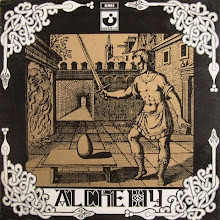
[This is the second part of the TEB day-by-day chronology [for the first part, related to the period 1966-1971 go to http://ghettoraga.blogspot.com/2010/02/after-attempt-to-make-complete-list-of.html]
1972
January
?th – "Macbeth" album realised
Free copies are given by Rolling Stones to the new subscribers. One again the opinions in the press was very good. Deborah Thomas wrote: "Film track music often falls down when you take the film away. But the score painstakingly created for Roman Polanski's disturbing version of Macbeth stands on its own. A baleful, but strangely beautiful interweaving of modern and medieval music by the Third Ear Band".
The reliable "Observer Review" in the "Pop" section expressed enthusiastic opinion as well, concluding: "It's the first 'pop' score for a film can be misleading; it is skilled, farout chamber music, like so much rock today".
The reliable "Observer Review" in the "Pop" section expressed enthusiastic opinion as well, concluding: "It's the first 'pop' score for a film can be misleading; it is skilled, farout chamber music, like so much rock today".


An ad taken from "Melody Maker" published on March 25th, 1972.
“Benefit for U.C.S.”
TEB with Matching Mole, Trees, Keith Christmas and Mike Gibbs.

25th - BBC Studios (London) - Studio T1, Transcription Service, Kensington House, Shepherd's Bush
"John Peel Sessions" radio show: TEB played/recorded "Air" and "I The Key"
"John Peel Sessions" radio show: TEB played/recorded "Air" and "I The Key"
Quite strangely, for the official BBC site (read at http://www.bbc.co.uk/radio1/johnpeel/sessions/1970s/1972/Feb11thirdearband/) the TEB line-up that recorded the session was: Denim Bridges (guitar), Simon House (violin), Mike Marchant (guitar & vocal) and Peter Pavli (bass).
The session would be aired on the next February 11th.
31th – Plaza Theatre (London)


Fergus Cashin wrote on the "Sun":
"It's sexy! It's modern. It's a work of genius. One hell of story!
Polanski gives us a movie to queue for. Not be missed. Better than a
Western. I love it". Another review was written by critic Roger Ebert: read it at
http://rogerebert.suntimes.com/apps/pbcs.dll/article?AID=%2F19710101%2FREVIEWS%2F101010319%2F1023&AID1=%2F19710101%2FREVIEWS%2F101010319%2F1023&AID2=


February

 June
June
TEB with Egg and Edgar Broughton Band
18th – Marquee Club (London)
TEB with Camel
December
January
23th – Arts Theatre (Cambridge)
“Multimedia Mixed Festival”
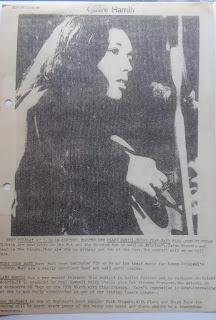 From the UAE student newsletter

?th – "Experiences" is realised by Harvest Records

Come back in London with the project to reform the Third Ear Band, Sweeney met Terry Haxton and Gary Heath (probably through a magazine ad), two musicians who had played in some bands not very successful indeed.
A new line-up is built infact during that year around the founder Sweeney and Minns, with Heath on bass and keyboards, Heath on synthesizer and Mick Carter, a musician known in Kent, on guitar. They rehearsed for some weeks at the Swiss Cottage Pub in London. But even if the new TEB have got some enthusiasm again, no contract is available and the band split again.

Spring-July
4th – Roundhouse Downstairs Theatre (London)


9th – Umbertide (Perugia)


December


12th – Psycho Club (Genova)


March
Enthusiastic reviews: Ugo Bacci on Italian rock magazine "Rockerilla" (July-August issue): “The album is divided into acid sound dissertations, charming and essential, exquisively minimal. They progress in a costant flow which admit “Alchemy” ascendancy; they may be considered the sourest raga in English underground”.


 Mick Carter photographed at the "Psycho Club", Genova January 12th, 1989 (photo by Luca Ferrari).
June
25th – S. Agostino Choister (Bergamo)
Luca Ferrari shows TEB album "Live Ghosts" inside the fifth edition of "Folk Out", a three days of concerts and various events promote by Gigi Bresciani.


July

24th - Borgo Castello (Gorizia)

In another interview of that year (with Brazilian DJ Fabio Massari) he declared that "a music is magic because it doesn't exist, it hasn't a concrete form. So the voice... It's all very subjective, so it's magic".
"Are TEB playing "world music"?" - asked the journalist.
"It's cosmic music! It's music of the universe. It embraces all cultures, we mix all kind of references - Africans, Indians... We play every kind of mixture...".

February

6th – Auditorium Flog (Florence)
TEB with Novalia
That day, just before the gig, Glen Sweeney was invited by Italian avant-garde composer Fabio Capanni (leader of an Italian group called Nazca) to record in a studio in Florence with Amon Duul's founder Chris Karrer. A track, titled "Old Man Kangaroo pt. 2" is recorded. It'll be include later in a Materiali Sonori compilation titled "The Greetings Compact" (read in this archive at http://ghettoraga.blogspot.com/2010/12/another-little-gem-for-tebs-aficionados.html).


 Luca Ferrari and Lyn Dobson at the piano in a recording studio in Florence (February 6th, 1990).
7th – Sgt. Pepper (Genova)
"The concert"

9th – Teatro Municipale (Meda, Venice)
10th – Teatro Petrella (Longiano, Forlì)

August
29th - Sant'Anna Arresi (Carbonia - Sardinia)
"Ai confini tra Sardegna e Jazz"
TEB (Mick Carter and Glen Sweeney) with Sardinia Project (Roger Eno).

December


2005
August
17th - The Royal Star & Garter Home (London)
September
http://ghettoraga.blogspot.it/2012/09/at-last-heres-wonderful-tremendous-1970.html
http://ghettoraga.blogspot.it/2012/09/teb-french-broadcast-unseen-cuts.html

Read at http://ghettoraga.blogspot.it/2013/12/bad-news-for-christmas-mel-davis.html
 Obscure cellist TEB's founder Brian Meredith (here on a picture taken in 2012) emerged from the Web writing to this Archive!
Read at: http://ghettoraga.blogspot.it/2013/12/finally-also-first-teb-cellist-brian.html
The first part of a planned two-parts exclusive interview is pubblished in this Archive here
After that he disappeared another time...
Original TEB guitarist Denim Bridges talks about it here
September
English Gonzo Multimedia published "New Forecasts from the Third Ear Almanac", the official reissue of the old rare live cassette recorded in Sarzana in January 1989. The record was edited by Luca Ferrari who wrote the booklet with the story of these concert.


March
http://rogerebert.suntimes.com/apps/pbcs.dll/article?AID=%2F19710101%2FREVIEWS%2F101010319%2F1023&AID1=%2F19710101%2FREVIEWS%2F101010319%2F1023&AID2=

Hugh Hefner (second right) joins (from left) Francesca Annis, Roman
Polanski, Irene Tsu and Barbara Benton at the premiere of their 1971
film MacBeth (Photograph: Everett Collection/Rex Feature).

Japanese film flyer published in 1972.
Other interesting stuff at http://www.bibliotecapgnegro.unipr.it/help-desk/macbeth/Macbeth_index.html and at http://www.tcm.com/tcmdb/title/3775/The-Tragedy-of-Macbeth/
Technical notes at http://www.michaeldvd.com.au/reviews/reviews.asp?id=6847
Technical notes at http://www.michaeldvd.com.au/reviews/reviews.asp?id=6847
 | ||||
| Polanski with Princess Anne at the film's premiere (photo by Central Press/Getty Images) |
"The tragedy of Macbeth" original trailer (UK 1971)

Original Italian poster of the film.
February
5th – Essex University (Colchester)

Around this period Paul Buckmaster quit the band. As to Paul Minns, by then famous musician and arranger thought the music played by the band in that period was really bad and just compromising for its own artistic reputation.
Sweeney, tactfully, to Roy Hollingworth ("Melody Maker", 1972): "Well, it was always a strange thing with Buck. He sort of drifted into the band, and I could never work out whether he was really with us or not. I remember we were travelling on the continent at one time, and Buck was sat writing music. It was "Space Oddity" - and suddenly Buck was famous. He drifdted away, and we struggled on with Ursula Smith on cello. Then I met Buck again - he was famous by then - and before I knew it, he was back in the band. But during the period with Macbeth, I had to tell him that we wanted him permanently, or not at all. We all know how pressured he is. Infact, during Macbeth, he should never have been working at all".
Benefit concert in aid for striking miners withTEB, Mick Abrahams Band, Lol Coxill etc.
12th - Town Hall (Birmingham)
 15th – Colston Hall (Bristol)
12th - Town Hall (Birmingham)

Italian VHS edition of the film.
Around this period Paul Buckmaster quit the band. As to Paul Minns, by then famous musician and arranger thought the music played by the band in that period was really bad and just compromising for its own artistic reputation.
Sweeney, tactfully, to Roy Hollingworth ("Melody Maker", 1972): "Well, it was always a strange thing with Buck. He sort of drifted into the band, and I could never work out whether he was really with us or not. I remember we were travelling on the continent at one time, and Buck was sat writing music. It was "Space Oddity" - and suddenly Buck was famous. He drifdted away, and we struggled on with Ursula Smith on cello. Then I met Buck again - he was famous by then - and before I knew it, he was back in the band. But during the period with Macbeth, I had to tell him that we wanted him permanently, or not at all. We all know how pressured he is. Infact, during Macbeth, he should never have been working at all".

The English VHS edition of "Macbeth" (1971).
March
1st - Chelsea College (London)
3rd - Seymour Hall (London)
"Fun 'an Games"
TEB with MC5, Pink Faires and Magic Michael

3rd - Seymour Hall (London)
"Fun 'an Games"
TEB with MC5, Pink Faires and Magic Michael

16th - Kingston Polythechnic
18th - Sweeney announced to "Melody Maker" a new line-up
"Drummond" radio show
18th - Sweeney announced to "Melody Maker" a new line-up
A new TEB line-up is announced to the press: besides Sweeney and Minns, also Simon House on violin and VCS3, Peter Pauli (ex High Tide) on bass and Mike Marchant on guitar an voice. Interviewed by Roy Hollingworth for "Melody Maker", Sweeney explained the great changes in band's music: "I think us changing in a natural way - and not just for the sake of it - is far more rewarding. I know we will be far more rational band - giving out something which everyone can enjoy. After three months of rehearsing we are now capable of playing a varied menu for more than two hours. You wouldn't have got more 45 minutes a year ago".
21th - BBC Studios (London) "Drummond" radio show
TEB played "Groan's Dance", "Fleance's Song", "Hierophant".
 |
| The TEB's appearance on "Macbeth". |
Around this period E.M.I.-Harvest terminates the contract with TEB.
 |
| A wonderful promo poster of Harvest (circa 1970). |
April
20th - "IT" vol. 1 n. 128
"International Times" announced: "A group temporarily without a recording contract - Third Ear Band. It seems that EMI's "progressive underground label" (or its overlords) doesn't see fit to employ "pot smokers" amongst its roster of artistes. Dear me, we don't want people like Syd Barrett to be influenced in any way, do we?"

22th - Disc & Music Echo

A new ad taken from "Melody Maker" published on April 22th, 1972.
22th - Disc & Music Echo
A short interview with Glen Sweeney about the recording of "Macbeth".
28th - London School of Economics (LSE)
TEB with Camel, Sandy Denny and others.
TEB with Camel, Sandy Denny and others.
May
5th - Bickershaw (UK)"Bickershaw Festival"
Announced by press and the promoters, TEB with Roy Harper, Memphis Slim, Jonathan Kelly. TEB, Royd Harper and Memphis Slim didn't show.

3th - Clitheroe Castle (Clitheroe)
"Clitheroe Festival"
TEB with Trees, Bridget St. John, UFO
(read a report at http://www.ukrockfestivals.com/clitheroe-festival.html)
(read a report at http://www.ukrockfestivals.com/clitheroe-festival.html)
9th – King Cross Cinema (London)
"As a 19 year old immigrant from Baltimore. Glen Sweeney was very nice to me. I met him back stage at the premier of Matching Mole's "Little Red Record". He was the first person to start talking to me. I told him that I had seen Third Ear Band at the Kings Cross Cinema that summer supporting Hawkwind. I remember Third Ear Band played last that night well into the dawn they were magnificent. They were performing material from the recording that released years later entitled "The Magus". I specifically remember the song "Cosmic Wheel" being performed. The vocals in this haunting song were unforgettable".
(Craig Runyon on the Facebook TEB's page, September 2013).
"As a 19 year old immigrant from Baltimore. Glen Sweeney was very nice to me. I met him back stage at the premier of Matching Mole's "Little Red Record". He was the first person to start talking to me. I told him that I had seen Third Ear Band at the Kings Cross Cinema that summer supporting Hawkwind. I remember Third Ear Band played last that night well into the dawn they were magnificent. They were performing material from the recording that released years later entitled "The Magus". I specifically remember the song "Cosmic Wheel" being performed. The vocals in this haunting song were unforgettable".
(Craig Runyon on the Facebook TEB's page, September 2013).
July
1st – Battersea Pavilion (London)
1st – Battersea Pavilion (London)
“War on Want Benefit”
TEB with Steve Tilston, Pete Atkin etc.
TEB with Steve Tilston, Pete Atkin etc.
9th – The Roundhouse (London)
"Implosion" TEB with Egg and Edgar Broughton Band
TEB with Camel
21th –Commonwealth Institute Theatre (London)
"Space Community"
TEB with Canton Trig and Dave Russell

22th – Peter Jenner on "Billboard" magazine about the problems with EMI
Philp Palmer on "Billboard magazine": "Blackhill, the management and production company, has severed his connections with EMI. "There's now no contractual relationship between us", commented Peter Jenner of Blackhill. Blackhill artists have been realised through EMI for nearly four years. "The Third Ear band and Chris Spedding are now free and we owe EMI one more album from Kevin Ayers" claimed Jenner. "Only Roy Harper is still tied to EMI". Blackhill is currently looking for a new production deal although no negotiations heve yet been finalized".
September
September
30th – Battersea Town Hall (London)
TEB with Matumbi Band

 October
11th – Bumpers (London)
TEB with Arthur Brown's Kingdom Dome and Graham Bond among the others.
November
TEB with Matumbi Band


11th – Bumpers (London)
TEB with Arthur Brown's Kingdom Dome and Graham Bond among the others.
November
16th - TEB signes a recording contract with Island Records
Thanks to Blackhill's manager Peter Jenner, who has placed The Sharks to Chris Blackwell, TEB signed a contract with Island Records for a new album, characterized for the first time by right songs composed and played by Marchant, who got inspiration from the Tarot. The agreement scheduled this track-list: "Cosmic Wheel", "I the Key", "Hierophant", "Magus", "New Horizon" and "Tent Dimensional Landscape".
Sweeney to Hollingworth ("Melody Maker", 1972): "Mike has been hanging around the group for some while. We heard the songs, and well, it seemed only natural that he should come in. It's a tremendous jump for us, I mean, we've never done songs before. It's right to say that Thirdies are feeling a little schizofrenic at the moment. I mean, there's that album out from Macbeth, and that's totally avantgarde, and there's us playing songs".
"So what of these songs?" - asked the journalist. "Well, at the start, we teated them in a sort of Velvet Underground, Leonard Cohen type of way. But we became dissatisfied with the limitations of eight bars, an 16 bars. We decided that we really wanted to open out. They certainly aren't pretentious songs, there's no pseudo rubbish about them. There's no Lucy in the Sky with feedback. But they are songs that fit Third Ear".
"They are all based around the Tarot, and they are purely descriptions of the cards, and their meanings. It's meant a lot of work, changing from a purely instrumental band, but it really seems to be working. And people certainly like it".
The album, in spite of all the enthusiastic anticipations, would be "disasterously recorded at Island and rejected" (Paul Minns in 1996).
It's been realised by Angel Air just in 2004 with the title of "The Magus".
Sweeney to Hollingworth ("Melody Maker", 1972): "Mike has been hanging around the group for some while. We heard the songs, and well, it seemed only natural that he should come in. It's a tremendous jump for us, I mean, we've never done songs before. It's right to say that Thirdies are feeling a little schizofrenic at the moment. I mean, there's that album out from Macbeth, and that's totally avantgarde, and there's us playing songs".
"So what of these songs?" - asked the journalist. "Well, at the start, we teated them in a sort of Velvet Underground, Leonard Cohen type of way. But we became dissatisfied with the limitations of eight bars, an 16 bars. We decided that we really wanted to open out. They certainly aren't pretentious songs, there's no pseudo rubbish about them. There's no Lucy in the Sky with feedback. But they are songs that fit Third Ear".
"They are all based around the Tarot, and they are purely descriptions of the cards, and their meanings. It's meant a lot of work, changing from a purely instrumental band, but it really seems to be working. And people certainly like it".
The album, in spite of all the enthusiastic anticipations, would be "disasterously recorded at Island and rejected" (Paul Minns in 1996).
It's been realised by Angel Air just in 2004 with the title of "The Magus".
Later, Sweeney had strong opinions about it: "(...) At the time I was surronded by idiots who were hoping I had a few quid! They dragged me in there - even now that Simon House swears it's a msterpiece - I had this rodie, Ron Cort, whose father was a hire car wallah, rolling in it - Ron really went to town on that album - he got acetates made, he got a single made. It was crap - even I didn't know what I was doing - the singer was terrible, we had vocals. All the songs were based on the tarot, but strangely enough his father [vocalist Mike Marchant's father] was a vicar and all the songs were based on hymns" ("Unhinged", Spring 1990).
17th - Chelmsford Mid-Essex College
17th - Chelmsford Mid-Essex College
December
16th - "Billboard" magazine Vol. 84 n. 51 (page 48)
On "Billboard magazine" an announcement: "March Artists, the agency arms of CBS has secured sole representation of Blackhill artists as Kevin Ayers, Third Ear Band and Roy Harper. The deal was set by Andrew King and Peter Jenner of Blackhill and David Apps of March".
1973
23th – Arts Theatre (Cambridge)
“Multimedia Mixed Festival”
TEB performed after Gentle Giant with this new line-up: Sweeney on drums, Minns on oboe, Simon House on violin, VCS3 and synth, Mike Marchant on guitar and voice and Dave Tomlin on bass and voice.
Sweeney remembered in 1990 that particular period: "That was the pits. I've got this awful thing. Whatever the trip, you must do it to end. Dave said that the band at the time sounded like an used car yard and it probably did. We did it till the end until nobody wanted to know" ("Unhinged", Spring 1990).
During the gigs TEB played also old Fugs' and Edgar Broughton Band's tracks (as like "Out demons Out"...). Sweeney (1990): "We had the whole audiences just split the gig immediately".
Sweeney remembered in 1990 that particular period: "That was the pits. I've got this awful thing. Whatever the trip, you must do it to end. Dave said that the band at the time sounded like an used car yard and it probably did. We did it till the end until nobody wanted to know" ("Unhinged", Spring 1990).
During the gigs TEB played also old Fugs' and Edgar Broughton Band's tracks (as like "Out demons Out"...). Sweeney (1990): "We had the whole audiences just split the gig immediately".
February
28th – Royal Albert Hall (London)
"1972 Film Performance Nominations. Awards Presentation Dinner & Dance"
28th – Royal Albert Hall (London)
"1972 Film Performance Nominations. Awards Presentation Dinner & Dance"
TEB gets the nomination for the "Macbeth" soundtrack. Among the fourth nominations, also Nino Rota with "The Godfather" soundtrack, that will win.
About the film and the TEB's contribution to the music soundtrack, on January 2006 Film Score Monthly Online (http://wordsofnote.wordpress.com/articles/shakespeare-films-tragedies/) wrote: "Superstition has surrounded productions of Macbeth since the 17th century. For instance, if a theater company was financially strapped, it would often announce a production of the popular tragedy in an attempt to boost ticket sales. If times were particularly bad, the play was often not enough to position the finances in the black, and Macbeth became synonymous with a company’s demise. Even today, it is referred to as “the Scottish play,” believed to be a precursor of bad luck to utter the name “Macbeth” inside a theatre. (...) Roman Polanski vehemently denied that his 1971 Macbeth was a personal response to the Manson murders of his wife, Sharon Tate. But the critics didn’t see it that way and the film languished in cinematic wasteland for years. Third Ear Band’s score, however, is a trip. The five-member band was formed in 1968 from an earlier psychedelic group, The Hydrogen Juke-Box. For Macbeth, violin, cello, bass and electric guitar, and synthesizers were added to the group’s foundation of percussion and oboe/recorder. In addition, rock elements enhanced the steady pulse of the hand drums, providing a contemporary complement to the gloomy, mystical aspects of Shakespeare’s story. But not everything in the score is “far out.” The Court Dance contains delightful folk rock, and the song, “Fleance,” is sung to a medieval accompaniment of recorder, guitar and drums.
Theatrical traditions and superstitions don’t often cross over to film, but neither Macbeth was particularly successful at the box office. So maybe there’s something to the superstition after all".
Theatrical traditions and superstitions don’t often cross over to film, but neither Macbeth was particularly successful at the box office. So maybe there’s something to the superstition after all".
April ?
? – University of East Anglia (Norwich)
TEB with Claire Hamill and John St. Field.
TEB with Claire Hamill and John St. Field.

May
18th – BBC Studios (London)
“Pete Drummond’ sequence” radio session with Al Stewart: TEB played "I The Key", "The Magus", "Ten Dimensional Landscape".
19th – Hampstead Town Hall (London)
TEB with Global Trucking Company
TEB with Kevin Coyne
18th – BBC Studios (London)
“Pete Drummond’ sequence” radio session with Al Stewart: TEB played "I The Key", "The Magus", "Ten Dimensional Landscape".
19th – Hampstead Town Hall (London)
TEB with Global Trucking Company
October
26th – Hemel Hempstead Arts Centre (London)TEB with Kevin Coyne
1974
August
24th-25th - London
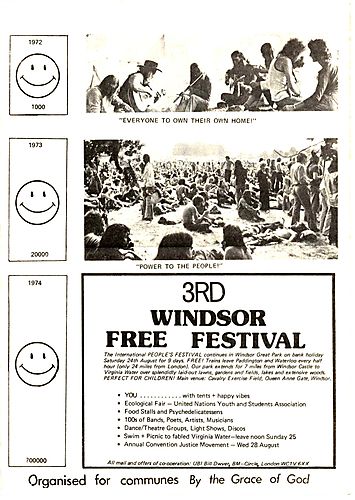
"3rd Windsor Free Festival"
A festival with a lot of bands, among them Hawkind, Pink Faires, Skin Alley.
"3rd Windsor Free Festival"
A festival with a lot of bands, among them Hawkind, Pink Faires, Skin Alley.
Around this time, Blackhill Enterprises quitted the group definitely...
Andrew King reported about the experience (1996): "Blackhill was interested only in Art, TEB was interested in money (and sex and drugs). EMI didn't know what they were interested in, but felt there should be money involved. There weren't really anyone at EMI (except perhaps Malcolm Jones) capable of having a conversation with them. So Blackhill was always the go-between; and really Blackhill had no clear plan as to what we were trying to achieve. Third Ear Band was so divorced from the normal sort of 'act', that it was always difficult to see them as anything more than a sort of strange hobby; despite the fact they sold a lot more records than more conventional bands (e.g. Kevin Ayers)".
Peter Jenner (1996): "Sweeney's approach to the musicwas a mixture of misticism, naivety and opportunism. He was the boss of the band and I can't believe how hardly was to talk with him. He wasn't a great drummer... he was a bullshit... but a great leader of the Third Ear Band".
Read a short interview with Andrew King about the TEB at http://ghettoraga.blogspot.com/2009/12/blackhill-enterprises-manager-and.html
Carolyn Looker (April 2012) has a different opinion about it: "Blackhill never really understood the music, if they had been more supportive TEB made more of film music. I.e. Polanski and Kubrick admiring TEB and involved them more in the arts as in Pink Floyd. Steered the right way the band could have been big".
Once the band definitively break, Glen Sweeney bought an houseboat and lived with Carolyn on a river in Kent.
He remembered in 1990: "Well, it took me three years to recover my brain. We bought this old houseboat down in Kent. There was this flood and it got washed up into a field - I didn't have anything to get it back into the water, so we just stayed there - and the council used to come and photograph it every week to see if it had moved".
Andrew King reported about the experience (1996): "Blackhill was interested only in Art, TEB was interested in money (and sex and drugs). EMI didn't know what they were interested in, but felt there should be money involved. There weren't really anyone at EMI (except perhaps Malcolm Jones) capable of having a conversation with them. So Blackhill was always the go-between; and really Blackhill had no clear plan as to what we were trying to achieve. Third Ear Band was so divorced from the normal sort of 'act', that it was always difficult to see them as anything more than a sort of strange hobby; despite the fact they sold a lot more records than more conventional bands (e.g. Kevin Ayers)".
Peter Jenner (1996): "Sweeney's approach to the musicwas a mixture of misticism, naivety and opportunism. He was the boss of the band and I can't believe how hardly was to talk with him. He wasn't a great drummer... he was a bullshit... but a great leader of the Third Ear Band".
Read a short interview with Andrew King about the TEB at http://ghettoraga.blogspot.com/2009/12/blackhill-enterprises-manager-and.html
Carolyn Looker (April 2012) has a different opinion about it: "Blackhill never really understood the music, if they had been more supportive TEB made more of film music. I.e. Polanski and Kubrick admiring TEB and involved them more in the arts as in Pink Floyd. Steered the right way the band could have been big".
Once the band definitively break, Glen Sweeney bought an houseboat and lived with Carolyn on a river in Kent.
He remembered in 1990: "Well, it took me three years to recover my brain. We bought this old houseboat down in Kent. There was this flood and it got washed up into a field - I didn't have anything to get it back into the water, so we just stayed there - and the council used to come and photograph it every week to see if it had moved".
An anedoct about the boat by Dave Tomlin (January 2012): "Glen was very much drawn to the Alchemical myth. In fact a few years before he died he kept an ex-WWII torpedo-boat on a north London canal. It's name was 'ALCHEMY' he and Carolyn used to roar around the canals in it and everyone had to get out of the way; they were the terror of the waterways. I sometimes visited them on the boat and when Glen died she took the compass from the boat and gave it to me. (This compass came from Glen Sweeney's boat Alchemy) I then passed it on to a friend but I don't think he is possesive about it and I'm sure would easily return it to me, and then... I wondered If you would like to have it. ( If so you could pick it up when next in London. It is too heavy to post)". Read a file about the Glen's compass discovered at: http://ghettoraga.blogspot.it/2012/02/glen-sweeney-s-compass-discovered.html
Carolyn Looker in April 2012: " "We had an idyllic Summer on the boat. Glen was writing poetry, I was painting. Hard work because the mooring wasn't residential we had to collect our water and calor gas about 1/2 mile away. We retired to a friend's flat in the Winter as the river flooded all the time. Infact one huge flood, the Ark, our boat, flooded over into the field and settled there when the floods ended. We lived that way chocked up in the middle of a field for an year. The council complained and at great expense we hired a crane to put us back in the water".
Carolyn Looker in April 2012: " "We had an idyllic Summer on the boat. Glen was writing poetry, I was painting. Hard work because the mooring wasn't residential we had to collect our water and calor gas about 1/2 mile away. We retired to a friend's flat in the Winter as the river flooded all the time. Infact one huge flood, the Ark, our boat, flooded over into the field and settled there when the floods ended. We lived that way chocked up in the middle of a field for an year. The council complained and at great expense we hired a crane to put us back in the water".
1976
May ?th – "Experiences" is realised by Harvest Records
"Fantastic cover!" was the Paul Minns' comment in 1996.
The album, sold at a very special price (just £ 1.99!), was launched in the Harvest Heritage's series with a promo poster (with Kevin Ayers' anthology titled "Odd Ditties"): "A superb compilation album performing The Third Ear Band at their best...".
The album, sold at a very special price (just £ 1.99!), was launched in the Harvest Heritage's series with a promo poster (with Kevin Ayers' anthology titled "Odd Ditties"): "A superb compilation album performing The Third Ear Band at their best...".
The cover was especially designed by chief Druid Lynn Darnton (read some memories on him at http://ghettoraga.blogspot.it/2010/02/lyn-dobson-or-lynn-darnton-david-aragon.html).
Come back in London with the project to reform the Third Ear Band, Sweeney met Terry Haxton and Gary Heath (probably through a magazine ad), two musicians who had played in some bands not very successful indeed.
A new line-up is built infact during that year around the founder Sweeney and Minns, with Heath on bass and keyboards, Heath on synthesizer and Mick Carter, a musician known in Kent, on guitar. They rehearsed for some weeks at the Swiss Cottage Pub in London. But even if the new TEB have got some enthusiasm again, no contract is available and the band split again.

1977
New attempt to reform the band, this time with ex-Magic Muscle Rod Roodway involved. Rod Roodway: "I ended up getting a call from Glen Sweeney. Now my whole attitude was kind of punk at that time but the thought of joining a reformed Third Ear Band was bizarre to say the least. So bizarre, what with my marriage cracking up and all, that I thought "Great, I'll go along with it".
So in the spring of 1977 I started to go to London, go down to Shepherd's Bush and rehearse with The Third Ear Band once a week to start with. Every Saturday we'd go and rehearse and there were tapes; we recorded them ourselves, they weren't studio tapes but they were well recorded Glen Sweeney apparently played one of these tapes to Pete Drummond the Radio One DJ and he wanted us to do an "In Concert" immediately, for the BBC.
I've got a piece here that says "whilst still at rehearsal stages, members have come and gone, but with only the problem of finding a bass player left, the remaining lineup was settled down finally to Glen Sweeney (percussion), Paul Minns (oboe), Mick Carter (guitar and violin) and ex-Magic Muscle guitarist/vocalist Rod Goodway. Musically things have changed dramatically. The extensive use of stringed instruments has been replaced by more inventive use of conventional rock instrumentation. The new material also lends a more attacking quality (“a type of medieval rock'n'roll” is what Glen Sweeney calls it) - a sharp contrast with the calm floating sound of yore. "I thought it was quite good because it had a lot of eastern tinges to it and that kind of is my dream, eastern-flavoured rock or mantra rock That was definitely what The Third Ear Band were into doing in 1977".
Sadly, and I take the full responsibility, my marriage breakup had caused more of an impact than I'd thought and my liver (you know, with the previous problem I'd had) couldn't take the drinking and stuff that I was involved in, and I had a liver failure. So I'm afraid - what with the liver and a mini nervous breakdown - I couldn't continue with The Third Ear Band and wrote many letters to Glen Sweeney and had many kind letters back. We parted amicably but sadly; I'd work with the guy again any day. Great guy".
So in the spring of 1977 I started to go to London, go down to Shepherd's Bush and rehearse with The Third Ear Band once a week to start with. Every Saturday we'd go and rehearse and there were tapes; we recorded them ourselves, they weren't studio tapes but they were well recorded Glen Sweeney apparently played one of these tapes to Pete Drummond the Radio One DJ and he wanted us to do an "In Concert" immediately, for the BBC.
I've got a piece here that says "whilst still at rehearsal stages, members have come and gone, but with only the problem of finding a bass player left, the remaining lineup was settled down finally to Glen Sweeney (percussion), Paul Minns (oboe), Mick Carter (guitar and violin) and ex-Magic Muscle guitarist/vocalist Rod Goodway. Musically things have changed dramatically. The extensive use of stringed instruments has been replaced by more inventive use of conventional rock instrumentation. The new material also lends a more attacking quality (“a type of medieval rock'n'roll” is what Glen Sweeney calls it) - a sharp contrast with the calm floating sound of yore. "I thought it was quite good because it had a lot of eastern tinges to it and that kind of is my dream, eastern-flavoured rock or mantra rock That was definitely what The Third Ear Band were into doing in 1977".
Sadly, and I take the full responsibility, my marriage breakup had caused more of an impact than I'd thought and my liver (you know, with the previous problem I'd had) couldn't take the drinking and stuff that I was involved in, and I had a liver failure. So I'm afraid - what with the liver and a mini nervous breakdown - I couldn't continue with The Third Ear Band and wrote many letters to Glen Sweeney and had many kind letters back. We parted amicably but sadly; I'd work with the guy again any day. Great guy".
 | |
| The "piece here"... David Ilic article published by NME in 1977. |
1978
During the year a new project for the Third Ear Band thought as a pop-rock group involveed Sweeney, Minns and Carter. A lot of rehearsals (mostly in Minn's flat in Sheperd's Bush) but very few concerts.
June
A new TEB line-up played in concert with Sweeney, Minns, Carter and new musicians Marcus Beale (on Fender violin) and Brian Diprose (bass), the latter member of the Ragged Robin and session man for folk artists as Anne Briggs or Steve Ashley.


?th – Norwich University
During that year, after Paul Minns' quit (not interested to invest energies in a pop-rock project) a new TEB line-up with Sweeney, Carter, Diprose and Jim "Gipsy" Hayes (on vocals) played at Norwich University and recorded in Dansette Studios (Kent) the album "Apocaliptic Anthems" with the name The Hydrogen Jukebox [Listen a rare Glen Sweeney's auto-interview at http://ghettoraga.blogspot.com/2010/06/glen-sweeney-interviewed-himself-in.html about the brief story of the Hydrogen Jukebox].
The tracks, once again inspired by Tarots, had been composed by Sweeney during the 'houseboat period'.
 Another shot from the sessions.
The album, remixed by Carter, had been 'forgotten' in his own studio file and realised only later, in 1991, by Italian label Materiali Sonori with a new title, "Prophecies".

The tracks, once again inspired by Tarots, had been composed by Sweeney during the 'houseboat period'.
 |
| The Hydrogen Jukebox (L-R: Diprose, Hayes, Carter, Phil Shaw (recording engineer) and Sweeney). |
 |
| Jim 'Gipsy' Hayes recording his vocals. |

The album, remixed by Carter, had been 'forgotten' in his own studio file and realised only later, in 1991, by Italian label Materiali Sonori with a new title, "Prophecies".

 |
| A cover designed by Glen Sweeney in 1990 for the Hydrogen Jukebox CD edited by Materiali Sonori. |
1979
German underground filmmaker Clemens Klopfenstein used Third Ear Band music for his b/w film "Geschichte der Nacht" (Story of Night).
As journalist Chris Auty ("Programme Note London Film Co-op") writes, "It's a black-and-white record of European cities in the dark (2-5am), from Basle to Belfast. Quiet, and meditative, what ermerges most strongly is an eerie sense of city landscapes as deserted film sets, in which the desolate architecture overwhelms any sense of reality. The only reassurance that we are not in some endless machine-Metropolis is the shadow of daytime activity: a juggernaut plunging through a darkened village, a plague of small birds in the predawn light. The whole thing is underscored by a beautiful 'composed' soundtrack, from quietly humming stretlamps to reggae and the rumble of armoured cars in Belfast. A strange and remarkable combination of dream, documentary and science-fiction".
Watch the intriguing film (about 61 minutes) for free at http://ubu.com/film/klopfenstein_nacht.html
As journalist Chris Auty ("Programme Note London Film Co-op") writes, "It's a black-and-white record of European cities in the dark (2-5am), from Basle to Belfast. Quiet, and meditative, what ermerges most strongly is an eerie sense of city landscapes as deserted film sets, in which the desolate architecture overwhelms any sense of reality. The only reassurance that we are not in some endless machine-Metropolis is the shadow of daytime activity: a juggernaut plunging through a darkened village, a plague of small birds in the predawn light. The whole thing is underscored by a beautiful 'composed' soundtrack, from quietly humming stretlamps to reggae and the rumble of armoured cars in Belfast. A strange and remarkable combination of dream, documentary and science-fiction".
Watch the intriguing film (about 61 minutes) for free at http://ubu.com/film/klopfenstein_nacht.html
 |
| Clemens Klopfenstein. |
1984
"The Harvest Story vol. 1. Art School Dancing" anthology realised by Harvest Records with "Druid One" from "Alchemy".
1987
July
Luca Ferrari, during some researches on Syd Barrett, interviewed Peter Jenner and got Glen Sweeney's address. He met the drummer & his wife Carolyn Looker at their home in Sheperd's Bush (London) and tried to convince him to reform the TEB.
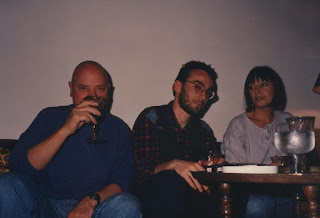
 |
| Glen Sweeney, Luca Ferrari and Carolyn Looker just that day of July 1987. |

 |
Glen, Luca and Elena (Luca's wife) photographed by Carolyn. |
1988
Summer
After months of hesitations and suspects ("Glen suspicious of you? I think he was suspicious of most people's intentions till proved otherwise!", stated Carolyn Looker in April 2012), Sweeney agreed to reform the band. During that Summer, Sweeney (han drums), Mick Carter (electric guitar and effects), Paul Minns (oboe) and Samuel Allen (a young violinist with academic career and Dave Tomlin's pupil) rehearsed some new tracks at the squatted Cambodian Embassy of London (read in this blog at http://ghettoraga.blogspot.com/2010/02/third-ear-band-rehearsaled-at-occupied.html).
From this sessions is been realised in 1993 "Necromanticus", a bonus track for the new edition of the CD "Live Ghosts". In the meantime "The Ear Management", a sort of agency witht the aim to organize band's concerts, especially in Italy, is made up. They pressed promotional t-shirts with the TEB concert playbill at Purcell Room in 1970.


From this sessions is been realised in 1993 "Necromanticus", a bonus track for the new edition of the CD "Live Ghosts". In the meantime "The Ear Management", a sort of agency witht the aim to organize band's concerts, especially in Italy, is made up. They pressed promotional t-shirts with the TEB concert playbill at Purcell Room in 1970.
 |
| The original card of The Ear Management. |
September
"The Peanuts tour"
The short tour, so called by Sweeney because the scarce moneys gotten, was organized by The Ear Management (Luca Ferrari) with the enterprising Gigi Bresciani's Music On agency.
8th – Chiostro di S. Agostino (Bergamo)The short tour, so called by Sweeney because the scarce moneys gotten, was organized by The Ear Management (Luca Ferrari) with the enterprising Gigi Bresciani's Music On agency.
Third Ear Band played with Sweeney, Carter, Minns and Allen.
.jpg) |
| Glen Sweeney photographed by Elena Blasi in Gandino (BG) on September 7th, 1988. |
TEB with Zsaratnok and Whippersnapper
The complete concert is been realised by Materiali Sonori in 1989 with the title "Live Ghosts". Also an home video of the gig does exist...

The complete concert is been realised by Materiali Sonori in 1989 with the title "Live Ghosts". Also an home video of the gig does exist...


 |
Original handmade flyer for the concert. |
 |
| Alternative poster |
9th – Umbertide (Perugia)
"Rockin’ Umbria” festival with TEB, Novalia and Peter Principle
Sweeney (1990): "I received a letter from Luca offering me a gig at Rockin' Umbria, a big rock event in Italy. He was very shrewd, he said £ 250 each and put me on the road, right? I was out there. It ended up at about £ 50 each, but it put me back in the picture.

 |
| Allen Samuel (photo by Elena Blasi). |
 | |||
TEB on stage at Umbertide: (L-R) Samuel, Carter, Minns and Sweeney (photo by Elena Blasi). |
 |
| Minns and Sweeney just before the concert (photo by Elena Blasi). |
 |
| Sweeney protographed by Elena Blasi. |
 |
| The late Brian (the tour driverman), Sweeney, Allen and Ferrari relaxing in Umbertide. |
December
A second Italian tour with four gigs (Gorizia, Bergamo, Genova and Viterbo), managed by The Ear Management, is cancelled owing to Sweeney’s unexpected personal problems.


During November the band had reharsaled at the Cambodian Embassy (read in this Archive at http://ghettoraga.blogspot.com/2010/02/third-ear-band-rehearsaled-at-occupied.html).

 |
| Promo ad for the cancelled gig in Genova. |
 |
| Flyer for the cancelled DIA Club (Bergamo) concert. |

During November the band had reharsaled at the Cambodian Embassy (read in this Archive at http://ghettoraga.blogspot.com/2010/02/third-ear-band-rehearsaled-at-occupied.html).
 |
| The band at the Cambodian Embassy (photo by Carolyn Looker). |

 |
| Glen Sweeney playing tablas at the Embassy (photo: Carolyn Looker). |
1989
The “Bad news, baby!” tour
Three concerts, once again organized by The Ear Management and Music On agency, have played by a new line-up with, besides Sweeney and Carter, Lyn Dobson (flute and saxes) and Ursula Smith (violin).
Three concerts, once again organized by The Ear Management and Music On agency, have played by a new line-up with, besides Sweeney and Carter, Lyn Dobson (flute and saxes) and Ursula Smith (violin).
January
11th – Teatro Impavidi (Sarzana, La Spezia)
11th – Teatro Impavidi (Sarzana, La Spezia)

The complete
recording of the concert has been released by Milan’s avant-garde label
A.D.N. on cassette only with the title “New Forecasts from the Third Ear
Almanac” (read at http://ghettoraga.blogspot.com/2009/12/new-forecasts-from-third-ear-almanac.html).


 |
| ADN promo for "New Forecasts" (January 1990). |
Thanks to TEB Italian fan Mirco Delfino, the concert is available (in a rough recording) at:
https://soundcloud.com/mirco-delfino/teb-ge-2 (part one)
https://soundcloud.com/mirco-delfino/teb-ge-1 (parte two)

https://soundcloud.com/mirco-delfino/teb-ge-2 (part one)
https://soundcloud.com/mirco-delfino/teb-ge-1 (parte two)

 |
| Sweeney and Carter on stage at Psyco Club (photo by Luca Ferrari). |
 |
| Lyn Dobson and Ursula Smith playing on stage (photo by Luca Ferrari). |
 |
| Ursula Smith and Lyn Dobson rehearsaling before the concert (photo by Luca Ferrari). |
13th – Sala Piatti (Bergamo)
TEB with Martin Carthy and John Kirkpatrick

 |
| The line-up of this tour: (L-R) Sweeney, Dobson, Smith, Carter (photo by Gigi Bresciani). |
14th
– Circolo Tuxedo (Piacenza)
This was a day-off gig, just before the band went back to England. Just 50 people in the audience for a very good performance now available at www.dimeadozen.org - a Torrent forum. The band played "Druid", "Hyde Park Raga", "Egyptian Book of the Dead" and "Spirits". Very particular the encore, Dave Tomlin's "Lark Rise" (from "Alchemy"), represented by Sweeney as "the legendary Dave Tomlin"...
Also an home video recording of the gig does exist...

March
“Live Ghosts” is realized by Materiali Sonori on LP, cassette and CD format.


Enthusiastic reviews: Ugo Bacci on Italian rock magazine "Rockerilla" (July-August issue): “The album is divided into acid sound dissertations, charming and essential, exquisively minimal. They progress in a costant flow which admit “Alchemy” ascendancy; they may be considered the sourest raga in English underground”.
Really surprised by how “a simple instrumentation could be the basis for such intensive and fascinating music”, Alan Freeman writes: “”Live Ghosts” (…) features just four tracks, these are lengthy hypnotic rhythmic works, with simple yet intense rhythms (on hand drums), varied use of guitar (picking, strumming, droning) topped off by carefully crafted entwining solos from oboe and violin. The ritualist intensity that grows out of the music is totally engrossing and exceptionally stimulating” ("Audion" #13, November 1989). Edwin Pouncey ("New Musical Express", August 19th): “New Age fans could do worse than dip into this smokey swamp of drifting sound. No dreamy, blue sky gazing anthems here though, instead expect storm clouds, ectoplasmic mirage and as near to an out of the body experience you'll get from listening to a mere LP. Let there ghosts haunt your house soon".
"Live Ghost" is moreover reviewed with exciting tones in France by the well known jazz critic Philippe Renaud ("Revue Notes" n. 34, August) and Sawada in Japan as well ("Marquee" n. 32, July).
"Live Ghost" is moreover reviewed with exciting tones in France by the well known jazz critic Philippe Renaud ("Revue Notes" n. 34, August) and Sawada in Japan as well ("Marquee" n. 32, July).

March-May
The band, in the same line-up of the tour (Sweeney, Carter, Dobson and Smith), came into Alchemical Studios (Kent) to record the new album announced as "Magic". A demo tape of that sessions is recorded (read at http://ghettoraga.blogspot.com/2010/11/feeding-starving-magic-never-realised.html).

June
25th – S. Agostino Choister (Bergamo)
Luca Ferrari shows TEB album "Live Ghosts" inside the fifth edition of "Folk Out", a three days of concerts and various events promote by Gigi Bresciani.


July
8th – Vinci (Florence)
TEB with Novalia and Nazca
Due to her job as a teacher in the school, Ursula couldn't stay in the band. Allen Samuel came back replacing her in the line-up.
That July 2nd, in a sunny morning, first (and last) photo session of the new TEB managed by Materiali Sonori with photographer Lucia Baldini. Read and watch the pictures at http://ghettoraga.blogspot.com/2010/02/third-ear-band-last-photo-session-vinci.html
Due to her job as a teacher in the school, Ursula couldn't stay in the band. Allen Samuel came back replacing her in the line-up.
That July 2nd, in a sunny morning, first (and last) photo session of the new TEB managed by Materiali Sonori with photographer Lucia Baldini. Read and watch the pictures at http://ghettoraga.blogspot.com/2010/02/third-ear-band-last-photo-session-vinci.html
 |
| The original postcard realised by Materiali Sonori for the event. |
 |
| TEB photographed by Lucia Baldini at Da Vinci's museum. |
 The poster printed for the two-days concert. |
October
Neil Black, a young violinist with experiences with UB40, Joan Armatrading and John Porter, joined the band replacing Samuel Allen. The new TEB recorded some rehearsals in London then titled "Necromancer Suite", where the new album tracks previously recorded with Ursula Smith were resumed.
 |
| Promotional photo of John Porter and Neil Black (on right), circa 1989. |
November
TEB went into Alchemical Studios to record the new album with the final title of "Magic Music".
 |
| Carter and Black recording "Magic Music" at the Alchemical Studios (Kent). |

 |
| The pre-released review of "Magic" published by "Rockerilla" on November 1989. |
24th - Borgo Castello (Gorizia)
"Aria, terra, fuoco, acqua..."
Piero Bielli wrote on the event ("Auditorium" n. 4, 1990): "It's a total music which involves the listener's spirit in order to subdue and lead him in a sort of Nirvana; Glen, old elf with devilish eyes, would enchant the hardest viewer. "The Book of the Dead", another fantastic piece, has ended the gig with an anguish crescendo, so that the frailest minds feel confused as after a peyotl".
Piero Bielli wrote on the event ("Auditorium" n. 4, 1990): "It's a total music which involves the listener's spirit in order to subdue and lead him in a sort of Nirvana; Glen, old elf with devilish eyes, would enchant the hardest viewer. "The Book of the Dead", another fantastic piece, has ended the gig with an anguish crescendo, so that the frailest minds feel confused as after a peyotl".
The concert will be published later on two different CDs ("Live", in 1996, and "Hymn to the Sphynx", in 2005). About the event read in this archive at http://ghettoraga.blogspot.com/2010/12/live-ghosts-at-all-frontiers-beautiful.html
.jpg) " Il Messaggero del Veneto", November 24th, 1989.
" Il Messaggero del Veneto", November 24th, 1989.
25th - Sala Piatti (Bergamo)
 |
| The band on stage: (L-R) Dobson, Carter, Sweeney and Black. |
25th - Sala Piatti (Bergamo)
In the afternoon the band met the students of Centro Didattico Produzione Musica [Music Production Educational Centre] at a stage on "Research, technique and electroacoustic music instruments".
Ugo Bacci wrote in the local newspaper "L'Eco di Bergamo" (November 27th): "Sweeney, as in the past, looks on music with hieratic attention beating with the same regular times. He has got a sort of magnetic fluid which goes beyond technique and virtuosity. THe music of Third Ear Band is not a music that tends to a formal beauty, but a deep whirpool made of intensity and tension. The electric guitar as a cello, Ursula Smith's violin, the saxophone of an old character born from Lindsey Kemp's imagination: all this makes a mysterious music which is permanent fluid and rhythm".


December
15th - "Sir George Robey" pub (London)
Read about this concert in this archive at http://ghettoraga.blogspot.com/2009/12/tebs-tape-recordings-at-london-british.html
and download the full concert at http://ghettoraga.blogspot.it/2013/06/tebs-1989-concert-at-london-club-dog.html

and download the full concert at http://ghettoraga.blogspot.it/2013/06/tebs-1989-concert-at-london-club-dog.html

1990
January
"Magic Music", recorded by Sweeney, Carter, Black and Dobson, is released by Materiali Sonori on LP and CD format.
Sweeney talked about it to Italian magazine Auditorium: "It will be a collection of magic sounds, coloured by an antique Indian patina; with the electronic games of Mick Carter's guitar, Neil Black's soprano sax and flute and Glen Sweeney's alchemical percussion. Take a walkman, tune in and drop out with the magic music".
In another interview of that year (with Brazilian DJ Fabio Massari) he declared that "a music is magic because it doesn't exist, it hasn't a concrete form. So the voice... It's all very subjective, so it's magic".
"Are TEB playing "world music"?" - asked the journalist.
"It's cosmic music! It's music of the universe. It embraces all cultures, we mix all kind of references - Africans, Indians... We play every kind of mixture...".
 |
| Brouchure realised by Materiali Sonori for promoting the new album. |
A new tour, organized by Materiali Sonori with the cooperation of The Ear Management to promote the new album, is played by Sweeney, Carter, Dobson and Black.
3rd – Teatro Vespasiano (Rieti)

 |
| TEB technical equipment managed by Materiali Sonori for the tour. |
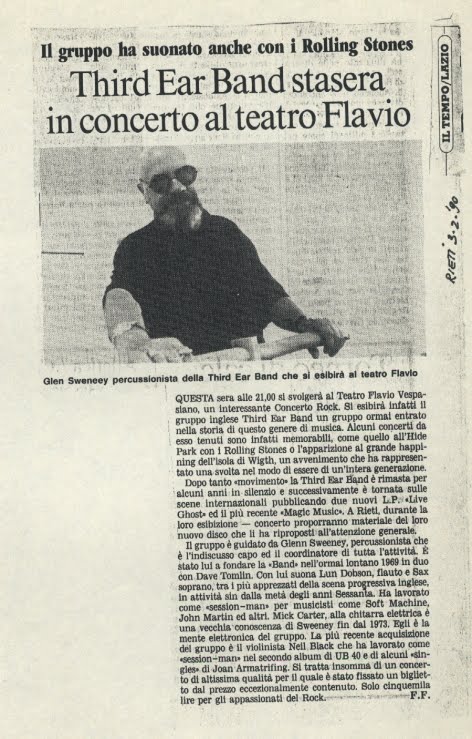
4th – Il Classico (Roma)
Aldo Lastella, on the Italian national newspaper "La Repubblica", ended a good article titled "Oriental scient" where he emphasized the novelty of the musical proposal of the band: "Nowadays it's electronics which supplies the sound carpet to the evolution of the wind instruments and to the overcoming tabla. And Mick Carter's versatile guitar and Neil Black's electronic violin change a piece twenty years old, like Egyptian Book, into a sort of bridge between yesterday and today, always witht the same desire to be free, without any compromise".
 | |
Aldo Lastella's article published by "La Repubblica" on February 6th, 1990.  |
5th – Prego Club (Milan)
The gig, broadcasted live on Italian radio programme "RAI Stereonotte" was compromised by technical problems on the PA system. A nervous Dobson quitted the stage while other band's members went on trio with no amplifiers.

.jpg) |
| "La Repubblica - Tutto Milano", February 1st, 1990. |
6th – Auditorium Flog (Florence)
TEB with Novalia
That day, just before the gig, Glen Sweeney was invited by Italian avant-garde composer Fabio Capanni (leader of an Italian group called Nazca) to record in a studio in Florence with Amon Duul's founder Chris Karrer. A track, titled "Old Man Kangaroo pt. 2" is recorded. It'll be include later in a Materiali Sonori compilation titled "The Greetings Compact" (read in this archive at http://ghettoraga.blogspot.com/2010/12/another-little-gem-for-tebs-aficionados.html).

"The concert"

 |
The programme of the club..jpg) |
10th – Teatro Petrella (Longiano, Forlì)
"Il terzo occhio" - Musica per la scena.
 |
| The original concert programme. |
 |
| Mick Carter, Neil Black and Luca Ferrari on the scene at Longiano. |
Spring
"Unhinged" Glen Sweeney interview
Interviewed by Nigel Cross for the English fanzine "Unhinged", it's one of the best and deep interview of the press with Glen Sweeney. Read it at http://ghettoraga.blogspot.com/2010/09/return-of-acid-prankster-glen-sweeney.html

May
12th - Dog Club (London)
August
26th - Isle of Wight Festival |
| Glen Sweeney and Pete Brown that dat at the Isle of Wight |
 |
| Glen in his Sheperd's Bush flat on August 1990. |
September
Glen wrote me a letter announcing the idea to reform The Giant Sun Trolley (!!!) for a new record: "(...) I have a new musical event, it will be the return of the Gaint Sun Tolley with the star Dave Tomlin on genar (a musical instrument invented by Dave), I will play drums and Mick will play guitar and effects. Mick will record an LP of this music on digital DAT tape, we will then send you some copies to send to record companies. If we are succesfull you can get us some dates to promote the LP. I will be busy getting all the promo and photos together for the start, which will take about six months, so we will be ready in March...".
1991
March
Nothing happened about the new Giant Sun Trolley, the group by Sweeney's will became Elektric Third Ear Band and went into Alchemical Studios to record a new album.
Barry Pilcher, Sweeney's old friend since The Hydrogen Jukebox, replaced Lyn Dobson on the sax. A track from that sessions, titled "Raga of the Wind" is been included by Materiali Sonori ont the CD "Sonora - The compact", given free with magazine "Sonora" (issue 2, 1991): read and download the track at http://ghettoraga.blogspot.com/2010/11/elektric-third-ear-band-raga-of-wind.html
Another one, "Song of Gaia", will remain unrealised.
In the meantime, owing to some disagreements with the band regarding the relationship with the record label, The Ear Management winded up.
Barry Pilcher, Sweeney's old friend since The Hydrogen Jukebox, replaced Lyn Dobson on the sax. A track from that sessions, titled "Raga of the Wind" is been included by Materiali Sonori ont the CD "Sonora - The compact", given free with magazine "Sonora" (issue 2, 1991): read and download the track at http://ghettoraga.blogspot.com/2010/11/elektric-third-ear-band-raga-of-wind.html
Another one, "Song of Gaia", will remain unrealised.
 |
| A poor poster designed by Sweeney about the project of the Elektric TEB. |
 |
| Pilcher posing with Glen in his flat at Sheperd's Bush. |
April
12th - Dog Club (London)
This concert, as the following one, was held by the Elektric TEB with Barry Pilcher on sax.
12th - Dog Club (London)
This concert, as the following one, was held by the Elektric TEB with Barry Pilcher on sax.
May
12th - Il Posto (Verona)
A concert managed by Gigi Bresciani's "Music On" agency.

12th - Il Posto (Verona)
A concert managed by Gigi Bresciani's "Music On" agency.

 |
| A postcard from Cappadocia by Paul Minns and his wife Kathryn... |
August
29th - Sant'Anna Arresi (Carbonia - Sardinia)
"Ai confini tra Sardegna e Jazz"
TEB (Mick Carter and Glen Sweeney) with Sardinia Project (Roger Eno).

September
5th - Naples
Lyn Dobson got back on the TEB line-up replacing Pilcher.
December
28th - Rome
April
A new Italian mini-tour is organized by Gigi Bresciani's Music on. TEB line-up was Sweeney, Carter, Dobson and Black.
11th - Mantova
12th - Folk Club "Gli Zanni" (Ranica, Bergamo)
5th - Naples
Lyn Dobson got back on the TEB line-up replacing Pilcher.
December
28th - Rome
 |
| 1991 Materiali Sonori promo ad. |
1992
A new Italian mini-tour is organized by Gigi Bresciani's Music on. TEB line-up was Sweeney, Carter, Dobson and Black.
Glen tries to involve Luca Ferrari in a new adventure, but Luca is not interested anymore in managing the group. On a postcard sent to him, Glen writes: "Dear Luca, sorry to hear you are an idealist, because playing great music means having a great band and that costs money. My job is getting work for the band and selling records, so that more and more people get to hear the band, which makes me an idealist with experience! Anyway, come and hear the band in Bergamo, first week in April. I will bring you a Jukebocx CD. Love and peace, Glen".
 |
| Luca, you're an idealist! |
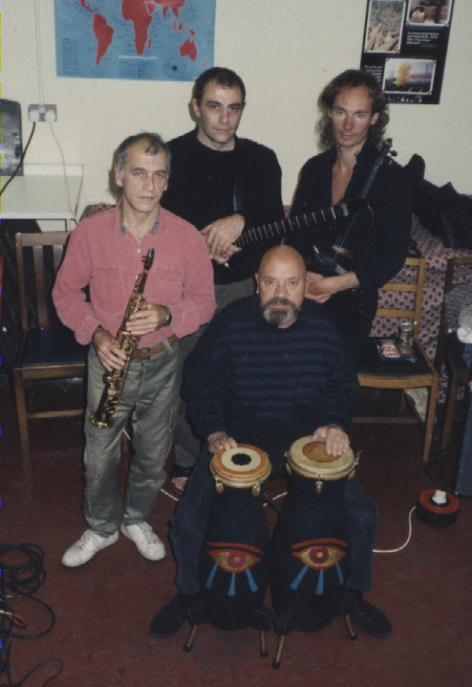 |
| The last TEB line-up! |
12th - Folk Club "Gli Zanni" (Ranica, Bergamo)
"Magiche alchimie" (Magic Alchemy)
With an audience of about fifty persons (!), at this tiny club it'll be remembered as the last ever TEB concert!

During that year TEB came back in the studio to record a new album, being not satisfied with the results of the year before. Lyn Dobson returned definitely in the band on wind instruments and vocals (for the first time in the TEB history two vocal tracks was recorded!) replacing Barry Pilcher. An instrumental track, recorded with Pilcher ("Song of Gaia") was put aside to remain unrealised.
With an audience of about fifty persons (!), at this tiny club it'll be remembered as the last ever TEB concert!
During that year TEB came back in the studio to record a new album, being not satisfied with the results of the year before. Lyn Dobson returned definitely in the band on wind instruments and vocals (for the first time in the TEB history two vocal tracks was recorded!) replacing Barry Pilcher. An instrumental track, recorded with Pilcher ("Song of Gaia") was put aside to remain unrealised.
July
Glen and Carolyn went to holidays in Greece.

Glen and Carolyn went to holidays in Greece.

 |
| Glen's postcard sent to Luca Ferrari from Greece. |
December
Around Christmas, Glen Sweeney had a strong heart-attack and he's recovered at the hospital for some weeks.
1993
In the meanwhile, at the beginning of the year, "Brain Waves" was realised by Materiali Sonori. 
TEB last line-up (from the booklet of "Brain Waves", Materiali Sonori 1993 - photo by Lucia Baldini).
March
Glen Sweeney sends a little message to Luca Ferrari, announcing to stop live concerts and the intention to write a novel based on TEB's story.March

 |
Glen in Richmond (London), just after the first heart-attack (March 1994). |
A bitter balance about the experience witht he TEB by violin player Allen Samuel in 2013 at http://ghettoraga.blogspot.it/2013/02/a-valuable-lesson-but-not-one-that-i.html
1996
Italian home publishing Stampa Alternativa realised Luca Ferrari's book on the Third Ear Band titled "Necromancers of the drifting West", written with the direct contribution of band's members (copies is available at http://www.stampalternativa.it/libri/322-0/luca-ferrari/third-ear-band.html).
In the book is included, for the first time, a CD with the unrealised music of "Abelard & Heloise" soundtrack.
"The recording quality of original recording of "Abelard and Heloise", wrote me Richard Coff in 2008, "was not great"... It suffer, too, from poor production (mix and editing) and, because they are not in multi-track format, there is little or nothing that can be done to mine any musical gold that may be hidden with. The transfer to the master you made appears to be as good as can be expected".

In the book is included, for the first time, a CD with the unrealised music of "Abelard & Heloise" soundtrack.
"The recording quality of original recording of "Abelard and Heloise", wrote me Richard Coff in 2008, "was not great"... It suffer, too, from poor production (mix and editing) and, because they are not in multi-track format, there is little or nothing that can be done to mine any musical gold that may be hidden with. The transfer to the master you made appears to be as good as can be expected".
1997
Paul Minns, come back to live in Scotland after the last TEB reunion, committed suicide. Popular music lost one of the best oboe players ever...
 |
| Paul Minns rehearsing at the Cambodian Embassy (London, Summer 1988). |
 |
| Another portrait of the great Paul in 1988 (photo: Carolyn Looker). |
1999
November
A very good retrspective on the band by Alan Freeman on "Audion" magazine.


2000
October
During that year Carolyn Looker, Glen Sweeney's wife, painted a work inspired by the history of her and Glen, intended as a cover for a tribute CD projected by Luca Ferrari.
Titled "The Dragon Wakes", the album was compiled with unrealised studio and radio tracks from Luca's private archive.
Read a reconstruction of the story of this project - never realised - at http://ghettoraga.blogspot.com/2009/12/on-october-2000-just-after-paul-minns.html
Titled "The Dragon Wakes", the album was compiled with unrealised studio and radio tracks from Luca's private archive.
Read a reconstruction of the story of this project - never realised - at http://ghettoraga.blogspot.com/2009/12/on-october-2000-just-after-paul-minns.html
 |
| The beautiful painting made by Carolyn Looker. |
2004
Quite surprising, the legendary fourth 'lost' album recorded in 1972 riemerged from the vaults thanks to (the late) sound engineer Ron Cort, published by Angel Air as "The Magus".
2005
17th - The Royal Star & Garter Home (London)
After some strong heart-attacks (the first was on December 1992) and a long sojourn at The Royal Star & Garter Home (a residential hospital in Richmond, London, where he was recovered from Spring 1999), Glen Sweeney died "peacefully" (in his wife Carolyn's words).
"(...) It was a beautiful ceremony rather than a conventional funeral, Steve Pank read from the "Egyptian Book of the Dead" and tracks from "Alchemy" were played, incense was burning, Glen was in a raffia coffin with sunflowers on top. Everyone said what a wonderful experience it was and some were reminded of being at an early Third Ear Band concert. I'm sure Glen would have approved" (from a postcard sent by Carolyn Looker to Luca Ferrari on September 3rd, 2005).
"(...) It was a beautiful ceremony rather than a conventional funeral, Steve Pank read from the "Egyptian Book of the Dead" and tracks from "Alchemy" were played, incense was burning, Glen was in a raffia coffin with sunflowers on top. Everyone said what a wonderful experience it was and some were reminded of being at an early Third Ear Band concert. I'm sure Glen would have approved" (from a postcard sent by Carolyn Looker to Luca Ferrari on September 3rd, 2005).
 |
| A nice portrait of Glen Sweeney in 1989 (photo by Carolyn Looker). |
 |
| A tribute to Glen Sweeney written by Steve Pank (December 2005). |
 |
| Glen drinking wine just before the Umbertide concert, on September 9th, 1988 (photo by Elena Blasi). |
In the same year also Roger Bunn, former musician of the Giant Sun Trolley passed away. Read a brief article at http://ghettoraga.blogspot.it/2009/12/roger-bunns-role-in-giant-sun-trolley.html and watch a 2004 video with him at http://www.youtube.com/watch?v=VOgzb6Ym84Q
2007
2009
November
13th - Guitarist Mike Marchant passed away.
Read in this archive at http://ghettoraga.blogspot.it/2010/01/mike-marchant-rip.html

April
Original viola player Ben Cartland died. He was living in the Northamptonshire where he used to play avantguarde music with the Northamptonshire Composers Association. It seems he was writing a book with his memories...(read at http://ghettoraga.blogspot.it/2010/01/teb-viola-player-ben-cartland-died-on.html).
2009
November
13th - Guitarist Mike Marchant passed away.
Read in this archive at http://ghettoraga.blogspot.it/2010/01/mike-marchant-rip.html
2011
October
3rd - DVD with rare TEB television appearances realised.
English Gonzo Multimedia realised a TEB DVD titled "The Lost Broadcasts" with TV video from 1970 (German programme "Beat Club").
Read a review in this archive at http://ghettoraga.blogspot.it/2011/11/lost-broadcasts-dvd-review.html

English Gonzo Multimedia realised a TEB DVD titled "The Lost Broadcasts" with TV video from 1970 (German programme "Beat Club").
Read a review in this archive at http://ghettoraga.blogspot.it/2011/11/lost-broadcasts-dvd-review.html
2012
January
From the miracles of YouTube emerged a very rare unknown short clip of the band playing at Hyde Park on June 7th, 1969 (the so-called "Blind Faith concert"):
September
Another unexpected miracle! On INAfr (the Web site of French television) at http://www.ina.fr/ a rare 27:00 TEB broadcast is available, recorded on May 25th, 1970 at the Olympia Theatre of Paris. Two tracks ("Hyde Park Raga" and "Mosaic" (or "Dog Evil") played by the legendary quartet with Sweeney, Minns, Smith and Coff.
The story of this incredible retrival is reported at the pages:
http://ghettoraga.blogspot.it/2012/09/a-new-sensational-retrieval-second-part.htmlhttp://ghettoraga.blogspot.it/2012/09/at-last-heres-wonderful-tremendous-1970.html
http://ghettoraga.blogspot.it/2012/09/teb-french-broadcast-unseen-cuts.html

2013
November
Pianist/multistrumentist Mel Davis (who played on"Alchemy") passed away.Read at http://ghettoraga.blogspot.it/2013/12/bad-news-for-christmas-mel-davis.html
Lyn Dobson about him: "I can say first that Mel was an exceptionally warm, empathetic and caring person,who almost single handed, started the Free Music movement in the entire world (including the United States!). He also pioneered the self sufficiency movement in England. I first met him in Luton in my early twenties at Art college, where we played with a young Graham Collier, before all moving to London...".
December  |
| The funeral lament played by musicians friend of Davis. |

Read at: http://ghettoraga.blogspot.it/2013/12/finally-also-first-teb-cellist-brian.html
The first part of a planned two-parts exclusive interview is pubblished in this Archive here
2014
June
Just unexpected an unknown 1971 TEB short video emerged from the Web thanks to a fan (read here).Original TEB guitarist Denim Bridges talks about it here
September
Luca Ferrari, editor of this Archive, published for Gonzo Multimedia a biography on English jazz pianist Mike Taylor, with memories of Dave Tomlin and Steve Pank who played and knew him in the Sixties.


Gonzo Multimedia announced two new records by the TEB with old stuff. The project will be realised in cooperation with Ghettoraga Archive.
2015
May
Barry Pilcher (old Glen Sweeney's friend)... lost & found! Read a report at http://ghettoraga.blogspot.it/2015/05/lost-found-news-about-barry-pilcher.html
English Gonzo Multimedia published "Necromancers of the Drifting West", a brand new Third Ear Band CD with "Rare gems from the Vaults". The record was edited by Luca Ferrari who wrote the booklet with all the story of these rare tracks. Read a brief articles at http://ghettoraga.blogspot.it/2015/04/first-of-two-new-third-ear-bands-cds.html and some reviews HERE.

June
Barry Pilcher (old Glen Sweeney's friend)... lost & found! Read a report at http://ghettoraga.blogspot.it/2015/05/lost-found-news-about-barry-pilcher.html
English Gonzo Multimedia published "Necromancers of the Drifting West", a brand new Third Ear Band CD with "Rare gems from the Vaults". The record was edited by Luca Ferrari who wrote the booklet with all the story of these rare tracks. Read a brief articles at http://ghettoraga.blogspot.it/2015/04/first-of-two-new-third-ear-bands-cds.html and some reviews HERE.

June
Ghettoraga published an exclusive interview with Mary Hayes, Paul Minns' first wife. Read it at http://ghettoraga.blogspot.it/2015/06/interview-with-mary-hayes-paul-minns.html (first part) and at http://ghettoraga.blogspot.it/2016/04/with-obsession-of-reed-second-part-of.html (second part).
Luca Ferrari, editor of this Archive, published for Gonzo Multimedia a biography on English jazz pianist Mike Taylor, with memories of Dave Tomlin and Steve Pank who played and knew him in the Sixties.

September
English Gonzo Multimedia published "New Forecasts from the Third Ear Almanac", the official reissue of the old rare live cassette recorded in Sarzana in January 1989. The record was edited by Luca Ferrari who wrote the booklet with the story of these concert.

2016
February
Gonzo Multimedia published "EXORCISM", an album that showcases recordings from the 1988-1989 period, when the musicians involved were Glen Sweeney, Mick Carter, Ursula Smith, Lyn Dobson and Allen Samuel: three tracks from the Cambodian Embassy rehearsal (Summer 1988) and five from the sessions for "Magic Music" (May-November 1989), with a different line-up from that played on Ma.So. album published in 1990.

An unknown wonderful footage with the TEB playing in 1970 emerged from the Web aired by German WDR TV on March 28th, 2016: the brief cameo (2:38), maybe recorded in studio at the Essen TV on April 24th, 1970, is the last part of "Earth", from the "Elements" album, played by Sweeny, Minns, Coff and Smith.
An article in the Archive at http://ghettoraga.blogspot.it/2016/04/an-unknown-wonderful-footage-with-third.html
NOTE ABOUT THE SOURCES:
no©2013 Luca Ferrari (unless you intend to make a profit. In which case, ask first)
(last updated August 2024)
This historical reconstruction of TEB's musical life has been based on Paul Minns' personal diary; several interviews made by Luca Ferrari to the members of the band between 1987 and 1996 utilised for the book "Necromancers of the drifting West"; the extraordinary "International Times" web archive (http://www.internationaltimes.it/); the "Billboard Magazine" Web archive; the "OZ" Web archive; Nigel Cross' "The Return of the Acid Prankster. Glen Sweeney tells the Third Ear Band story" ("Unhinged" n. 6, Spring 1990); rare paper cuttings & posters from Glen Sweeney and Steve Pank personal collections; "Marmalade Skies" Web archive (http://www.marmalade-skies.co.uk/); the Family Web archive (http://www.familybandstand.com; the kind Jon Limbert of Beatchapter music shop in London (old issues of "Zigazag", "Beat Instrumental" and others); original interviews made by Luca Ferrari just for this Archive with Clive Kingsley, Dave Tomlin, Steve Pank, Carolyn Looker, Denim Bridges, Ursula Smith, Mary Hayes, David Loxley, Muz Murray, Paul Buckmaster, Brian Meredith and other musicians/people involved in TEB's glorious story.
 |
| Original TEB pins produced by The Ear Management in the '80's (sold out). |
no©2013 Luca Ferrari (unless you intend to make a profit. In which case, ask first)
(last updated August 2024)