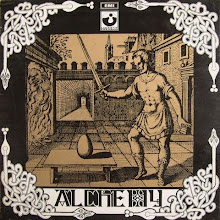
When analyzing the musical form of a band, the question of sources of inspiration, if not actual influences, is fundamental in order to even begin to understand it.
We have often discussed the sources that inspired the music of the Third Ear Band, and this archive is proof of that. By the musicians' own admission, Indian music, Vaughan Williams' pastoral compositions (which undoubtedly inspired DaveTomlin in the composition of “Lark's Rise”), the works of modern classic musicians as Stravinsky or Penderecki, and the aleatoric music of John Cage were undoubtedly the basis of TEB musicians.
Wim Mertens, a Belgian composer, musicologist and pianist also known as Soft Verdict, in his fine 1983 essay dedicated to American Minimalism (“American Minimal Music,” published by Kahn and Averill) adds Terry Riley to the pantheon of composers who influenced TEB. He wrote:
"Riley’s music has influenced a number of American and European avant-garde composers and many jazz and pop musicians. The Soft Machine’s Moon in June is a clear example of this — in fact, the cofounder of this group, David Allen, was a good friend of Riley’s. The English group Third Ear Band also show their debt to Riley in their use of modal patterns on the principle of periodic progression."
Do you think this assertion has any basis?
From a historiographical point of view, I don't recall any admissions in this regard by members of the group, while in Paul Minns'
memoirs, which I first published in my short essay “Necromancers of the
Drifting West” in 1996, the vaste references include classical modern
musicians as Stravinski, Malipiero, Ives and jazz giants as Miles Davis, Dolphy, Coltrane, Pharoah Sanders, YusefLateef; but, most of
all, Indian players as Dr. Jog, BismillahKhan, sitarist VilyatKhan and sarod master Sharon
Rani.
In the same essay, guitar player Mick Carter, analyzing the structure of the tunes, refers exclusively to Indian modal music and the different modes/scales that inspired the last compositions of the 1980s and 1990s.
There is no denying that Terry Riley has been a major influence on the music scene since the second half of the 1960s, especially thanks to his wonderful works “A Rainbow InCurved Air” (1968) and “In C” (1969), but, as far as I can tell, there is no evidence that it was a conscious source of inspiration for the TEB.
It seems to me that also Riley was influenced by Indian music, which plays a decisive role in the syncretism of TEB's work.
Here is the second part of the extraordinary accidental discovery (read the first part here).
2.
On 1st June I took the train and went to meet in Milan, Lambrate area. There, a stone's throw from the station, is the photographic archive where many treasures unknown to most are kept. So many photos that tell the story of 20th century Italian culture through the world of entertainment, especially live concerts and television appearances. Portraits of Italian cultural personalities such as Pasolini or Moravia, singers such as Modugno or Dalla, directors such as Fellini... mostly unpublished or rarely circulated shots (which may have appeared in a magazine or newspaper article).
Giuseppe Ferlaina (June 1st, 2022).
Giuseppe Ferlaina himself turned out to be a character with an important story to tell, strong passions (Erik Satie), great ambitions (writing, between art and philosophy). Speaking of "Vexations", Satie's composition-paradox, he says, for example: "Even today Satie is an undefeated master, because he dilutes the music, at a certain point you don't hear it any more, entering the mechanism of compositional praxis... you don't hear it any more, he liquefies it, which with "4'33"" Cage evokes it, he only represents it. Satie doesn't make a representation... No one else succeeded in obviating the work like Satie... All the avant-garde, the happenings, Fluxus, where do they come from? They come from there, an absolute master!"
Born in Naples in 1970, after graduating, he first moved to Milan in 1989, only to return almost immediately to Naples, working in a photography studio as a fashion assistant. In '94 he returned to Milan again and worked for a few agencies doing simple auditions, but was dissatisfied because he had an idea for more creative work and returned to Naples again, before finally moving to Milan in 1997. At that point, 'disappointed with the economic results achieved', he went to work as an agent for the prestigious Treccani publishing house; then as commercial director for Vallecchi. Marriage and the birth of two children forced him 'to put his head down' and accept a more coventional job as an employee in a cooperative. "In the meantime, I still continued to study, particularly philosophy of art... I had to, like it was medicine..."
Once this experience was over, he took up photography again and came up with the idea of the archive, opened around 2012. "I was already buying photographs, I was interested in the 1970s, in artistic research. Everything was born out of love for art, despite the fact that I had graduated without practically opening a book..."
Italian musician and composer (and film maker) Francesco Paolo Paladino, apart being a friend of mine for many years (and collaborated on the last Third Ear Band's live CD "Spirits"), is an architect of sounds and concepts.
His last two works, investigating the nature and the power of air and water, are a clear connection to the pagan ideal world of the Third Ear Band, just actualized in these crazy days.
I've asked him some questions about his research, his ideas about the music today and his ideal bond to the TEB's experience.
Luca Chino Ferrari: How do you have moved from a traditional way of composing/recording music to the present research of sounds?
Francesco Paolo Paladino: In June 2016, just the day of my birthday (June 9th), I lived a particular state of reflection, depression, instinct, transgression, that particular feeling of one who becomes "more adult", one who makes a balance with the "outcomes" of his being and acting.
While I was beating around the bush, I felt this incredible creative energy for the making of music and suddenly I had clear the work I wanted to do for the next few years. Actually not a general work but a triptyque. I had clear in my mind the titles of the works I wanted to realise: "Ariae", "Siren" and "Icereport".
Basically, first of all I wanted to consider the element of air, then the element of water. Thus, at the end of this process I wish to work on the modification of both, the dimension of ice.
The transition from the avant-rock to another musical level (but I can't define it) was a kind of unconscious but lucid ones. I'm still guessing why it happened, and why just last year...
Maybe it was all written in my fate, I might work at this particular state of musical knowledge. From there my work started and I'm going to complete the tryptique. I've already published two parts of it - "Ariae", a contribute to the evolution of the so called ambient music, and "Siren", a complex kind of opera or marine cantata, a drama that sounds as an elegy to our sad world destroyed by pollution.
"Siren" encapsulates the female side of my being and my need of protection beyond the life, the desire of a "great mother" who heartens me. But we are alone in the ocean, I know it well...
LF: Can you describe us in detail how is born the idea of this kind of 'collective work'? Apart the beautiful artwork designed by the very talented artist Maria Assunta Karini, in "Siren" among the others 'play' also Judy Dyble, Paolo Tofani, Sean Breadin, Alison O'Donnel, Riccardo Sinigaglia...
FPP: For doing this three-parts project I recycled the concept of "doubling music" I used for years with the Doubling Riders, the band with which I played years ago. During the Eighties, just before Internet and the MP3, I had the idea to make 'sound exchanges' (reels, tapes...) with other musicians, having a 'at a distance collaboration'.
Thanks the melt and the bind of different artistic experiences I produced brand new sonic objects. Well, I ask some friends to send me everything they wanted, suggesting tonalities and explaing the sense of my projects. Maybe this method of work can recall that sort of randomness introduced by Brian Eno in the '70's... but anyway at the end the final results was better that I could imagine.
LCF: So you don't consider yourself a proper typical musician/composer...
FPP: I can consider myself a film-maker, but also a sound artist, a composer, but together with many other musicians, a creativeperson because I make sound entities, starting from the awareness that all is existing out there...
La Monte Young explained it in a very easy and genial way: when he made a full LP with a sound that can be listened to from different perspectives and it become 'different' because different is our perception. Making sounds with already-made stuff is a charming experience. It means to be cauterized for warping and cutting, being concentrated on very pure parts; it means you can realise hidden or only rough architectures, writing a unique personal language that you can play in the same time.
I'm very satisfied with my new direction and I hope I can ride it for a long time.
LCF: Most of all I have been very impressed by "Ariae", because I think here the listener is not simply in an unheard soundscape dimension but also in a real experimental work of physics... For the ears these are very amazing and disconcerting sounds!
FPP: Few people noted this and I'm very glad that just you do it because "Ariae" surely is a CD very inspired by Ambient music but also it's an attempt to go 'beyond' it for revolutioning this kind of sounds. The phisycs of sound you referred to with your questions is an identification (I have to admit very cultured) about my achievement of this new way.
I have created (most of all on the second track) some phisic paths for my recorder and michrophone from a room to another, opening (partially or fully) opening windows for transforming the phisic path in a ritual one, with localized sources and lappings of air that one could find in a predetermined moment. Then, in other sessions I have dealed with masses of air through improvised gestures that forced microphones and recorder to become a method for translating air movements in something that could have a meaning for human senses. There is a moment in "Ariae" where, after few minutes when the wind talks its unique vocabulary, the sound restarts and who have listened to this sequence says that it's very appease. The sound becomes a reassuring element because it can be recognised. Well, this is the part of my album I prefer because just there two different sound languages meet, creating into the listener a condition of disorientation before, then a calmness dimension.
Also the repetition of a theme, its being mutant, is the clear statement of the existence of sound as a container of silence, in other words a silence that is never the same, therefore sound. Also my decision to record the album with a very low sound level, suggesting to the listener to listen to it "playin' loud" (as it happens for the metal) is a strategy to create infinite opportunities of choice for the listener who can decide what to listen to, if prefering "sonic silences" or getting the dynamic of music. Many listeners said that turning up the volume they listened better to the silences and that was exactly what I wanted to obtain!
LCF: In "Ariae" I've found some references to the Third Ear Band music dedicated to the elements. Apart the project itself, and the title of it, some effects of your experiment sound to me as "Water" beacuse your recorded air sometimes surprisingly seems to have this suggesting nature... What do you think about? Was the Third Ear Band a landmark for you through the years? FPP:Third Ear Band is one of the band that goes with my life. I knew the TEB through "Music For
Macbeth", and precisely "Fleance" strake me like a thunder; it was 1972. Suddenly that track reminded me "Le petit Chevalier" from Nico's
"Desertshore" (1970). I was looking that terrific music as a kind of phoenix, for listening to, for realising, for eating it...
From that precise moment I'd been dreaming of a record played by the Third Ear Band with Nico: it would have been wonderful to listen to "Abschied" fading in "The Banquet".... And I used to record on my C45 cassettes tracks from "Macbeth" pasted with "Desertshore"'s tracks, listening them all alone in my little room. From those days that cellos are remained in my heart. "Ariae" is just that "air" I breathed in my little room, a place totally inaccessible to my sister and my parents. Just the friends who "understood" could go in. And I'm sure some notes from that records are still there, in my little room... some sequences of my favourite music...
Of course, just after "Music for Macbeth" I bought also "Alchemy" and "Third Ear Band" (the second
album). It was an emotional earthquake. That records became a magic trio that I listened to just in some particular occasions. I had music for many kind of situations: that very important for me was signed by the TEB, Nico, Tim Buckley, the first King Crimson's record and some tunes from Don Cherry's "Relativity Suite".
If I had a girlfriend, I had to decide what soundtrack to use: I played the Third Ear Band just in some rare occasions, because it was my personal "magic cult" that warmed my heart. "Ariae" is a work that can be interpretate as a spiral of sounds remained in that my little room and thus in the deep of my heart.
LCF: What do you think about the music today?
FPP: I think today there's no a "dominant" kind of music around even if music magazines try to force us to believe it, creating new fashions that vanish in few months... We're living very peculiar times... I remember that on a 70's Italian music magazine named "Gong" someone wrote that the music had to be listenend to without knowing who was the musician or the singer etc., thus not being influenced by the album cover or something else. Well, I think we are here now.
The listening of MP3's and of iTunes by the teens is a sort of buig minestrone where everything is mixed up in a grey anonymity. I think this is not acceptable! Also because some deeped opinions about historical discographies have been challenged. Just an example: Tangerine Dream's "Phaedra" was considered the best album the band recorded before its 'commercial' phase; today this album is valued as the album that launched techno music.
Francesco with a "myth" of our generation, Joe Boyd.
Can I tell you very diplomatically that we are just in a period of "evolution" towards something we don't understand at the moment? Sure, this is an irrelevance, because this is happened in every historical period of music, but we can admit that today music is quite less important for teens than it was for our generation. So, now it's more a question of music market than the music itself, the music as a commercial product. Our myths have been transformed in fetishes by the music market. The only important thing is to sell, and because the market is selling generally the same records, now we have this "box syndrome" where an old album, became an old CD, is now republished in various different editions - blue-ray, mono, stereo, enhanced, with bonus tracks... maybe with boring studio sessions, but with a wonderful, catching packaging... This is the Age of Form that triumphs on the substance, where a pretty and correct "didactis of sounds" is preferredto a "magmatic alphabet"... But a "fog effect" still exists.
LCF: What do you mean with this?
FPP: In this vaste mare magnum of sounds and musicians, with lot of music magazines reviewing more than 300 records in a month, inside this bland soup with too much flavours, we have to activate the "fog effect".
If you drive with the fog, you don't know where you are, you don't realize if you have passed one or two roundabouts, you are alone with your intuition only. This is the magic word, today one says "the password", this is intuition. Inside the fog you meet lot of people, you don't know many of them, you don't see them, but your intuition brings you to some of them, the best ones, as you might reorganise your own microcosm of friends and your musical perspectives. But you have to use your intuition instead the "intellectual factor". We have to reconstruct our lives on an intuition basis, on that intelligence conceived by John Cage where randomness becomes the will to live new experiences. Intuition brings you to your soul mates, people who has your sensibility.
LCF: How can you conciliate this with technologies evolution?
FPP: For myself one has to live technology evolution in this way: I buy a camera, I don't read instructions, I work on it with the same passion of a child who cannot read. It's that intuitive passion that brings me to the "not compliant solution"... (even if soon or late I have to endure one hour or more of reading instructions...).
LCF: What kind of music are you listening to? What do you suggest to a young listener to listen to?
FPP: I use to buy CDs at Amazon or Discogs, selecting the cheapest albums. The offer is so wide that I don't follow the logics of a collector but that of a music lover with no limits. What I like, I listen to. Just recently I've discovered a group (I don't know if they are existing or not), they called AU. Simply outstanding! Again, I listen to poetic ballads by Martyn Bates, Judy Dyble and Alison O'Donnell.
My 'protective deities' are Robert Wyatt and Brian Eno (even if in these last years the latter is fully deluding me), Don Cherry and Alice Coltrane, of course 'our' Third Ear Band. About new things, I'm now oriented to buying "new classical music" at New Amsterdam Records, a label that none knows but in these last few years has published incredible masterpieces. I don't intend to suggest any records or musicians to young listeners, I suggest only to listen to everything with the "third ear": I'm sure they don't be sorry of it!
FRANCESCO PAOLO PALADINO's
SELECTED DISCOGRAPHY
A.T.R.O.X. - "The Night's Remains"
(LP - Trinciato Forte Records T.F.L.P. 001, 1982 - reissued by Spittle Records in 2015)
A.T.R.O.X. - "Water Tales"
(Contempo Records L.P.001, 1984 - reissued by Spittle Records in 2015)
Italian musician and journalist Pierluigi Castellanodedicated to the Third Ear Band an interview in a book edited in 2004 by publisher DeriveApprodi (http://www.deriveapprodi.org/estesa.php?id=157) titled "Le sorgenti del suono. Trenta incontri con musicisti straordinari" ("The sources of sound. 30 meetings with extraordinary musicians" - pages 192, € 13.00).
Among the others, original interviews (just in Italian) with 'monsters' as Terry Riley, John Cage, Philip Glass, Uri Cane, Alice Coltrane, Brian Eno...to investigate the origins of theirsound.
As
the author states in the preface, the aim of this book is "to detect
the freedom of choice inside and against the limits imposed by present
conditions. Suggesting an idea of musical expression deprived of
gerarchies, with processes of contamination taken even from scientific
disciplines, and restating the power of collision between subversive
power of art and his reduction to the logic of a controlled
communication".
About the Third Ear Band, in December 1989 Castellano asked few questions to Glen Sweeney related to the origins of the group, the first two albums recorded ("Even today I like much to listen to them: in particular the second one that probably is the best album we have done..."), the experience with Polanski's Macbeth. About this Sweeney reveals: "(...) Personally, I had the idea that a soundtrack were something of too artificial, not so ideal to make good music: so I replied we were just available to improvise on the pictures he'd given to us. (...) I think music we recorded was very very good, but it happened something of very funny: the copy on which we had worked was b&w and just the evening before we realized Polanski's Macbeth was a wonderful full color movie... Obviously it was really pleasant, while the black and white ones was so glum...".
Because if it’s quite easy to discover some elements of cultural suggestions just based on the tracks’ titles, linked to the feelings of its time (the epic Sixties…), in my opinion, “Alchemy” was thought as a strong summa for an alternative life. A philosophic (music) treatise for a New Age.
Also for this, this album seems to transcend its time…
I’ve already written about the “Egyptian Book of the Dead” in this archive (read at http://ghettoraga.blogspot.com/2011/08/tebs-egyptian-book-of-dead.html) as a piece of incredibly scary sounds intended for going with the dead through his death.Music composed to remember us our ephemeral life and the responsibility to live with an ethical approach to human things.
But what about the album's other tracks?
Druids painted by Charles Knight (1845)
It's easy to state that “Alchemy” (1969) is conceptually more complex than “Third Ear Band” (1970), even if for music critics the second is generally considered better than the first. Anyway, here we have a stonecircle and a druid, surely alluding to the pagan druidic ancient tradition; the direct quotation of the ancient Book of the dead (Egyptian history related); the dragonlines, as Cresti explains in his book, “a clear musical transposition of pioneer theories of John Michell, who had transposed Chinese tradition of "Lung Mei" on English culture and told about "Dragon Paths". These "Lung Mei" (an expression we can in fact translate as "Dragon Paths") are energetic lines discovered by ancient Chinese; from the heart of a dragon, usually laid in a valley among the hills, springs of energy have radiated, as it occurs with the "Ley Lines"".
Swinside stone circle (West of Broughton in Furness)
And we can listen also to three apparently more obscure tracks - “GhettoRaga”, “Mosaic” and “Area Three” - all related to the idea of space: a space to protect (thanks to the snakes on the cover...), a ghetto, a place for Hermetics where to practice alchemy (the cover concept) and turn the poor metals in gold (PrimaMateria).
Asking Dave Tomlin about this idea of space (January 24th, 2012), he writes to me: "I could speculate a little. "Area three" comes I think from the film world. It is a forbidden place; maybe dedicated to government secret experiments on... humans? There is a place like that in the Russian film 'Stalker' - Tarkowski, I think -, which would tell you all. I think they used "Ghetto Raga" just because it sounds good. Ghettos are run down areas where poor people, usually of the same race live (Jews etc.). So Ghetto gives a rough type image, and raga is another racy word, although it's doubtful if any of the band studied Indian music. So together the two words create an interesting effect. No more than that...".
But a ghetto of raga, where religious musicians play ragas besieged by the (post) modern world, could be the same area three (three as the TEB musicians?), a place for (musical) alchemic experiments...
Thus a record as a clear powerful metaphor alluding to turn bad music in good music, a superficial/commercial listening to a deep one, a materialistic life to a spiritual one…
I think “Alchemy” is a coherent, integrateddevice of ideas related to a definite conception of life - very distant from the usual Sixties Egyptian ephemera of fashion.
The best work ever produced by the band and one of the best albums of its time (no Egyptian junk, please!).
Maybe an alchemic product itself!?
A detail of the egg (the Great alchemic Opera) from "Alchemy" front cover
As Glen Sweeney said about the TEB music, "the music is the music of the Druids, released from the unconscious by the alchemical process, orgasmic in its otherness, religious in its oneness communicating beauty and magic via abstract sounds whilst playing without ego enables the musicians to reach a trance-like stage, a "high" in which the music produces itself. Each piece is as alike or unlike as blades of grass or clouds" (from the original 1969 Isle of Wight concert programme).
And again, just around the period when "Alchemy" was recorded: "We are beginning to move into some strange musical areas, doing a piece we call Druid. Once or twice when we've played this thing, we've gone into a weird sort of experience we call a 'Time-shift'. Nobody really knows what it is. The whole Druid piece is repetitive and extremely hypnotic and yet you have some of the instruments doing far out things so that a fantastic tension is built up. It's like alchemy. The alchemical emphasis is on the endless repetition of experiments, doing the same thing over and over again, and waiting for some sort of X-factor to appear. This is more or less what we do when we play. And our X-factor is this time-shift thing".
"It happened once at the London Arts Lab, and as we played, it seemed as if time had slowed down and we had drifted into a completely different dimension. And when we finished, nobody moved at all. They were kind of stuck there. So I felt that perhaps it had happened to them too. So that's the thing we are trying to get into. Although it can be quite a strain during a public performance, like living on the edge of a cliff, since nobody knows what might happen. To be on stage and feel it happening can be quite frightening. You go out of yourself, and when you come to, you discover yourself on stage with hundreds of people staring at you. You get this split-second thought: 'Have I been playing? Have I ruined the whole thing?' In a way, it's very similar to meditation and mantra chanting, which is why I feel what we are doing has a very religious depth" (from "Gandalf's Garden" #4, 1969, interviewed by Muz Murray).
Tomlin clarifies me (January 30th, 2012) that "in the mid-Sixties, there were many different influences. One was the legend of King Arthur's Court. Another was the Aliens - flying-saucers - messages from the stars. Also Blake's "Jerusalem", the Ley-Lines, Ramana Maharishi. And the mysterious arts of Alchemy. There was an Alchemical saying of the time: 'When the sound of the music changes the walls of the city shake', which the Third Ear used at one time. Glen was very much drawn to the Alchemical myth. In fact a few years before he died he kept an ex-WWII torpedo-boat on a north London canal. Its name was 'ALCHEMY', he and Carolyn used to roar around the canals in it and everyone had to get out of the way; they were the terror of the waterways. I sometimes visited them on the boat and when Glen died she took the compass from the boat and gave it to me (this compass came from Glen Sweeney's boat Alchemy)...".
As in the past, people used to write books for initiates, in modern times, musicians play records to open the mind and soul of people ("Happy new ears!" John Cage wrote): Third Ear Band has left us a beautiful, scary record of magic/esoteric/philosophic music for the everyday life & death... Also for this reason sometimes we return to it as a sort of breviary, listening to little drops of it as a thaumaturgical magic potion!
"Someone else who posted here said they've learntmore about TEB in a fewhours here than in 30 years. I'd agree with that except inmy case it would be 44 years. An excellent archive for TEB fans and historians of the era. Thank you!" RACHAEL TYRELL
A TEB BOOK...
CLICK ON THE PICTURE TO BUY THE BOOK.
NEW TEB 3CDs BOX OUT NOW!
Click on the picture to get a copy.
"ALCHEMY" REMASTERED EDITION OUT NOW!
Click on the picture for buying the album.
WRITE TO GHETTORAGA
Search This Archive
New TEB remastered CD on sale!
Click on the picture to purchase the record.
NEW THIRD EAR BAND REMASTERED CD EDITION ON SALE!
Click on the picture to buy the record
Translate
Third Ear Band 1969: Paul Minns, Glen Sweeney and Richard Coff (photo: Ray Stevenson).
Luca Chino Ferrari (b. 1963) is an Italian music writer. Since 1985 he has written and translated books about folk and rock musicians as Third Ear Band, Robyn Hitchcock, Captain Beefheart, Tim Buckley, Nick Drake, Syd Barrett & the Pink Floyd for the main Italian publishers. He met Syd Barrett in 1986 and did contribute to the reunion of the Third Ear Band during the '80s. His latest books was published in 2020 for English ReR November Books, as a collection of stuff about the Third Ear Band, and in 2024 as a collection of writings about Syd Barrett (in Italian). He runs a personal Web site (in Italian/English) at https://chino6339.wixsite.com/gelatoaicorvi
TEB recording at Abbey Road Sudios in February 1971
Click on the picture to watch the video!
"Third Ear Band music is a reflection of the universe as magic play illusion simply because it could not possibly be anything else. Words cannot describe this ecstatic dance of sound, or explain the alchemical repetiton seeking and sometimes finding archetypal formes, elements and rhythms...".
(Glen Sweeney on "Alchemy", Harvest Records 1969)
Paul Buckmaster at Hyde Park (June 7th, 1969).
Total Pageviews
"ALCHEMY"
"Alchemy" (Harvest 1969)
Third Ear Band live at Hyde Park (June 7th,1969)
Click on the picture to watch the video!
Read "Necromancers of the drifting West"!!!
A book on the Third Ear Band edited by Luca Ferrari (published by Stampa Alternativa, Rome 1997). WITH THE FIRST ORIGINAL VERSION OF "ABELARD & HELOISE" SOUNDTRACK!
Third Ear Band at the Roundhouse (London, May 30th 1969).
As alike or unlike as blades of grass or clouds...
"The music is the music of the Druids, released from the unconscious by the alchemical process, orgasmic in its otherness, religious in its oneness communicating beauty and magic via abstract sounds whilst playing without ego enables the musicians to reach a trance-like stage, a "high" in which the music produces itself. Each piece is as alike or unalike as blades of grass or clouds".
(From the 1969 Isle of Wight concert programme)
TEB - "THE LOST BROADCASTS" DVD (Gonzo Multimedia, UK 2011)
Richard Coff at Isle of Wight Festival, August 1969 (photo: Barry Plummer).
Pseudo-mystical...
“The trouble is that you can't be mystical without being called pseudo-mystical, and it's the fault of our previous education. I'm at Glastonbury most of the time, but we're all completely honest about it. We'll even use it honestly to make money, because the ancient Egyptians who were into it all said that you had to be rich because only then can you resist temptation”.
(Glen Sweeney to Richard Williams, “Melody Maker” June 1970)
"Macbeth" by Roman Polanski (Playboy Production, UK 1971)
“I've always felt that music should be pure. If you have lyrics, you are preaching in a way. Somehow words are a block to communication. It's almost impossible for me to explain exactly how I feel about this, that's why I'm a musician. The only way to really understand what I mean, is to firstly listen to a pop group and then listen to us, and then I hope you will know what we're trying to say."
(Glen Sweeney to Muz Murray, 1969)
A Third Ear Band tribute
Roberto Musci - "Mosaic. A tribute to Third Ear Band" (CD - Gonzo Multimedia HST411, 2016)
TEB 1971: Sweeney, Minns, Bridges and Buckmaster (photo: Blackhill Enterprises).
NOTES FROM OVERGROUND
“No announcements, numbers lasting 15 to 20 minutes, art form or con?
This might be valid criticism of (A) Thunderstorm (B) a cricket (C) Third Ear Band.
Their approach to music is different because there is no duality, no conflict between the natural element of chance and the human element of control, did the moon ask to be reflected in the water? If it wasn’t for the trees would the wind know when it was blowing? Paul Minns says there are some very beautiful forests in Hyde Park, trying to put titles to music is rather like trying to answer the question where does my hand when it becomes my fist”.
(From the Al Stewart-Third Ear Band 1970 tour programme)
TEB 1970: Sweeney, Minns, Coff & Smith (photo: Blackhill Enterprises).
"The Centipede was happy, quite, until a Toad in fun said: "Pray, which leg goes after which?". This worked his mind to such a pitch, he lay distracted in a ditch considering how to run". (Third Ear Band, 1970)
TEB at Isle of Wight Festival, August 1969 (photo: Barry Plummer).
"Music from Macbeth" (Harvest 1972)
Third Ear Band - "Experiences" (Harvest 1976)
WEIRD SCENES
“We'd rather people called us a pop group. We do ragas, that aren't really ragas at all, and unless we get a turned on promoter, we get into some weird scenes. At Norwich once, when the promoter saw the audience sitting down and closing their eyes to our music, he accused us of putting them to sleep! Complete paranoia. So I imagine we wouldn't do too well on the Pop Proms”.
(Glen Sweeney interviewed by Chris Welch - “Melody Maker” July 12th, 1969)
Third Ear Band - "Fleance" (Odeon 1972) Japan single edition
Third Ear Band - "Live Ghosts" (Materiali Sonori 1988)
VERY MUCH UNDERGROUND
“It's just a question of advertising. We've stayed very much Underground - no photos - and I think this was necessary so people wouldn't put us in a bag. We'd rather the just came up and heard us without ANY preconceived ideas. I suppose it is a bit shattering to see violins and cellos”.
(Glen Sweeney interviewed by Chris Welch - “Melody Maker” July 12th, 1969)
Third Ear Band at a Druids ceremony in Glastonbury Tor (April 15th, 1970).
OTHER TEB RELEASES/APPEARANCES
"Picnic. A breath of fresh air" (2LPs - Harvest SHSS 1/2, UK 1970) various Harvest artists anthology
"Harvest Heritage. 20 Great" (LP - Harvest , UK 1977) various Harvest artists anthology
"The Harvest Story Vol. 1" (LP - Harvest EG 260097 1, UK 1984) various Harvest artists anthology
"All frontiers" (CD - Materiali Sonori MASO CD 90026, ITA 1991) various artists live compilation
"Sonora 2/91" (CD - Materiali Sonori, ITA 1991) various Materiali Sonori artists compilation
"Radio Session" (CD - Voiceprint VPR017, UK 1994) live album
"Materiali Sonori" (CD - Olis OM 0021, ITA 1996) various Materiali Sonori artists compilation
"Live" (CD - Voiceprint VP157CD, UK 1996) live album
Third Ear Band - "New Forecasts from the Third Ear Almanac" (ADN Records 1989)
90% improvisation...
"I'd say ninety per cent of our music is improvisation. It's not really Indian music, although we use a drone instead of the usual bass line riffs. The music draws from everywhere.
"I think our appeal is that audiences can draw their own thing from us. We make no announcements and none of the numbers have titles. People in colleges we play come up after and say they can get fantastic images in their mind when they listen. We can offer a complete dream. The old Celtic bards used to have the same ability".
(Glen Sweeney interviewed by Chris Welch - “Melody Maker” July 12th, 1969)
“Third Ear Band’s new album “Magic Music” isabout music as pure vibrations, as such it can be linked with colour because colour is vibration. It can even be linked to the music ofthe spheres which states that the vibrations of the planets can be heard with the third ear (silence). The free ragas that we play are modal, each note can be heard as a sound-colour that produces its own mood.Our rhythms come from all overthe world, and we use these ideasand many others to try to make a new world music”.
(Glen Sweeney, notes on the “Magic Music” inner cover, 1990)
SOLOS DISCOGRAPHIES
- GLEN SWEENEY -
Various Artists - "The greetings compact vol. 2" (CD - Materiali Sonori, 1990)
Rolling Stones - "Sticky fingers" (LP/CD - Rolling Stones Records, 1971)
Carly Simon - "Hotcakes" (LP/CD - Elektra, 1974)
Elton John - "Single man" (LP/CD - Rocket, 1978)
- NEIL BLACK (selection) -
UB40 - "Present Arms" (LP/CD - DEP, 1981)
Joan Armatrading - ""Track Record" (LP/CD - A&M, 1983)
Third Ear Band 1969: Minns, Sweeney and Coff at the Kensal Green Cemetery of London (photo: Ray Stevenson).
Third Ear Band - "Brain Waves" (Materiali Sonori 1993)
Eight drunk rugby players
"We once had eight drunk rugby players yelling dirty songs at us. We played quieter and quieter. In the end they seemed ashamed and shut up. But I still don't think they dug the music!".
(Glen Sweeney interviewed by Chris Welch - “Melody Maker” July 12th, 1969)
Third Ear Band, Vinci 1989: Allen, Sweeney, Dobson and Carter (photo: Lucia Baldini).
QUOTATIONS, COVERS, REMIXES, MANIPULATIONS OF THIRD EAR BAND MUSIC
Stone Breath - "A silver thread weave the seasons" (2CDs - Hand/Eye, USA 2008). A 'cover' of "Fleance".
Marco Lucchi - "Baby a" (ITA 1982). A composition with a sampler of "Stone Circle".
Radio Noisz Ensemble - "Yniverze" (CD - Garden of Delights 1982/2009). A 'folky' quotation of "Water".
Fabio Zuffanti - "Third Ear Band demixed" (CD-r - Spirals Records, ITA 2000). The four elements electronically manipulated.
Algarnas Tradgard - "Delayed" (CD - Silence Records, UK 2001). A quotations of "Water" recorded in 1973-1974 (!).
Lady Husk & The Good Ship Neotropic - "A monstrous psychedelic bubble exploding in your mind" (file MP3 - The New Worck, NL 2007). A remake of "No title" (?!).
I Monster - "The Art of Chill vol. 6 - Mixed by I Monster" (2CDs Platipus, UK 2009). A remix of "Fleance".
Vibes and Stuff - guest mix Coby Sey (MP3 - UK, 2010). A remix of "Water".
AA.VV. - "The Fruits de Mer Annual for 2011" (2x7" - Fruits de Mer Records, UK 2011). A cover of "Fleance" by the HI-Fiction Science.