TEB UBER ALLES!, dear maniacal alchemical fans! TEB is alive and well and on last April 30th, 2013 French Web radio Robotouffe aired the infamous "Fleance".
Dave Harrieswas the sound engineer of TEB's "Macbeth" soundtrack recorded at George Martin's Air Studios (London) in the second half of 1971. Quite accidentally, surfin' on the waves of the Web I've been so lucky to meet him, he's been so kind to accept a short interview about his past... Here's this Special Thing.
Dave Harries on December 19, 2011 (photo by David McSherry)
Describing the Macbeth's soundtrack project to the press ("Sounds" magazine) in 1972 Glen Sweeney said: "We originally were going to use a small dubbing theatre at Air and we thought we would rehearse the film score, but on the first few clips - they only sent the movie on a clip at the time, you see - things went to well that we eventually sent the dubbing theatre up and plugged it into an eight-track and it became the original film soundtrack, part from overdubbing... (...) The way we did it mainly was by viewing the clip that they needed music for and them maybe somebody would have musical idea which we would try out, and if nobody had any ideas then we would hope for the best and try again. And it worked nearly one hundred per cent. I mean, the ideal way would have been to get someone to write the whole score and hire a bunch of studio musicians to play it". Is this description correct?
"Yes, they did view the clip and then compose the music on the spot to go with each scene. We did it one clip at a time so at times to me the music can seem a bit disjointed. Roman Polanski used to come in and review the work. We sent the music mixes to Shepperton Studios to lay them up with the film as we completed them. Often Shepperton would label them wrongly so we would sometimes show scenes with the wrong music as a result. Very confusing. Roman Polanski used to get annoyed about this! We worked in Studio 4 which was designed as a dubbing theatre with film projection facilities. This notably was one of the first movies to use Dolby on the soundtrack". How did you meet the band? Did you know them before to start the recording sessions? "I first met the band because they started the project with our film recording engineer Jack Clegg but he didn't like working with multitrack recording so he asked me to take over the recording along with assistant Bill Barringer".
Can you tell us your career at that point? "I started work at EMI Studios in 1964 as a technical engineer staying there for 6 years and working with all the famous bands of the era including The Beatles, Pink Floyd, The Hollies, Beach Boys and many more. I left in 1970 to join George Martin helping to set up the new Air Studios in Oxford Circus".
One of the rare photo taken at the Macbeth recording sessions.
Which was your exact role in the recording process at Air Studios? "I was the recording engineer responsible for the sound and the organisation of the sessions. I recorded the band to multitrack locked to the picture and mixed the music down to two track magnetic.Also I mixed and edited the soundtrack album".
Do you remember which was the equipment you used for recording the music? "I was speaking with Bill Barringer yesterday about the equipment. We
think we used a Studer A80 8 track machine the a 50Hz pulse on track 8
to synchronise with the film. We mixed down to stereo or maybe three track to an Albrecht film recorder. The projectors in that room were Phillips. Microphones mostly would have been Neumann U87 or U67, maybe an STC 4038 on drums.The whole track was Dolbied and we had regular visits from Elner Stetter of Dolby throughout the recordings".
What can you tell about the condition of the band in the studio (I mean if they were competent about playing and recording, if they used to get drugs, if they were serious worker...)?
The TEB appearing on the movie...
"The band worked very well in the studio and were very creative and constructive in forming the musical passages to accompany the film. Don't remember any drugs. At the time they weren't tolerated in the studios". In a recent interview with myself, Paul Buckmaster stated: "Glen, Paul, Richard and Denny trusting me with my suggestions. For example, I actually wrote the dreary "Witches Song", which we played, and sang. The singing was done by the five of us; Roman wanted it to be "kind of disgusting"… We did a certain amount of overdubbing, to create a more dense texture in places, with me and Richard making clustery string harmonies… I think the End Titles is one of the better pieces in the score; Denny contributed a lot to that, and a great driving pulse from Glen! I believe Denny composed "Fleance's Song" with Paul… but we're all credited as co-writers, which was Glen's democratic, egalitarian virtue". Was the role of Buckmaster so decisive into the composing and recording process? "Paul Buckmaster was an integral part of the band, particularly contributing to the more modern sounding pieces which were almost becoming classical musically".
What do you remember about the recording of the "Fleance's Song", probably the most known track of the soundtrack? I know that Glen and Paul hated it and it is confirmed by Denim Bridges that recently revealed me: "Glen and Paul hated that track because it didn't fit in with TEB concept. It was composed for the movie and it was composed by me alone. The words were provided to me so I, of course, just wrote the melody and chords. The turn around where I repeat the line as a sort of refrain was my trick that I often use(d) and using the minor chord was cool I think. The rest of the band improvised the arrangement in TEB style as best we could within the ridged structure. Anyway that song was the start of my demise with TEB as that's the way I wanted TEB to go". "Fleance's Song was recorded by Jack Clegg and Bill in Studio 2 at Oxford Circus. I mixed it with Bill in Studio 4 along with everythingelse. It was so good and very commercial that at the time we all agreed that it should be released by EMI as a single but the record company didn't agree".
Which was the real contribution in the studio work of George Martin? "To my knowledge George didn't have anything to do with the recording of "Macbeth"".
Had you been involved with the film premiere in London? Do you recall something? "Didn't get an invitation to the premiere".
Have you got any stuff, photos or something else about that experience that you wish to share with the Archive's readers? "Unfortunately I don't have any pictures or anything. I will do some research however.I hope that the above is of help. All the best,Dave Harries".
Dave Harries (on left), after receiving his Lifetime Contribution Award in 2009 from Sir George Martin and Ken Townsend (on right)
"Hello Luca, Don't know if you remember me but my name is Ed Wilkins, and I hosted a progressive rock show on Stroud FM in 2011. I did a show covering the Third Ear Band and we conversed over for a while but it kept not going out and we eventually lost touch. I ended up leaving the station not long afterwards and move on to other things. The reason I am writing to you after so long is due to the fact that I recently decided to return to the station and this time also got a Listen Again page, so until I have more shows I have decided to put up some of my old ones - including the Third Ear Band show! You can listen to all of my shows on here - I intend to play more Third Ear Band on later shows so you can keep an eye out for them! http://podcasts.stroudfm.co.uk/index.php?cat=An%20Hour%20of%20Prog%20with%20Ed%20Wilkins The Third Ear Band show itself is this one: http://podcasts.stroudfm.co.uk/index.php?id=1282 I deeply apologize once again for the problems encountered the show and hope this makes up for it. It will remain on the page until I have more shows to put up (eight hour limit) but that won't be for a while yet and I can always re-upload it.Hope you are well. All the best Ed Wilkins".
So thanks a lot Ed for putting the Third Ear Band music on air again!
After TEB's "Magic Music" reprinted last year for English indie label Floating World (with that Looker's awful cover), just at the beginning of 2013 Voiceprint has reprinted the Glen Sweeney's Hydrogen Jukebox album with the title "Songs from the Hydrogen Jukebox".
Same song list and sameCarolyn Looker's controversial cover...
Stewart Mason on cdUniverse Web site about the record:
"(...) The results sound a bit like a somewhat more
song-oriented version of Angels Egg-era Gong: The groove is paramount,
but in a structured format that, in spots, is recognizable as the kind
of post-new wave/art-pop music that, say, Simple Minds was doing around
the time of New Gold Dream. That connection to '80s pop is cemented in
the album's last three songs, recorded by a reunited (and newly
electronic) Third Ear Band in the early '90s and sounding like outtakes
from Japan's later records, especially on the worldbeat-influenced
"Behind the Pyramids."
"It was great reading this interview with Ursula as it helped fill in her
back story to a great extent. Ursula was kind enough to record some
cello and a little violin on a couple of tracks for my band, Big Ray,
back in 1991. I knew she had been in the Third Ear Band, but at the time
knew little about them or her beyond the fact that she was an
acquaintance of my ex-girlfriend's mother (who was herself a violin
teacher). So, like I said, it's great to find out more :-)
For the
record, Ursula was very, very generous with her time and her talent and
contributed some beautiful cello to our songs. Considering that we
called her out of the blue and gave her almost no notice, it's
astonishing she didn't tell us to go and take a hike. She's credited as
Ursula Pank on the album. For the completists among you the details are
here: http://www.discogs.com/Big-Ray-Naked/release/2446276".
The Big Ray
Ursula played violin and cello on three tracks of the album (titled "Naked" and published on CD and LP format by City Slang in 1992) - "Windfall", "Missing a train" and "Carousel" - that you can listen and download free at http://mp3twister.com/Big-Ray.html
Japan EMI-Harvest has recently reprinted the first three Third Ear Band's albums in a limited press CD format at the cheap prize of 1143 yen (9.47 euros - 7.98 pounds - 12.14 dollars).
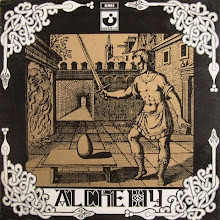
Published on February 27, 2013, the label has sent to the shops "Alchemy", "Third Ear Band" and "Music from Macbeth" with the original artworks and the famous Japanese strip, as you can see on the pictures of the "Alchemy" edition here below:
These are the details:
"ALCHEMY" (EMI Music Japan TOCP-71515)
"THIRD EAR BAND" (EMI Music Japan TOCP-71516)
"MUSIC FROM MACBETH" (EMI Music Japan TOCP-71517)
It would be interesting to check the audio quality, if some engineers have worked on the original masters, expecially for the "Macbeth" soundtrack available for years on CD just in that awful BGO edition...
Anyway, all things considered, a must just for compulsive kollectors!
I've asked Dave Tomlin to analyze his old compositions for the TEB's THE MAGUS album, "New Horizon" and "The Phoenix" (actually a poem declaimed by himself), and he has been so kind to do it for Ghetto Raga Archive. As everyone knows, THE MAGUS was recorded in 1972 by a line-up with Sweeney (drums), Minns (oboe, recorders and hammond), MikeMarchant (electric guitar and vocals), Simon House (electric violin,VCS3 and piano), Dave Tomlin (bassand flute) and Ron Kort (percussion, doom piano).The late Mike Marchant composed the majority of tracks inspired by Tarots. Recorded just in five days, rejected by Island Records, the album was lost in the vaults, re-discovered and published for the first time in 2004 by English Angel Air thanks the late sound engineer Ron Kort.
Here's Dave's writing about his tracks.
New Horizon(music & lyrics by Dave Tomlin) There are four significant verses in the lyrics of this song. 1) ‘We are standing on, our own horizon’. This, the first line of the song although intriguing, is in fact nonsense. For those whose English is a little weak, the horizon is the visible line between the earth and sky. Sometimes this can be quite near depending on the kind of landscape. At other times it can be at a great distance (while at sea for instance). Nevertheless, to stand on one’s own horizon cannot be done and were it to be accomplished would require shifting to another dimension. However, the concept leads to another seeming impossibility which is revealed in the second verse.
2) ‘Paths that lead this way, by-pass yesterday’.
I wrote this song around 1966 when the idea of ‘now’ was inspiring the minds of the hippies of that time. 'Baba Ram Das’ (Richard Alpert) book, ‘Be here now’, was required reading and the idea of abandoning the past in this quest had much power. This was the notion that launched the ‘happenings’ and spontaneous events that were the signature phenomena of the time. On a more personal level the idea also supported the idea that the personal ‘self' belonged to the past, and freedom from that self lay only in the present moment. Therefore, to by-pass yesterday was an invitation to a new kind of freedom.
3) ‘It’s made more or less, out of nothingness but that doesn’t mean, it cannot be seen’.
Quantum physics had of late revealed the insubstantial nature of matter which, although obtuse to the point of almost non-existence is still, nevertheless, commonly perceivable by the human eye.
Some forms of Buddhism also speak of this paradoxical fact.
4) ‘There’s no reason why, we should have to lie/die. If the Pope goes mad, we’ll be very glad/sad’.
I realised when writing these lyrics that they might be controversial amongst those of a particular religious persuasion and therefore, as above, considered some alternatives. However, I left this decision to the very last moment, in fact while I was singing it, and, the times being what they were, I was seized by a bolshie spirit and went for ‘lie’ and ‘glad’.
Catholics of course are excused from adopting this view, but for those outside that mindset such an affliction to the Holy Father would seem to be of great benefit and undermine the credibility of that teaching, particularly for children who are being programmed into such a Satanic doctrine. For instance, in the view of that perfidious teaching to miss mass on Sunday is a mortal sin, and should that sinner die without seeking forgiveness in the confessional, will be cast into Hell for all eternity.
Enough to terrify and give nightmares to any sensitive and vulnerable child.
A beautiful page from "Conference of the birds" by Farid Ud-Din Attar (1177).
The Phoenix(music andpoem by Dave Tomlin)
This song also written in 1966 was based on and inspired by
‘The Conference of the Birds’. A 12th century Persian poem by Farid Ud-Din Attar.
‘Come you lost atoms to your centre draw and be the eternal mirror that you saw Rays that have wandered into darkness wide return and back into your sun subside’. etc.
The birds go on a journey to seek their King, the ‘Simoch’ otherwise the Phoenix.
"Conference of the birds" (detail), from Attar Mantiq al-Tayr (1493)
"The name is taken from the second track "Ghetto Raga" on the first 1969 album by british THIRD EAR BAND "Alchemy" and also is program: instruments usually played in classical music playing free improvisations fenced in by simple and monotonous hand drum rhythms - usually just one ongoing hypnotic rhythm per piece. Glen Sweeney, mastermind and drummer of TEB, later called their pieces "electric ragas"".
Thomas Zunk
Here's the description German musician & advantgarde composer Thomas Zunkuses to describe his music on his Soundcloud profile (https://soundcloud.com/ghetto-raga and https://soundcloud.com/ghetto-raga-2), a miner of experimental music with clear references to the Third Ear Band's poetics...
His Berlin based free improvising project called Ghetto Raga started in 1993 and through various different line-ups he recorded very interesting trackswith the intention of creating a synthesis between freely improvised music and the classical gamelan styles of Indonesia. Ghetto Raga's pieces sometimes evoke spherical, metallic landscapes; some others position hypnotically pulsating, monotone grooves under a virtuoso violin.
As usual, listen to these tracks and make a your opinion about the real connections with Glen Sweeney/Paul Minns' music...
Quite unexpected, I've received a handwritten letter from Allen Samuel, as you remember the first Italian tour Third Ear Band's violin player.
At that time, living at the Cambodian Embassy of London, he was a Dave Tomlin's friend and it was just Dave to suggest Glen to get Allen in the band: from a young age he was always on the fiddle and it seemed just the right choice.
The first TEB Italian tour, in some way, was a little nightmare, because as the same Allen remembers "Paul and Glen were falling out and Glen was giving me a very hard time. Before we even arrived we were all emotionally drained and physically exhausted from the long car drive from London".
Anywway, as Allen admits, that experience with the TEB "taught me a valuable lesson, but not one that I would ever wish to repeat"...
Here's the original letter, another important tile of this Archive.
TEB on stage at Umbertide, first Italian tour on September 9th, 1988: (L-R) Allen Samuel, Mick Carter, Paul Minns and Glen Sweeney.
"Dear Luca, thanks for your letter, and many apologies for taking so long to reply. In the interim I have managed to lose your letter amid the chaos on my table but I can remember most of your questions I haven’t been sure how to answer them without adding a sour and perhaps unnecessary element. With members of the band now deceased, I didn’t want to add a posthumous unpleasantness. But on reflection, I’m sure you would prefer a truthful account of my experience with the Third Ear Band.
The Allen Samuel's letter. There was one thing that I really enjoyed and that was the inspirational playing of Paul. In a way, the rest of the band were a rhythmic background to the stories that he told on the oboe. When I joined the band Glen and Paul were the only original members and the sound was very different from the earlier incarnations of the band. We had just a few play-throughs in my room in London [at the Cambodian embassy] before coming over for our first Italian trip. I don’t think we had enough time to find a new integration between the players, but it could have been a lot worse. Before joining the band I hadn’t even known of its existence and had no idea of what to expect beyond stories I heard about wild madness an nervous breakdowns during previous tours of the band. Though classically trained, I have always loved making up my own music as I went along. It seemed that the Third Ear Band might be a valuable opportunity to collaborate with others in a spirit of free improvisation. A major problem with the band was emotional dischord between its members. For myself, an emotional harmony between musicians is essential for satisfactory music making. Music is a language of the feelings expressed in sound, and the feelings between the players are the raw ingredients of that language. I don’t enjoy bad feelings between people and I find playing music in such an atmosphere a nightmare.
Cremona (September 1988), first Italian tour: L. Ferrari, Glen Sweeney, Allen Samuel,Mick Carter, Paul Minns, Kathryn Ade (Minns' wife) and Elena Blasi.
In our first tour in Italy, Paul and Glen were falling out and Glen was giving me a very hard time. Paul was so distressed that he left the band. Before we even arrived we were all emotionally drained and physically exhausted from the long car drive from London. We arrived at the hotel at dawn and got no sleep. I have no idea how we were even able to stand up, let alone play, in the first gig. We were ill-prepared in every sense, and the most I can say in that my experience with the Third Era Band taught me a valuable lesson, but not one that I would ever wish to repeat. I was never the less glad to meet you and appreciated your kindness and enthusiasm. All I can say is that I am sorry this is not a more positive reply to your questions. I am still playing and engaged in some unusual and interesting musical projects. All best wishes,
Allen”.
Samuel with the TEB at Vinci (Florence), July 2nd, 1989(photos by Lucia Baldini).
Thanks to Denim Bridges I've got a contact with musician/producer/arranger/sound engineer
Paul Buckmaster
in Los Angeles, former cellist/bassist of the Third Ear Band in 1969-1972 phase. A long career started in the early '60's and filled by important collaborations (Miles Davis, David Bowie, Elton John, Rolling Stones, Leonard Cohen...) and many hits (i.e. a Grammy Award in 2002) that is well summed up in an excellent 2009 interview by Christian Dueblinpublished in this archive at http://ghettoraga.blogspot.it/2011/12/interview-with-paul-buckmaster-from-net.html with a selected discography. Here I ask Paul to examine in depth his experience with the Third Ear Band, a dimension often strangely disregarded in his biography...
Paul in his L.A. studio on August 15th, 2011.
When did you meet Glen and join the Third Ear Band?
"Early 1969, at a music club in the Paddington/Westbourne Grove area of London. As I recall, it was David Bowie who took me there. Had my cello with me, and asked if I could sit in with the trio (Glen, Paul Minns, and Richard Coff). So I jammed with them, and it was exciting; I was playing some kinds of funky bass riffs in the groove with Glen. Really exciting. At the end, I was invited to join, by Glen and Paul, with Richard enthusiastic".
Which was your first impression about the group?
"Loved them and their music – everything about it".
I mean did you know them?
"Until that evening at the club, was only vaguely aware of them; saw the name on posters for UFO club, Tottenham Court Road, Thursday nights".
May 1969: one of the first live apparence of Paul with the TEB at Camden Fringe Festival (photo: Robert Ellis)
What did you think about their music at that time (I refer to the first two records)?
"Loved it!"
Do you remember where did you rehearsal with them? "Rehearsed (infrequently) at Glen's (or was it Paul's) place in South London, Battersea area, I think".
Which was your contribution to their music? I mean, all the tracks was usually "composed by TEB", but I know that your specific contribution regarded the composition and the music orchestration...
"There was no composition per se – i.e., nothing was written down, to my knowledge; I saw no scores, sketches or any kind of notations. It was all based around Glen's drum pulse/rhythms; Paul had certain motifs or themes, which were associated with certain titles – and codified as master recordings for the Harvest albums. Those titles would be played at concerts, but as far as I recall, we didn't have a set program. Mostly, it was Glen who started any particular piece, with me and Richard – or, later, Denny – joining in a little later, then Paul, who was the actual "lead" voice in the ensemble. Richard – and later Denny - were next accompaniment, with the cello – and later, bass guitar – holding the bottom end. I suppose we were all collectively "composing" with little being said beforehand – or after, for that matter! But even all that was not hard-set!".
Did you have contacts with the Blackhill management (Jenner and King): which is your opinion about it?
"As I recall, I had little or no opinion of them at the time: from what I could determine, they were professional and competent. I imagine that were Glen and Paul alive today, they would be able to far more precisely answer these questions. Have you contacted Richard and Denny? Certainly Richard would be able to answer better than me!".
I ask you that just because Glen and Paul told me it (and Richard didn't accept to have an interview for the archive...)... Can you confirm that EMI didn't understand the real meaning of TEB's
music and didn't give to the band the right support?
"No: I cannot, but then, few people in A&R are really competent in this particular area, unless they're of the "old school" in which nearly all were competent in music; for example, the people at Columbia (CBS) records, New York - Dr George Butler – head of A&R for the whole jazz sector - comes to mind, or Jay Landers. Can't recall who was at EMI Harvest at the time, but the chances are that there were still a few people of the serious "old school" there".
TEB at Hyde Park on June 7th, 1969 with Paul at cello.
What about the reactions of audience there? And generally which was the reactions of people at your concerts?
"I can't say what the reactions of the audience were, as I was – along with everybody else in the band up on the bandstand, playing our gig, and I could only see a small portion of them! However, from what I could sense, the audience was curious, wondering what the heck this music was we were playing. I suppose the audience were really there for the Stones, and "semi" couldn't care less for what we were doing. Of course they were enjoying a rare day of bright sunshine in a beautiful London park, and they were open to all kinds of different stuff; maybe some of them were even fans of the TEB!
I was told, later, that they (the Stones) had chosen us to open for them, because we were more likely to calm the crowd. You've got to remember that a large number of people were (stupidly) into drugs (mostly hashish and herb), me no less. So maybe that was a part of the audience … 40 percent or more? Who knows!
All four of us had spliffed up – a large six-Rizla-skin combo of tobacco, sensimilla, Moroccan kif, and heavy opiated Afghani hashish, with a concomitant thin cardboard roach – and were smoking it prior to going on stage. So you can imagine just how ripped we must have been. The music – whatever there is that remains from the gig – does not display any bravura or professionalism.
As for any other gigs, we were sometimes excellent – even transcendent to the Empyrean; that is what I and all the members lived for - and sometimes not quite so transcendent, and the Hyde Park gig was among those. The audience didn't notice anything, tho' - as far as I could tell".
Third Ear Band live at London Hyde Park (June 7th, 1969)
What do you remember about the period before "Macbeth", when the band tried to record a pop album at the London Balham Studios titled "The Dragon Wakes"?
"Don't recall any sessions at Balham Studios or the title. This may have been one of the periods I was not a member; this was one of the reasons I quit; I was an on-again-off-again member, which, as I say, was not fair on them".
I'm sure at that time you was in the band. You can listen here (https://rapidshare.com/#!download|452p1|407890537|_Raga_n.1_|8181|0|0) to an unrealised track taken from the Balham sessions in February 1971 titled "Raga n. 1" (Paul Minns discovered it on a reel in his attic). The line up included you and Bridges. There's a remote project of Bridges to realize a CD with that tracks, because he has all the original reels of it, but we're talking about it from 2010 and at the moment nothing happened... Anyway, can you comment it for us? "Amazing! Sounds really good; and as you say, shows the potential of what kinds of directions the music might have taken ... You know, I cannot recall the session, tho' I'm obviously playing on it, and cannot recall any "Balham Studios". Paul has clearly double-tracked - or even triple-tracked - himself, and altho' there's no violin, heard some brief phrases of a bowed instrument towards the end, which is probably me overdubbing some cello. I miss the sound and texture of a violin, and have some critical thoughts about the bass guitar, which are in any event irrelevant, since nothing can be done about it. What's wrong with the bass? a) rhythmically too "on" the beat; the bassist (me!) should have being playing a regular, repeated, tho' slightly syncopated riff, perhaps never changing at all, and perhaps staying only on one note. b) The problem here is that he (the bassist) is playing too many tonal phrases, even in the major mode! And is a bit scattered in the ideas. I could say more, but don't want to spoil the listening of the fans! Everybody else is playing great, altho' Denny has a slight tendency to rush … but I attribute that to us not playing together more frequently, and doing lots more gigs! Who knows where it would have gone, had the band stayed together and played at least four days a week … I'm sure somewhere really special and new, and strange and other-worldy – I mean in the science-fictional sense, not "supernatural" (whatever that means). The potential was vast".
Have you ever seen that1970 German TV broadcast recently issued on DVD? Which is your opinion about it? Are you proud of that season of your career? Do you remember who and how TEB involved conga player Gaspar Lawal?
"Is that the one with Denny's vocal? I think it's fine! Don't recall how Gaspar joined us for those TV – and some other – dates: No doubt, Glen and Paul were the deciders, and I'm glad of it: I loved the sound of the congas in the band's context at the time, with Glen on traps, Denny on electric guitars, and me on electric bass and electric cello. By the way, the roadie who drove us everywhere - whose name I can't immediately recall - and did the stage set-ups, was an expert maker of stuff (any stuff!); he built a damped metal pick-up bridge with dense rubber feet, for my cello, which was amplified (a few years later – 1972 – I bought a wood Barcus-Berry bridge, which had buried inside it a transducer, which could be plugged in … also had a wah–wah pedal!). I am probably the first cellist to go electric! (But there was a cellist in Holland whom I heard, a year later – maybe 1970-'71, who sounded like Hendrix – brilliant and highly skilled. I think he may have overdosed on heroin – at least that's what I heard.)".
TEB (L-R: Buckmaster, Bridges, Lawall and Minns) on stage for the German TV broadcast.
How do you react to the common idea about Miles Davis' "Bitches Brew" inspired 1971-1972 TEB's music?
"It's not accurate, except that – maybe – there's a bass riff for "Ecstasy in D" which recalls the bass riff under "Bitches Brew", but it's not anywhere as brilliant as the "Bitches Brew" riff, which is one of the many touches of genius in that incredible album of fierce beauty. What's amazingly excellent about that riff is the key-modulations it goes thru' over the two-measure duration: 2 beats of C major, two of B major, two of E major (but here you have an even greater touch of genius: the first 8th of the E major chord is in the first inversion – E over G# - classically written by Miles, with no doubling of the third - going to E major root position on the second 8th, as a syncopation), with the last two beats – anticipated in syncopation by an 8th – back to B major, with the last 8th being the perfect cadence (G-to-C) into the new two-measure cycle starting with C major!!!
Those of your readers who know a little proper classical harmony will know what I mean, but those who don't, can still enjoy the piece … Remember, as a student at Juilliard, and earlier, when he received private lessons, Miles had studied classical harmony and counterpoint".
A rare picture of the TEB in 1971.
What about the Macbeth period? Which was the mood in the band? What happenend in the George Martin's Air studios? "I had a little more say in the direction the music took for the movie score; Glen, Paul, Richard and Denny trusting me with my suggestions. For example, I actually wrote the dreary "Witches Song", which we played, and sang. The singing was done by the five of us; Roman wanted it to be "kind of disgusting" … We did a certain amount of overdubbing, to create a more dense texture in places, with me and Richard making clustery string harmonies … I think the End Titles is one of the better pieces in the score; Denny contributed a lot to that, and a great driving pulse from Glen! I believe Denny composed "Fleance"'s Song" with Paul … but we're all credited as co-writers, which was Glen's democratic, egalitarian virtue".
Infact in that period (January 16th, 1971) you sent a letter to Melody Maker explaining about the rules in the band (you wrote: "(...) If anybody thinks differently, thinks that the band "led" by one member (i.e. one person deciding the format, tempo, key or mode, changes etc. and imposing this on the others) then they have totally missed on the most important point, if not the most important point of the Third Ear Band. It's not I, it's we, and we're free".): why did you decide to write it?
"I don't even remember writing such a letter … wow!!! That is perfectly true".
About "Fleance"'s song, I know Glen and Paul didn't love it, Glen
considered it "rubbish". This is confirmed by Bridges in a recent
interview I had with him: which is your opinion about this track, not so
hortodox in the TEB's repertoire?
Paul in studio (February 2012).
"You're right: it certainly is not. Not at all typical of what one would expect from the TEB! My opinion: Roman Polanski was satisfied, and that's all that really matters in the final analysis! From a musical perspective, it's kind of "OK", but not a work of genius, for sure".
Is there something you've taken from the experience you had with
the TEB that you've used forward?
"All musical experience – I suppose, all mixed in!!! But I "used" nothing specific".
Thank you very much, Paul, for your very rare kindness!
"A pleasure, Luca! Cari saluti, Paul".
27-02-2012: Ocean Way Studios, Hollywood, Paul directinga session for Oriane Hazan.
"Someone else who posted here said they've learntmore about TEB in a fewhours here than in 30 years. I'd agree with that except inmy case it would be 44 years. An excellent archive for TEB fans and historians of the era. Thank you!" RACHAEL TYRELL
A TEB BOOK...
CLICK ON THE PICTURE TO BUY THE BOOK.
NEW TEB 3CDs BOX OUT NOW!
Click on the picture to get a copy.
"ALCHEMY" REMASTERED EDITION OUT NOW!
Click on the picture for buying the album.
WRITE TO GHETTORAGA
Search This Archive
New TEB remastered CD on sale!
Click on the picture to purchase the record.
NEW THIRD EAR BAND REMASTERED CD EDITION ON SALE!
Click on the picture to buy the record
Translate
Third Ear Band 1969: Paul Minns, Glen Sweeney and Richard Coff (photo: Ray Stevenson).
Luca Chino Ferrari (b. 1963) is an Italian music writer. Since 1985 he has written and translated books about folk and rock musicians as Third Ear Band, Robyn Hitchcock, Captain Beefheart, Tim Buckley, Nick Drake, Syd Barrett & the Pink Floyd for the main Italian publishers. He met Syd Barrett in 1986 and did contribute to the reunion of the Third Ear Band during the '80s. His latest books was published in 2020 for English ReR November Books, as a collection of stuff about the Third Ear Band, and in 2024 as a collection of writings about Syd Barrett (in Italian). He runs a personal Web site (in Italian/English) at https://chino6339.wixsite.com/gelatoaicorvi
TEB recording at Abbey Road Sudios in February 1971
Click on the picture to watch the video!
"Third Ear Band music is a reflection of the universe as magic play illusion simply because it could not possibly be anything else. Words cannot describe this ecstatic dance of sound, or explain the alchemical repetiton seeking and sometimes finding archetypal formes, elements and rhythms...".
(Glen Sweeney on "Alchemy", Harvest Records 1969)
Paul Buckmaster at Hyde Park (June 7th, 1969).
Total Pageviews
"ALCHEMY"
"Alchemy" (Harvest 1969)
Third Ear Band live at Hyde Park (June 7th,1969)
Click on the picture to watch the video!
Read "Necromancers of the drifting West"!!!
A book on the Third Ear Band edited by Luca Ferrari (published by Stampa Alternativa, Rome 1997). WITH THE FIRST ORIGINAL VERSION OF "ABELARD & HELOISE" SOUNDTRACK!
Third Ear Band at the Roundhouse (London, May 30th 1969).
As alike or unlike as blades of grass or clouds...
"The music is the music of the Druids, released from the unconscious by the alchemical process, orgasmic in its otherness, religious in its oneness communicating beauty and magic via abstract sounds whilst playing without ego enables the musicians to reach a trance-like stage, a "high" in which the music produces itself. Each piece is as alike or unalike as blades of grass or clouds".
(From the 1969 Isle of Wight concert programme)
TEB - "THE LOST BROADCASTS" DVD (Gonzo Multimedia, UK 2011)
Richard Coff at Isle of Wight Festival, August 1969 (photo: Barry Plummer).
Pseudo-mystical...
“The trouble is that you can't be mystical without being called pseudo-mystical, and it's the fault of our previous education. I'm at Glastonbury most of the time, but we're all completely honest about it. We'll even use it honestly to make money, because the ancient Egyptians who were into it all said that you had to be rich because only then can you resist temptation”.
(Glen Sweeney to Richard Williams, “Melody Maker” June 1970)
"Macbeth" by Roman Polanski (Playboy Production, UK 1971)
“I've always felt that music should be pure. If you have lyrics, you are preaching in a way. Somehow words are a block to communication. It's almost impossible for me to explain exactly how I feel about this, that's why I'm a musician. The only way to really understand what I mean, is to firstly listen to a pop group and then listen to us, and then I hope you will know what we're trying to say."
(Glen Sweeney to Muz Murray, 1969)
A Third Ear Band tribute
Roberto Musci - "Mosaic. A tribute to Third Ear Band" (CD - Gonzo Multimedia HST411, 2016)
TEB 1971: Sweeney, Minns, Bridges and Buckmaster (photo: Blackhill Enterprises).
NOTES FROM OVERGROUND
“No announcements, numbers lasting 15 to 20 minutes, art form or con?
This might be valid criticism of (A) Thunderstorm (B) a cricket (C) Third Ear Band.
Their approach to music is different because there is no duality, no conflict between the natural element of chance and the human element of control, did the moon ask to be reflected in the water? If it wasn’t for the trees would the wind know when it was blowing? Paul Minns says there are some very beautiful forests in Hyde Park, trying to put titles to music is rather like trying to answer the question where does my hand when it becomes my fist”.
(From the Al Stewart-Third Ear Band 1970 tour programme)
TEB 1970: Sweeney, Minns, Coff & Smith (photo: Blackhill Enterprises).
"The Centipede was happy, quite, until a Toad in fun said: "Pray, which leg goes after which?". This worked his mind to such a pitch, he lay distracted in a ditch considering how to run". (Third Ear Band, 1970)
TEB at Isle of Wight Festival, August 1969 (photo: Barry Plummer).
"Music from Macbeth" (Harvest 1972)
Third Ear Band - "Experiences" (Harvest 1976)
WEIRD SCENES
“We'd rather people called us a pop group. We do ragas, that aren't really ragas at all, and unless we get a turned on promoter, we get into some weird scenes. At Norwich once, when the promoter saw the audience sitting down and closing their eyes to our music, he accused us of putting them to sleep! Complete paranoia. So I imagine we wouldn't do too well on the Pop Proms”.
(Glen Sweeney interviewed by Chris Welch - “Melody Maker” July 12th, 1969)
Third Ear Band - "Fleance" (Odeon 1972) Japan single edition
Third Ear Band - "Live Ghosts" (Materiali Sonori 1988)
VERY MUCH UNDERGROUND
“It's just a question of advertising. We've stayed very much Underground - no photos - and I think this was necessary so people wouldn't put us in a bag. We'd rather the just came up and heard us without ANY preconceived ideas. I suppose it is a bit shattering to see violins and cellos”.
(Glen Sweeney interviewed by Chris Welch - “Melody Maker” July 12th, 1969)
Third Ear Band at a Druids ceremony in Glastonbury Tor (April 15th, 1970).
OTHER TEB RELEASES/APPEARANCES
"Picnic. A breath of fresh air" (2LPs - Harvest SHSS 1/2, UK 1970) various Harvest artists anthology
"Harvest Heritage. 20 Great" (LP - Harvest , UK 1977) various Harvest artists anthology
"The Harvest Story Vol. 1" (LP - Harvest EG 260097 1, UK 1984) various Harvest artists anthology
"All frontiers" (CD - Materiali Sonori MASO CD 90026, ITA 1991) various artists live compilation
"Sonora 2/91" (CD - Materiali Sonori, ITA 1991) various Materiali Sonori artists compilation
"Radio Session" (CD - Voiceprint VPR017, UK 1994) live album
"Materiali Sonori" (CD - Olis OM 0021, ITA 1996) various Materiali Sonori artists compilation
"Live" (CD - Voiceprint VP157CD, UK 1996) live album
Third Ear Band - "New Forecasts from the Third Ear Almanac" (ADN Records 1989)
90% improvisation...
"I'd say ninety per cent of our music is improvisation. It's not really Indian music, although we use a drone instead of the usual bass line riffs. The music draws from everywhere.
"I think our appeal is that audiences can draw their own thing from us. We make no announcements and none of the numbers have titles. People in colleges we play come up after and say they can get fantastic images in their mind when they listen. We can offer a complete dream. The old Celtic bards used to have the same ability".
(Glen Sweeney interviewed by Chris Welch - “Melody Maker” July 12th, 1969)
“Third Ear Band’s new album “Magic Music” isabout music as pure vibrations, as such it can be linked with colour because colour is vibration. It can even be linked to the music ofthe spheres which states that the vibrations of the planets can be heard with the third ear (silence). The free ragas that we play are modal, each note can be heard as a sound-colour that produces its own mood.Our rhythms come from all overthe world, and we use these ideasand many others to try to make a new world music”.
(Glen Sweeney, notes on the “Magic Music” inner cover, 1990)
SOLOS DISCOGRAPHIES
- GLEN SWEENEY -
Various Artists - "The greetings compact vol. 2" (CD - Materiali Sonori, 1990)
Rolling Stones - "Sticky fingers" (LP/CD - Rolling Stones Records, 1971)
Carly Simon - "Hotcakes" (LP/CD - Elektra, 1974)
Elton John - "Single man" (LP/CD - Rocket, 1978)
- NEIL BLACK (selection) -
UB40 - "Present Arms" (LP/CD - DEP, 1981)
Joan Armatrading - ""Track Record" (LP/CD - A&M, 1983)
Third Ear Band 1969: Minns, Sweeney and Coff at the Kensal Green Cemetery of London (photo: Ray Stevenson).
Third Ear Band - "Brain Waves" (Materiali Sonori 1993)
Eight drunk rugby players
"We once had eight drunk rugby players yelling dirty songs at us. We played quieter and quieter. In the end they seemed ashamed and shut up. But I still don't think they dug the music!".
(Glen Sweeney interviewed by Chris Welch - “Melody Maker” July 12th, 1969)
Third Ear Band, Vinci 1989: Allen, Sweeney, Dobson and Carter (photo: Lucia Baldini).
QUOTATIONS, COVERS, REMIXES, MANIPULATIONS OF THIRD EAR BAND MUSIC
Stone Breath - "A silver thread weave the seasons" (2CDs - Hand/Eye, USA 2008). A 'cover' of "Fleance".
Marco Lucchi - "Baby a" (ITA 1982). A composition with a sampler of "Stone Circle".
Radio Noisz Ensemble - "Yniverze" (CD - Garden of Delights 1982/2009). A 'folky' quotation of "Water".
Fabio Zuffanti - "Third Ear Band demixed" (CD-r - Spirals Records, ITA 2000). The four elements electronically manipulated.
Algarnas Tradgard - "Delayed" (CD - Silence Records, UK 2001). A quotations of "Water" recorded in 1973-1974 (!).
Lady Husk & The Good Ship Neotropic - "A monstrous psychedelic bubble exploding in your mind" (file MP3 - The New Worck, NL 2007). A remake of "No title" (?!).
I Monster - "The Art of Chill vol. 6 - Mixed by I Monster" (2CDs Platipus, UK 2009). A remix of "Fleance".
Vibes and Stuff - guest mix Coby Sey (MP3 - UK, 2010). A remix of "Water".
AA.VV. - "The Fruits de Mer Annual for 2011" (2x7" - Fruits de Mer Records, UK 2011). A cover of "Fleance" by the HI-Fiction Science.
 TEB UBER ALLES!, dear maniacal alchemical fans!