Showing posts with label Syd Barrett. Show all posts

October 26, 2025

Do you know Hanif Kureishi's The Buddha of Suburbia (1990) quotes the Third Ear Band?

 
Do you know that a great novel as Hanif Kureishi's "The Buddha of Suburbia", published in England in 1990 by Faber & Faber, quotes the Third Ear Band at the beginning (page 10)?
He writes:

"(...) Mum often said Eva was a vile show-off and big-mouth, and even I recognized that Eva was slightly ridiculous, but she was the only person over thirty I could talk to. She was inevitably good-tempered, or she was being passionate about something. At least she didn't put armour on her feelings like the rest of the miserable undead around us. She liked the Rolling Stones's first album. The Third Ear Band sent her. She did Isadora Duncan dances in our front room and then told me who Isadora Duncan was and why she'd liked scarves. Eva had been to the last concert the Cream played. In the playground at school before we went into our classrooms Charlie had told us of her latest outrage: she'd brought him and his girlfriend bacon and eggs in bed and asked them if they'd enjoyed making love."
 
In the book, a wonderful fresco of London in the Sixties through the eyes of an English/Indian young, there are also some quotations of popular music's bands/musicians as Soft Machine, Kevin Ayers, Syd Barrett, Pink Floyd; rock magazines as Melody Maker and New Musical Express; songs as "Come Together," "Greensleaves"...
 
Unfortunately, however, in the Italian translation by the otherwise talented Ivan Cotronero (p. 17), who was clearly unaware of who they were, the Third Ear Band clumsily becomes “the band of Third Ear”...
 
no©2025LucaChinoFerrari (unless you intend to make a profit. In which case, ask first).
 

October 12, 2024

My new book on SYD BARRETT out now.


A new book of mine on Syd Barrett has been in the bookstores for a few months now. It is called "Scritto sui Rovi" (Written on the Brambles).
After Syd's death on 7 July 2006 and all that followed (estate auction, sale of the house, an attempt to normalise his figure by means of the website run by his nephew Ian, Rob Chapman's biography/textbook and the recent TV movie ‘Have you got it yet?‘, a book on the alleged Asperger's syndrome...) I felt it my moral duty to take up my long-standing thesis on the fate of the English musician: Syd consciously withdrew from the rock scene because he was uninterested in becoming yet another music biz star and ‘society of the spectacle’ (see Guy Debord).


If you are interested in this alternative interpretative trajectory, you can buy the book (this time written only in Italian) either directly from my publisher Zona (at: https://editricezona.it/), in bookshops or on online sales portals.


 no©2024 LucaChinoFerrari (unless you intend to make a profit. In which case, ask first)

October 18, 2019

Good article on the Harvest years...


Clock Carousel's musician BEN FINLAY remembers one of the hipper record labels from the end of the 1960s at https://thelionandunicorn.wordpress.com/2019/03/07/shine-on-harvest-moon/
Here's the full text:


Shine on, Harvest moon


You always knew it was going to be something interesting when we were working with Harvest. Out of the mainstream, sometimes wacky, and you would be working until the early hours – not for the faint-hearted. 

Peter Mew, Abbey Road engineer


It’s faintly ridiculous, the sense of nostalgia that the sight of certain record labels can evoke in music fans of a certain age. After all, who bought an album for the label it was released on? However, a handful of those logos stood out, representing companies that have now garnered cult status and are considered to represent the importance of artistry over ribald commerciality. And in the front rank was Roger Dean’s ‘harvest moon over a valley’ design set on a light green background that signified a Harvest Records release.

As rock music became the dominant artform of the late 1960s, and the underground became a recognisable ‘scene’, major British record companies sat up and took notice. Whilst Island had been increasingly thriving in the UK since 1962 – founder Chris Blackwell signed underground groups such as Traffic, King Crimson and Fairport Convention – other longer-established labels were keen to get involved with the new wave of creativity. In 1969, Philips Records introduced its new Vertigo label – with its Op Art black-and-white spiral – specifically launched to specialise in the burgeoning progressive rock movement. And in the same year, EMI did the same, starting their underground subsidiary, Harvest.

This was the era of the record label as brand, and of course America led the way. By mid-1969, underground papers in Britain such as International Times were featuring half- and full-page advertisements from US companies, including Elektra and CBS, the latter notable for their timely adoption of the radical fervour of the era, assuring the prospective record buyer that ‘the revolutionaries are on CBS’.
 
The new British labels were less declamatory – Decca’s subsidiary Deram never resorted to invoking left-wing radicalism in their sales pitch – but they did reflect the plurality of music stemming from the counterculture. This was the dawning of ‘progressive’ rock (then more a statement of intent than the recognisable genre it became), and EMI’s Harvest label had Pink Floyd, the darlings of the UK underground and prog pioneers.

Harvest was set up by former Manchester University economics graduate Malcolm Jones, who joined EMI in 1967 as a trainee manager. Jones managed to persuade the powers-that-be to launch Harvest in June 1969, bringing together a number of dispirate acts that were signed to older, established labels. New recruits Barclay James Harvest (who apparently gave the new company its name) and Deep Purple were originally on the roster of Parlophone, and Pink Floyd were recording for Colombia. In the spirit of the times, Jones deviated from the more established companies’ A&R policy, employing Andrew King and Pete Jenner of Blackhill Enterprises, organisers of the huge free concerts seen in Hyde Park. King and Jenner were also the original managers of Pink Floyd, and came with the prerequisite underground cachet. Jenner certainly thought so himself, telling the NME in 1989 that ‘I thought I had golden ears, I thought everything I heard and quite liked would be a hit.’

There is no need to add anymore to the story of the Floyd, of course, except to say there was plenty of talent on Harvest that made for far more interesting listening than the studio LP of Ummagumma. We can also pass over the debut album by Deep Purple (The Book of Taliesyn), and disregard the label’s two future rock monoliths for the more interesting stuff.

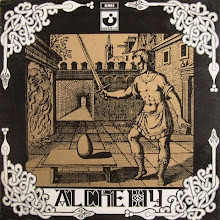
And what an eclectic, interesting bunch of records was released in Harvest’s 1969–73 period. In the second half of 1969 alone, the label engaged with traditional English folk (Shirley and Dolly Collins’ Anthems in Eden), free form folk/jazz/classical esoterica (the Third Ear Band’s Alchemy), original and diverse singer-songwriters (Michael Chapman’s Rainmaker and Kevin Ayres’ Joy of a Toy), and Wasa-Wasa, the debut by psych-festival freak favourites the Edgar Broughton Band.

The creativity of the music was matched by the attention paid to the artwork. The renowned SHVL* series (the catalogue name and number seen on the vinyl’s distinctive label) produced glossy artwork from the likes of designers Hipgnosis in a gatefold sleeve – perfect for skinning-up whilst enjoying the sounds of Flat Baroque and Berserk (1970) by Roy Harper.
And it was 1970 when the label had its golden age. No less than twenty-six records were released that year, including the label’s double-set sampler, Picnic – A Breath of Fresh Air. EMI also ensured that the label was distinct from the mother-company, as future label head Mark Rye described in 2014: ‘The Harvest office was just this dark corner, as far away from everyone else as you could get. It had cushions on the floor rather than desks and chairs…’
1971 would see the last album by the Move (Message from the Country) before they mutated into the Electric Light Orchestra, their debut album released on the label towards the end of the year. Roy Wood went on to form Wizzard, who would have Harvest’s strongest single success with ‘I Wish it Could be Christmas Everyday’, reaching #4 in the UK singles chart in December 1973. Artistically, however, the label had peaked by this point. 

Whilst The Dark Side of the Moon enjoyed huge sales, many of Harvest’s original signings had moved to other labels, or fallen by the wayside as the underground ebbed away. Aside from the Floyd’s subsequent releases, the mid-1970s were an uncertain time for the label; when EMI signed the Sex Pistols in 1976, the band declined to be on Harvest, considering its artists to be ‘hippie shit’. The label would continue through into the 1980s, but by the middle of the decade Harvest lay dormant. It was revived in 2006 by EMI A&R man Nigel Reeve and has relocated to the US as part of Capitol.

That is of course, a long way from the label’s origins. The formation of Harvest reminds one of a brief time when the majors relinquished control to the hip, therefore creating a space for freedom and progression. Although it was bound to pass, the four-year period from 1969-1973 saw Harvest release music that was original and progressive in the best sense of the term. How often does one genuinely see that these days?

* SHVL stood for ‘Stereo Harvest Very Luxurious’.


             Notable Harvest Releases 1969–1973


1969
Shirley and Dolly Collins – Anthems in Eden
Michael Chapman – Rainmaker
Third Ear Band – Alchemy
Kevin Ayers – Joy of a Toy

1970
Syd Barrett – The Madcap Laughs
Roy Harper – Flat Baroque and Berserk
Shirley and Dolly Collins – Love, Death and the Lady
Edgar Broughton Band – Sing Brother Sing
Pete Brown & Piblokto! – Things May Come and Things May Go but the Art School Dance Goes on Forever
Barclay James Harvest – Barclay James Harvest
Shirley and Dolly Collins – Love, Death and the Lady
Third Ear Band – Third Ear Band
The Pretty Things – Parachute
Syd Barrett – Barrett
Various Artists – Picnic: A Breath of Fresh Air (sampler)
Michael Chapman – Fully Qualified Survivor

1971
The Move – Message From the Country
Pink Floyd – Meddle
Kevin Ayers – Whatevershebringswesing

1973
Roy Wood – Boulders
Pink Floyd – The Dark Side of the Moon
Electric Light Orchestra – ELO 2
Kevin Ayers – Bananamour
Roy Harper – Lifemask


no©2019 Luca Chino Ferrari (unless you intend to make a profit. In which case, ask first)

December 13, 2017

The "unfolk" music of Alessandro Monti, Italian composer & musician.

Alessandro Monti is a quite intriguing musician. I listened to his music years ago when he published his first album titled "Unfolk" for his own little label Diplodisc and I really liked it. I usually give away lots of the Italian records I receive at home (for reasons you can easily understand...), but that Monti's album is still one of the few I hold in my discography with some great old Italian experimental music (Area, first Battiato's albums, Aktuala, Alan Sorrenti' first two records, Zeit, Dissoi Logoi, Tangamanu...).

At 57, Alessandro has been composing and recording music for almost two decades, a peculiar research deeply rooted in folk and world music, but that shows to know well electronic and popular music too. As in his last studio work titled "Intuitive Maps", full of ideas and suggestions that you could record three different albums!

Because he admits, among other bands, to be inspired by the Third Ear Band, and because I feel that something of TEB is displayed in his music, here I am with a long, articulated interview about music, compositions, record market, technologies... And even if he states popular music is living a big crisis now, he's the clear example we can have some hopes for the future... 


LCF: "Your first solo album, this wonderful "spiritDzoe" published in 2014, is a syncretic fusion of lot of folkloric and WM elements... and it seems to me to detect in it bits of Terry Riley, Richard Youngs, Cuffern (that wonderful album "Wyrdstone"), Michael Cashmore, 'our' Third Ear Band... all in a very personal, unique style that it's just yours, of course - this "Unfolk"music you're playing for at least one decade... How is born your "unfolk" and this marvellous solo record?"

AM: "Well, last year we celebrated 10 years of Unfolk with a collective album and "spiritDzoe" was my previous effort, my only "solo" album so far: I must confess I'm still very fond of its silent and humble perspective.
"Unfolk", first edition (2006).
It was a sort of musical therapy for me at the time in a difficult moment (separation from my wife, health problems, issues in my daily job), and something which took shape directly in the studio, with few pre-conceived ideas playing virtually everything at hand, deliberately leaving noises and imperfections on tape as a sort of human document, for me intensity was more important than perfection, expression more vital than showing off. So after listening back to all the pieces of the puzzle it seemed like a ritual, I was searching for the primitive rhythm, the purest essence of sound... passing through all the elements and instruments, finally reaching it in the all-percussive ending.


Frankly I never heard some names you quote, but of course I've grown up listening to Terry Riley and John Cale (who indeed followed the most unique and extraordinary path in music), the Incredible String Band, Art Bears, Stockhausen and "our" Third Ear Band: listening to "Macbeth" as a teenager was a life-changing experience.
"Unfolk" celebrative edition (2016).
I actually saw Richard Youngs in Venice years ago and I liked the records, but I think we have a different approach, he seems to enjoy singing a lot, while I mostly love the instrumental side... even if I'm working on an album of "songs" right now! Perhaps we both share this idea of Unfolk ("non folk" in Italian), traditional elements to be transformed by the times we're living, through new technologies and other cultures. My "Un-folk" is "Un-orthodox" folk music, "Un-known" tradition, an organic update of that timeless musical language... it's also a vital transformation, a never ending work-in-progress..."

Listening to the recording after all these years, on that final section I was influenced by the style of The Art Ensemble Of Chicago and the master Japanese percussionist Stomu Yamash'ta.

LCF: "And what about "spiritDzoe", your first solo effort?
 
AM: ""spiritDzoe" starts with a mandolin feedback (parte 1), I think the only one recorded so far... but I could be wrong [laughs]. After I used all the possibilities of that instrument (both acoustic & electric) on the previous cds ("Unfolk" & "The Venetian Book Of The Dead"), I felt the need to go beyond the strings, because nothing's sacred in my opinion; plus I love feedback and I tried to obtain the right notes while moving the neck in front of a small Orange amp at maximum volume... 


 "The Venetian Book of the Dead"
I practiced for approx 30' until I found the right notes; it was truly inspiring and it slowly became a "composed" piece, using a synthesizer drone like a tamboura... in early music is called "bordone", nothing's changed and both East and West share the same elements. Lou Reed's "Metal Machine Music" and Derek Bailey's guitar improvisations were other influences at the time, and of course Syd Barrett's use of controlled feedback on early Pink Floyd recordings. And yes: World Music has a special place in my heart: I started studying indian music in the early 80's, then Greek, Balkan and African styles; we're in the middle of a crisis in our Western world and arts reflect all this, so I'm learning from other cultures... there's always something new to enjoy out there!

"spiritDzoe" (2014)
Anyway in the making of "spiritDzoe" I was listening to the so-called post-rock scene... bands like Rachel's, Labradford, Tortoise and the most popular of them all: Talk Talk, their last recordings "Spirit Of Eden", "Laughing Stock" and the acoustic Mark Hollis' solo cd are crucial records to understand the evolution of alternative music, still important and influential... perhaps the last great records produced by a rock band.


I'm so happy you love "spiritDzoe" because it comes directly from my heart, it's sincere and true and definitely the difficult and esoteric side of my work. I'm not a full-time professional musician, I'm also a healthcare worker and parts of "spiritDzoe" were inspired by my job with disabled people; I realized I wasn't paying much attention to rhythm, but I was amazed at how important it can be... I mean spiritually, physically and psychologically.""

LCF: "So you are inspired by a lot of references and different music genres... what do you think about the present condition of Western popular music?"

AM: "What can we say? Something radically changed after the 90's and during the last few years it seems that all quality pop songs disappeared from airplay, leaving only the same old melodies, the same chord changes and the same electronic tricks with no ideas, but I think that it reflects society's decadence... I'm not sure if we're living through an era of transition but you can experience this in politics, arts, media and culture in general.

Talking about music: we don't have talented artists like we used to, they were creating art-songs with lots of ideas. Technology nowadays is often used with boring effects, take the Autotune for example: you can hear it everywhere, but few people can obtain original effects from it; it could be really interesting for vocal transformations (like Vocoder in the past), but I only heard John Cale & Todd Rundgren using it in a creative way so far... but the fact is they're both 70, this means a lot to me: different generations, different understanding of music and social awareness... this is truly a “generation gap” in a negative sense.

"After the 70's many people of my generation hated the 80's, but I remember I was listening to a lot of great songs back then, post-punk bands, new wave and synth-pop... recently I transcribed many 80's classics on my guitar for a live unplugged project and I decided to choose mostly electronic dance pieces because they were a sort of challenge: all results were great, I had fun with the chords and structures... really good stuff. Now it's over, I hear only bad copies of old styles.

"Intuitive Maps" (2017)
By the way I always loved pop songs and I really miss a good song coming from the radio; I used to buy pop records once in a while, but now I can only feel a deep void, we're quickly going into a black hole where everything is filtered through social networks and cell phones taking control of the lives of millions: it's very dangerous... I ran out of facebook years ago when they blocked my account for no reason: I was only promoting my music but they didn't like it! Young kids now listen to music in cell phones, with awful audio setups, playlists made of short fragments downloaded for free from the Internet.They just don't know how to hear music anymore, they can't imagine what a full album is, and they don't care about the work behind a record... they take their files for granted. I think it's our responsability: we created a lot of culture in the past but we destroyed it with apathy and laziness. It's a complicated matter and there are many levels of reading this, but the truth is: today showing a new tattoo is much more important than sharing a record, sad but true.

"So I could answer that the condition of Western popular culture is the result of a dramatic change in Western society. From time to time we still hear some great music... at 57 I'm still producing new records with the same enthusiasm though: you may say I'm a dreamer, but I'm not the only one (thanks, John!)."
 
LCF: "Yes, I agree with you, we're living in very strange times: it's so easy to produce music now, but at the same time we have a huge amount of rubbish around... What kind of music you're listening to in these very difficult momentum for popular music?"
 

"Firstly I don't rely on the web too much... I only try to get infos about some rare material or specialist distributions, but I still support the local shops a lot: they're the most important source for culture and they must live! Inside the booklet of the new "Intuitive Maps" cd I wrote very "alternative" notes: I thanked all friends working in record shops, they helped Unfolk so much through the years. Plus I think that walking inside a shop and hearing something new is still a fascinating experience to me. I must admit I never listen to music on YouTube or Bandcamp, I don't really like the sound on tiny computer speakers and I enjoy cds very much: I think they're the best solution for sound today; I don't believe in vinyl reissues, except for original copies or old analogue pressings. All new editions on vinyl transferred from digital masters are pointless to me, the sound is flat and the dynamics almost non-existent... we have the best support, why don't we choose it? Having said that, the strangest thing is: I never saw so many new releases as in these difficult times... I mean reissues, remasters, unreleased stuff and live broadcasts: they're financially impossible to follow. So, sometimes I prefer buying something old than new, I only bought one or two new releases this year, but I got lots of amazing stuff from the past... perhaps I'm getting old [laughs]. 

I like Contemporary Classical, electronic and concrete music, many rare and deleted recordings are available now, so it's the right time to get them. I also love unusual Library music and jazz reissues (classic Sun Ra and Don Cherry recordings always seems to be inspiring), and I always love to hear the occasional african vibe. About rock music: it seems to me that the best of the last few years came from Eastern Europe, bands like Plastic People Of The Universe, Pulnoc, Reportaz, ZGA, Roz Vitalis... all very original and inventive. My favourite labels are ReR Megacorp and LTM (their 20th Century Avant-garde series is priceless), and I think Burning Shed has the best prog distribution... so I always discover stunning works I missed with unusual material and beautiful artworks. But I always ask my local shop first!"

LCF: "You're from Venice, or at least I think so, one of the most famous historical town in the World. Is this fate inspiring in some way your own creativity?"

AM: "Good question. I was born in Venice but I live in Mestre (only 10' by bus)... when I was a kid I spent every weekend in Venice because my grandmother lived there; I loved the City and the unique atmosphere, it was quiet and much different back then, less tourists and caos. Perhaps some traces can be found on my use of mandolin, it was a popular instrument in Venice during the past centuries (Vivaldi concerts are wonderful examples); funnily enough the instrument I used on the early Unfolk cds isn't Italian but Irish! 


Paul Delvaux (detail of "Thevenetian Book of the Dead" cover ).
Another hidden influence could be my interest in world music because Venice was an important crossing of different cultures in the past. So I surely love that City but Mestre had a deeper and darker influence on my work: "The Venetian Book Of The Dead" is an album inspired by the industrial disasters in Marghera where many workers died by cancer in the PVC/vinyl factories (I wrote long notes about this album on my blog: unfolkam.wordpress.com): environmental issues are still alarming here for many reasons."

LCF: "Do you think TEB's music can be still influential for a contemporary musician in terms of improvisational music?"

AM: "It's a difficult question... during the mid-70's when I was at high school, Third Ear Band was a rather famous group, nowadays it's hard to imagine so many students having copies of the second Lp or "Alchemy"; they were esoteric of course, but I clearly remember exchanging copies of the albums with many friends. TEB were unique, something that was truly original even in the record boom of those years, but people who listened to conventional rock music, Kosmische Couriers or The Soft Machine were enjoying their sound: it's no coincidence that TEB was a perfect opening act for bands as diverse as The Rolling Stones, King Crimson or Pink Floyd... they created a sonic flux literally uplifting the audience to another level. Those were incredible times for sure and many improvising musicians were touched or influenced by them; certainly when I was at high school I was growing up in a cultural environment and turmoil very different from the present one, but I feel that TEB could still be influential in post-folk, new jazz, world and progressive music. I think that the balance you hear on the classic recordings by TEB is nothing short than exemplary and instructive; it could be a source of inspiration for new generations. Thanks to your website, a true labour of love, you're unveiling the mystery surrounding Third Ear Band 's existence and recordings... it's the best thing you can do: using today's technology and tools to promote their music and make musicians aware of their improvising art." 

Paul Delvaux (detail of "Thevenetian Book of the Dead" cover ).

LCF: "Which specific elements of Third Ear Band's music you feel are in your "unfolk" approach to sounds?"

AM: "I think that perhaps all specific TEB elements found in my music surface on a sort of unconscious level, but I'm sure that the use of hand percussion, strings and eastern drones come directly from those records. I dedicated one requiem to Florian Fricke (of Popol Vuh) on the first Unfolk record, but I should do the same for Glen Sweeney as well! There's a spiritual and primitive side in TEB's music that I love, I really think that TEB captured the essence of a timeless sound. I played a version of "Eternity In D" linked to "Bitches Brew" like a medley; the bass riffs are quite similar but the notes evolve in different directions (Paul Buckmaster explains the musical aspect in detail in your interview); I love electric Miles and knowing that there's a link with TEB seems logical and beautiful. The incredible thing about the 60's, 70's & 80's was that everyday search for new solutions and cross-pollinations, in other words there was MUSIC, no boundaries or style limitations... "file under freedom".


I'm very proud that some of my cds have been linked to TEB by critics and listeners. I was a teenager when I first heard "Macbeth" in a Venice record shop... I can still remember the feeling I had in my headphones, standing petrified and listening to a whole side without interruption, it was an epiphany of new sounds: those dissonant string arrangements by Paul Buckmaster & Simon House, the non-classical use of oboe by Paul Minns, Denim Bridges' distorted guitar totally out of a rock context and Glen's basic 4/4 rhythm patterns were a total revelation to me. The music was so simple and rich at the same time, leaving a lot for imagination. I actually watched the film many years later but I already made my own personal images with the music. Sometimes I think that soundtracks shouldn't be made for a film! If music works you can close your eyes and live through a parallel dimension creating your own story... imagination is the key: that's why I prefer records to films, and radio to TV.
 
I'm working on a new project of songs right now with a deep subject: the musician's oblivion... I think that music exists before and after its actual creation, so the composer's ego is totally useless, he's only a decoder of cosmic waves, nothing more. Fame, success and stardom are the other (wrong) side of the coin. When I listen to TEB records I always forget who's playing and concentrate only on sound: the notes are living their own life both individually and collectively... that is a rare achievement in my opinion and all the best music should have this quality."

Promo poster for the last CD.


A Third Ear Band sketchbook
(8 random notes for Ghettoraga Archive by Alessandro Monti)

1. The pizzicato violins on “Stone Circle” and “Earth” are among my favourite sections of TEB's records;

2. the non-classical use of oboe on TEB's recordings reminds me of the sound of an ancient and rediscovered instrument, like something unearthed from the dust of time. The experiments by Yusef Lateef, Paul McCandless and Karl Jenkins were very much interesting but more structured and modern;

3. the hand drums on “Air” have an almost electronic quality, something rarely heard in folk/world music at the time... the rhythm is so good even today that it could be confused for a sampled track!

4. the trance-like “Fire” is a monolith performance that seems to me without a beginning and without an end. The result is very close to La Monte Young's experiments of the 60's with John Cale (on viola) and Tony Conrad (on violin). The collective playing on “Fire” is so intense that it could only be interrupted!

5. the only song recorded by TEB in the classic trilogy is “Fleance”, a functional piece in the film, but also an effective folk ballad: in my opinion it's a deliberate reminder of the essential purity and utter simplicity of their almost childish approach;

6. many artists tried to convey in music “The Egyptian Book Of The Dead”: Pierre Henry recorded the darkest composition on the opposite side: concrete & electronic music. Here's a subject that will resurface in different ages and styles, until people will rediscover the early acoustic pioneers! 

7. the balance between traditional instruments and electronics on “Macbeth” is unparalleled: still in a no-man's land;

8. few artworks can be so "iconic" than the trilogy...


ALESSANDRO MONTI's DISCOGRAPHY

"Unfolk" (CD - Diplodisc , ITA 2006)  350 copies limited edition
"The Venetian Book of the Dead" 
 (CD - Diplodisc dpl 002, ITA 2009)
"spiritDzoe" (CD - Diplodisc dpl 008, ITA 2014)
"Unfolk"/Live Book 
(CD - Diplodisc dpl 005/6, ITA 2016)
"Intuitive Maps"  
(CD - Musiche Particolari & Records MPRCD072, ITA 2017)


 OTHER PROJECTS/SAMPLERS/COMPILATIONS

Caveman Shoestore
"Master Cylinder" (Tim/Kerr Records, 1992) production
Various Artists
"Italia No! Contaminazioni No Wave Italiane (1980 - 1985)"
(LP/CD - Spittle Records, 2013) 
 Massimo Berizzi 
"Spirali"(CD - Diplodisc dpl 007, 2013)
Various Artists
"Diplocomp. A Diplodisc Sampler"
(CD - Diplodisc dpl 010, ITA 2014)
 Various Artists
 Burning Shed Free EP (Burning Shed) limited download only
Quanah Parker
"Suite degli Animali Fantastici" (MP& Records, 2015)
 Quadelectronic
"QE98" (Quadelectronic Documents, 2017) 12 × File – FLAC Digital album
Various Artists
 "The Wire Tapper 44"
(CD - The Wire magazine, UK 2017)


 CONTACTS  
Web site:  
http://unfolkam.wordpress.com
Soundcloud:  
http://soundcloud.com/unfolk 
no©2017 Luca Chino Ferrari (unless you intend to make a profit. In which case, ask first)