Showing posts with label Egyptian Book of the Dead. Show all posts

July 28, 2019

A review on "Alchemy" on Facebook...


Esoteric according the G-man, on his Facebook page, reviewed here  "Alchemy"...

Sometimes, I wonder why I do this to myself.........after the “Elements” album being quite, shall we say, “challenging”, I was consumed with curiosity, bearing in mind I'd never heard any of their albums before now, to see what happened next........
…..to which the answer is........things got “less challenging”..... you can see this review is really gonna help, can't you.......
With a whole CD and a bit of previously unreleased tracks, let's start with the “Alchemy” album itself. The whole package is instrumental – get that out of the way first – and the main album is a whole lot more cohesive and structured than what came before, or it certainly sounds that way. For the first track, against a shuffling tabla rhythm, the violin, or viola, interweaves with the oboe and the effect is both mesmerising and hypnotic as the instruments kind of stride along with the textures counteracting and creating an almost melodic feel to the density. The 10+ minute “Ghetto Raga” that follows, is, however, the first time for this band, that my ears (lol) pricked up and something really grabbed me, coz this track is an absolute gem. Again, with tabla rhythms to the fore, the viola and oboe continue to weave, soar, drone, stride and fly over the ever gathering rhythmic clouds and something akin to Terry Riley meets Indian, unfolds in all its glory to remarkable degree and itr's this track that makes you think “thank the heavens I bought this album” as, despite what comes next, you somehow manage the resist the urge to loop this and make it last about 10 hours, never mind 10 minutes. There follows a couple of 3+ minute tracks that are more sedate, as the tabla rhythms calm, the strings plink and pluck and drone their way to infinity while the oboe continues to whirl and swirl, the whole thing achieving that Philip Glass/Terry Riley kind of cyclical nirvana, but injected with greater texture, less intensity and more melody.
“The 8+ minutes of “Egyptian Book Of The Dead” (kinda gives it away, really) starts more of a wail before the slow tabla beats begin, the dervish like dance of the oboe begins and it all gets rather rhythmic in a quite unexpected but delightful way, as the cello unfolds a mournful meandering underneath, and you can just picture the boat with the body on it, floating down the Nile, as the mood darkens, the strings shimmer eerily and the beats keep beating.
From there on in, things swing to and fro from slowly sailing to wickedly dervish swirling and most points in between, the whole album a huge step up from the first and, although I never thought I'd say this, something I'll be listening to again when the mood is right (you know, funerals, bad news, your girlfriend's dumped you – that sort of mood). As a bonus there are two 6 minute tracks froma 1969 “Top Gear”session which continue the mood of the album, only here in a “live” situation, the viola and cello sound incredibly Cale-esque (that's John, not JJ) while the oboe is just sensational sounding with the tablas as the heartbeat that keeps it all alive – superb stuff and a thoroughly excellent CD.
The extra bonus CD consists of all previously unreleased tracks from recordings made in 1968 (back to “challenging” although not quite as harsh) plus tracks recorded at Abbey Road studios in 1969 which are more varied yet consistent with the moods of the main album, but I won't go into detail as (a) you'll be bored, and (b) life's too short. Suffice to say, the main album is a stunner so give this a go and if you only ever own and love one Third Ear Band album, this is definitely going to be the one.

no©2019 Luca Chino Ferrari (unless you intend to make a profit. In which case, ask first)

May 02, 2012

A review of "Hymn to the Sphynx" from "Prog Archives" Web site.


This recent quite interesting review of "Hymn to the Sphynx", written by "Sean Trane",  has been published by "Prog Archives" Web site 
(http://www.progarchives.com/Review.asp?id=743932): it'd be good if some TEB fans would like to review records, facts, things for this archive too!

"The present double-disc collection is a weird throw-it-all-together compilation, mixing some already-released first-era TEB material and some studio and live second-era recordings. The main interest of HTTS is the band's history in the booklet. A fairly ugly artwork disgraces this confusing compilation album as well, and while the music is mostly about the second-era, the pictures in the booklet are solely about the first-era, which kind of induces (willingly?) in error.


I'll first spend a few lines over the Abelard & Heloise suite, which had received a few months before its own release, and it represents quite well the TEB's first line-up. If you want to know more about A&H, read my review on that album's page. Of course, you'll find much more info about the piece and its background in the booklet of the present collection. To be honest, I'd have preferred the A&H suite to be released with the BBC sessions (are they still available?), rather than the second-era stuff present on HTTS.

Coming to that second TEB life, the studio tracks (recorded in 90, as part of the Magic Music album) on the first disc present relatively lengthy (5 to 9 minutes) ragas, that while being interesting, are mostly diluted via the electronic violin gear of Neil Back, while Dobson's saxes are in the line of what Minns did. But drummer Sweeney is the only remaining original member on this session. The trafficked violin gear was able to produce some electronic loops, sometimes approaching the future techno music stuff, even developing a slightly industrial feel, especially on the session-closing Midnight On Mars. The booklet tells us not to confuse the music of this session with the Materiali Sonori album of the same name, but you'd have to be a real TEB expert to tell a difference. To be honest, it's quite a relief when the A&H suite comes around.

As for the live recordings of the same year (featured on the second disc), it features the same line-up as the studio session; but they don't sound as "electronic" or "industrial" as those studio tracks, although the extended raga gives it a family resemblance. The set features a couple of tracks from their future album (most notably the very Indian-sounding Sun Ra Raga), one from the previous Live Ghosts, and more important their first-era compositions of Egyptian Book Of The Dead and Pyramid Song (both from their debut, the latter featuring some Dobson-scat vocals), which is an interesting exercise in comparison between the two eras - quite different versions, and the original being superior, but these are not without charm. It's unclear to me whether these live tracks are the ones that came out on the Voiceprint label's 96 release TEB Live, in which case this would render the present compilation almost utterly useless. Not sure the Mooncrest label did you a favour to you by releasing this one, because even parts of the liner notes seem to be paraphrasing Joynson's Tapestry Of  Delight book TEB entry. I'm rounding this up to the upper third star".

no©2012 Luca Ferrari (unless you intend to make a profit. In which case, ask first)  

February 19, 2012

"Alchemy": an esoteric record for initiates.


As a powerful musical/visual/conceptual device, “Alchemy” stands as a really unique work in the Popular Music history.

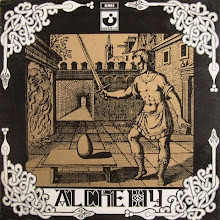
"Alchemy" CD booklet cover (Drop Out Records 1999)

As on a recent essay Italian writer, Antonello Cresti writes, “this album is full as ever of musical invitations (all the tracks are instrumental) to take a more deep and conscious form of spirituality up” (read at http://ghettoraga.blogspot.com/2012/01/tebs-cultural-sources-on-italian-book.html).

Absolutely right, but probably it’s much more.

Because if it’s quite easy to discover some elements of cultural suggestions just based on the tracks’ titles, linked to the feelings of its time (the epic Sixties…), in my opinion, “Alchemy” was thought as a strong summa for an alternative life. A philosophic (music) treatise for a New Age.
Also for this, this album seems to transcend its time…

I’ve already written about the “Egyptian Book of the Dead” in this archive (read at http://ghettoraga.blogspot.com/2011/08/tebs-egyptian-book-of-dead.html) as a piece of incredibly scary sounds intended for going with the dead through his death. Music composed to remember us our ephemeral life and the responsibility to live with an ethical approach to human things.
But what about the album's other tracks?

Druids painted by Charles Knight (1845)
It's easy to state that “Alchemy” (1969) is conceptually more complex than “Third Ear Band” (1970), even if for music critics the second is generally considered better than the first. Anyway, here we have a stone circle and a druid, surely alluding to the pagan druidic ancient tradition; the direct quotation of the ancient Book of the dead (Egyptian history related); the dragon lines, as Cresti explains in his book, “a clear musical transposition of pioneer theories of John Michell, who had transposed Chinese tradition of "Lung Mei" on English culture and told about "Dragon Paths". These "Lung Mei" (an expression we can in fact translate as "Dragon Paths") are energetic lines discovered by ancient Chinese; from the heart of a dragon, usually laid in a valley among the hills, springs of energy have radiated, as it occurs with the "Ley Lines"".

In "Alchemy" we have also Dave Tomlin's “Lark Rise” (based on Flora Thompson’s book “Lark Rise to Candleford”) that celebrates a vanished bucolic utopia as documented elsewhere here (read at http://ghettoraga.blogspot.com/2012/01/dave-tomlins-lark-rise-origins-cultural.html).

Swinside stone circle (West of Broughton in Furness)

And we can listen also to three apparently more obscure tracks - “Ghetto Raga”, “Mosaic” and “Area Three” - all related to the idea of space: a space to protect (thanks to the snakes on the cover...), a ghetto, a place for Hermetics where to practice alchemy (the cover concept) and turn the poor metals in gold (Prima Materia).

 Asking Dave Tomlin about this idea of space (January 24th, 2012), he writes to me: "I could speculate a little. "Area three" comes I think from the film world. It is a forbidden place; maybe dedicated to government secret experiments on... humans? There is a place like that in the Russian film 'Stalker' - Tarkowski, I think -, which would tell you all.
I think they used "Ghetto Raga" just because it sounds good. Ghettos are run down areas where poor people, usually of the same race live (Jews etc.). So Ghetto gives a rough type image, and raga is another racy word, although it's doubtful if any of the band studied Indian music. So together the two words create an interesting effect. No more than that...".


Byzantine mosaic (Galla Placidia Mausoleum - Ravenna, Italy)

But a ghetto of raga, where religious musicians play ragas besieged by the (post) modern world, could be the same area three (three as the TEB musicians?), a place for (musical) alchemic experiments...

Thus a record as a clear powerful metaphor alluding to turn bad music in good music, a superficial/commercial listening to a deep one, a materialistic life to a spiritual one…
I think “Alchemy” is a coherent, integrated device of ideas related to a definite conception of life - very distant from the usual Sixties Egyptian ephemera of fashion.
The best work ever produced by the band and one of the best albums of its time (no Egyptian junk, please!).

Maybe an alchemic product itself!?

A detail of the egg (the Great alchemic Opera) from "Alchemy" front cover

As Glen Sweeney said about the TEB music, "the music is the music of the Druids, released from the unconscious by the alchemical process, orgasmic in its otherness, religious in its oneness communicating beauty and magic via abstract sounds whilst playing without ego enables the musicians to reach a trance-like stage, a "high" in which the music produces itself. Each piece is as alike or unlike as blades of grass or clouds" (from the original 1969 Isle of Wight concert programme).

And again, just around the period when "Alchemy" was recorded: "We are beginning to move into some strange musical areas, doing a piece we call Druid. Once or twice when we've played this thing, we've gone into a weird sort of experience we call a 'Time-shift'. Nobody really knows what it is. The whole Druid piece is repetitive and extremely hypnotic and yet you have some of the instruments doing far out things so that a fantastic tension is built up. It's like alchemy. The alchemical emphasis is on the endless repetition of experiments, doing the same thing over and over again, and waiting for some sort of X-factor to appear. This is more or less what we do when we play. And our X-factor is this time-shift thing".


"It happened once at the London Arts Lab, and as we played, it seemed as if time had slowed down and we had drifted into a completely different dimension. And when we finished, nobody moved at all. They were kind of stuck there. So I felt that perhaps it had happened to them too. So that's the thing we are trying to get into. Although it can be quite a strain during a public performance, like living on the edge of a cliff, since nobody knows what might happen. To be on stage and feel it happening can be quite frightening. You go out of yourself, and when you come to, you discover yourself on stage with hundreds of people staring at you. You get this split-second thought: 'Have I been playing? Have I ruined the whole thing?' In a way, it's very similar to meditation and mantra chanting, which is why I feel what we are doing has a very religious depth" (from "Gandalf's Garden" #4, 1969, interviewed by Muz Murray).

Tomlin clarifies me (January 30th, 2012) that "in the mid-Sixties, there were many different influences. One was the legend of King Arthur's Court. Another was the Aliens - flying-saucers - messages from the stars. Also Blake's "Jerusalem", the Ley-Lines, Ramana Maharishi. And the mysterious arts of Alchemy.
There was an Alchemical saying of the time: 'When the sound of the music changes the walls of the city shake', which the Third Ear used at one time. Glen was very much drawn to the Alchemical myth. In fact a few years before he died he kept an ex-WWII torpedo-boat on a north London canal. Its name was 'ALCHEMY', he and Carolyn used to roar around the canals in it and everyone had to get out of the way; they were the terror of the waterways. I sometimes visited them on the boat and when Glen died she took the compass from the boat and gave it to me (this compass came from Glen Sweeney's boat Alchemy)...".

As in the past, people used to write books for initiates, in modern times, musicians play records to open the mind and soul of people ("Happy new ears!" John Cage wrote): Third Ear Band has left us a beautiful, scary record of magic/esoteric/philosophic music for the everyday life & death... 
Also for this reason sometimes we return to it as a sort of breviary, listening to little drops of it as a thaumaturgical magic potion!

"Alchemy" CD back cover (Drop Out Records 1999)

no©2012 Luca Ferrari (unless you intend to make a profit. In which case, ask first)

September 07, 2011

Italian composer STEFANO GIANNOTTI talks about Third Ear Band's music...


Stefano Giannotti (born 1963) is an Italian composer, author, director, guitarist and performer. He studied composition with Pietro Rigacci and he has been the assistant of the famous Alvin Curran on “Crystal Psalms" and "Tufo Muto". Between 1983 and 1990 he performed in several European countries with the chamber music group Trio Chitarristico Lucchese (an acoustic  guitar trio) and formed his first group called Ensemble Il Teatro del Faro. In 1997 he started a collaboration with the Italian choreographer Roberto Castello and between 1998 and 1999 he lived in Berlin. On 2000 he has been guest of the Kuenstlerhaus Schloss Wiepersdorf in Brandeburg and on 2002 he has been invited in Worpswede by the Ministerium of the Niedersachsen. The same year he has won the Karl-Sczuka-Preis (SWR, Baden-Baden) with his work "Il tempo cambia" and on 2007 he has got for the second time the Karl-Sczuka-Preis for his radio-piece "Gealogica".

On the present day he's playing with a new group, OTEME (Osservatorio delle Terre Emerse).
His repertoire ranges from performance, radio-art, dance theatre to chamber music, orchestral scores and songs.
Landscape, memory, life cycles, voices of people, languages are some of the main themes developed in Giannotti's work. His compositions have been performed in festivals, theatres, museums around the world and his collaborations included works for radios and TVs. 
With one of his groups, Vaga Orchestra, he played a new arranged version of TEB’s “Water” from their 1970 second studio album.
From the Eighties he declares his deep appreciation for the Third Ear Band's music.

We knew 25 years ago at the time of the Ensemble Il Teatro del Faro, when I was involved with the management of the reformed TEB. You declared your great interest for their music: can you tell us how it's happened your encounter with the TEB's music?
"I've known TEB's music when I was 17 at the secondary school. In my classroom there was some friends of mine not studying music so deeply as I did but they had musical knowledge much more than me - they knew bands and artists I didn't know - I never heard about them. At that time  I was listening to Genesis, David Bowie, Gong, Tangerine Dream, Van Der Graaf Generator and Mike Oldfield. They told me about Zappa (I didn't love him at the time), Soft Machine (the same), Henry Cow, Hatfield & The North, they made me know Robert Wyatt - a group of depth artists they was probably reading on some music magazines. Among these meetings there was also Brian Eno, Philip Glass and the Third Ear Band.
At the beginning, as for all these kind of music, they bored me, but after all through my personal peregrinations I've already bumped into La Monte Young and Igor Stravinski...
The Third Ear Band was a great discovering, I liked very much their approach to a kind of music that remembered me the Tangerine Dream and in the same time the popular theatre: I loved much the oboe, the ancestry of their proposal, maybe I was bored by the lenght and the repetitiveness of their compositions, but I got use to it quite soon.
Of course I had some disputes with my classroom mates about their music: I loved more "Macbeth", but the critics stated the other two albums was better, so my mates liked more that records.
There was also the pleasure for reasearching the records: infact in those days it was very difficult to find their albums in a record shop, and for that reason we did lend ourself one of two of them and we take them for many months..."

                                    OTEME  -"I was a mill"/CadutaMassi

Beyond to have included TEB music on some of your repertories, how much of their experience has gone in your music, about the sound research and the art of composition?
"The Third Ear Band has caratherized the sound of many works composed by me between 1991 and 1999. The Ensemble Il Teatro del Faro was made up with oboe/English horn, cello and electric guitar, with some other instruments as Indian organ, pan flute, ocarina, objects and toys. The music we played was quite different from the Third Ear Band's, but sometimes it contained the same spirit of improvisation and the love for that kind of sounds; maybe it was less similar about the hestetics, because, even if it was charaterized by improvisations, the most of my works is composed, not improvised".

Which are your compositions directly influenced by the TEB sound?
"The tune more directly influenced by it could be "La recita" [The play] from the suite titled "Ritratti, pagine e improvvisazioni su Amleto" [Portraits, pages, improvisations on Hamlet]. In this tune, electric guitar and English horn make a rhytmic sequence quite similar to the Sweeney's hand drums, and the cello sounds a melody, on a viola's extention, and at the end it improvises. Maybe it can recall "The Egyptian Book of The Dead", maybe more "Macbeth". Another tune surely is "Tema dei campi" [Fields' theme] that at last, after 20 years and a lot of different versions, this year it'll be recorded on a CD by my new group OTEME. On this composition the teponatzli, a percussion instrument similar to an ethnic marimba, play the continuous rhytmn, the oboe makes the melody, the clarinet does a rhytmic/melodic contracpuntual to the oboe and sometimes piccolo's phrases insert on it; the harmony is build by synth and electric bass. One of the first versions of the track (maybe composed in 1990) sounded as "Achemy", but globally my tune is more complex, because more contrapuntal.
There are some influences here and there on other  compositions I've written: the last one is from 2010, an experimental video I made in Poland ("The Walbrzych Notebook": see at http://www.stefanogiannotti.com/thewalbrzychnotebook.html): on a sequence of the soundtrack electric guitar is played with a bow, and I remember just before to compose this tune I used for the film the "Abelard & Heloise" soundtrack.
I liked so much the combination that I stopped immediately to listen to it to avoid the risk to become prisoner of it and don't be able to compose some of mine. But at the end I composed a tune that remember in some way the Third Ear Band atmosphere."


           Stefano Giannotti - "Corali III-IV"

How would you describe TEB music from a composer point of view?
"A music out of time and out of any label. As the music composed by Giacinto Scelsi, John Cage and Morton Feldman. These composers are very up-to-date in any age because they don't belong to a specific time, they are out of format. I've been so impressed to listening the TEB again after a very long time and compare them with other bands using the ethnic element in their work - as the Oregon, for example... TEB is unique, they don't smell of ECM or World Music, their semplicity is so disarming that one cannot apply the same critical categories as to a specific school of thought. It would be as lump everything together.
I can't labelled TEB music as psichedelia or etno-music, or minimal, because at the end none of this genres sounds as they play..."

Observing the condition of contemporary music (I mean his level of development), do you think TEB music is still up-to-date? Why?
Surely it's a music still very up-to-date, and it's shame (I'm polemic here!) you can hardly convince some young homo-sapiens to stop just for five minutes and listen to it (generally as for all sophisticated music). Periodically I do workshop about guide to listen to contemporary music and the Third Ear Band has a place of honour there. A  lot of contemporary ethno-jazz is so predictable until the first notes... it's not the same with the Third Ear Band, maybe because the musicians wasn't  so great virtuous, never rivers of notes as Paco De Lucia, but power of concentration, breath and sound. In some ways, as I stated, I find a parallelism with Feldman, Cage and above all Scelsi.

                                                      Giacinto Scelsi - "Trio for strings I-IV"

Sure, if you avoid any labels you bore the society and fatally you sink into oblivion.
Years ago I tried to arrange "Water" for Vaga Orchestra, an ensemble of students of music. The band was composed by two flutes, tenor sax, violin, keyboards, four guitars, Indian organ, bass and drums. Arranging the tune, I decided to round up for semitone every descending or growing note of Ursula Smith's cello. The harmonic result has been very interesting: a continuous stream of consonant and discordant chords perfectly tied to each other, creating a speech with sense in a harmonic point of view, never ordinary, that obliges you to listen the music until the end of the track. I never thought the cello was improvised on "Water", and I'm not still completely persuaded of it".

Visit Stefano Giannotti's Web site at:
http://www.stefanogiannotti.com


                                                                    Stefano Giannotti - "Dal recinto"

                                                                           OTEME - "Palude del Diavolo"

 no©2011 Luca Ferrari

August 05, 2011

TEB's " Egyptian Book of the Dead": an interpretation.


"Egyptian Book of the Dead" is one of the most popular TEB tracks. The band played the tune from the very first beginning of its career (the first documented performance is from "Night Ride" BBC radio programme on January 1st, 1969) and it was played constantly through the years until the last Italian tour in 1992 even if with different titles (i.e. "Live Ghosts" on the live from Bergamo or "Necromanticus" in a new studio rendition) and outcomes.
Composed by Sweeney, Coff and Minns almost surely in the second half of 1968, it  was included at the beginning of the second side of "Alchemy", the first  album published by Harvest Records on May 1969. It lasts 6:48, while on the last period, performed just at the end of the gig as a sort of seal, it could last also around 12:00.
Being so lucky to listening to the band playing live (even if after the '80's), my personal memories bring me to the concert in Gorizia (November 24th, 1989), during the third Italian tour: you can listen to the performance on some records (i.e. "Live", published by Voiceprint in 1996), but if you wasn't there that night you cannot feel on your spine that undescribable hanging atmosphere of gelid, sinister terror. As Italian journalist Piero Bielli wrote on the gig ("Auditorium" n. 4, 1990): "(...) "The Book of the Dead", another fantastic piece, has ended the gig with an anguish crescendo, so that the frailest minds feel confused as after a peyotl".

What kind of power has this incredible track?

From a musical point of view, "Egyptian Book of the Dead" (studio album version) has a simple structure: basically it is a hand drums drone with tonal/atonal improvisations of violin and oboe. One of the last version of the track,   "Necromanticus" (as bonus track on "Live Ghosts" CD reissue) is a powerful crescendo, based on a progressive accumulation of instruments (bells - hand drums - oboe - violin - electronic effects) that picks up speed culminating in a very strong cacophony just before to stop abruptly.

SOURCES & INSPIRATION
About the sources of inspiration, we know the band took it from the original ancient "Egyptian book of the dead" (the papirus of Ani, 24o BC), circulating in those years also inside the English undergound culture (an edition of the first version edited by E.A. Wallis Budge in 1895 was published in England also in 1967). The book was not a single text but a compilation of spells and instructions designed to guide the deceased through the dangers of the underworld, ultimately ensuring eternal life, and comprised a collection of hymns, spells to allow the deceased to pass through obstacles in the afterlife. The Book of the Dead was most commonly written on a papyrus scroll and placed in the coffin or burial chamber of the deceased.
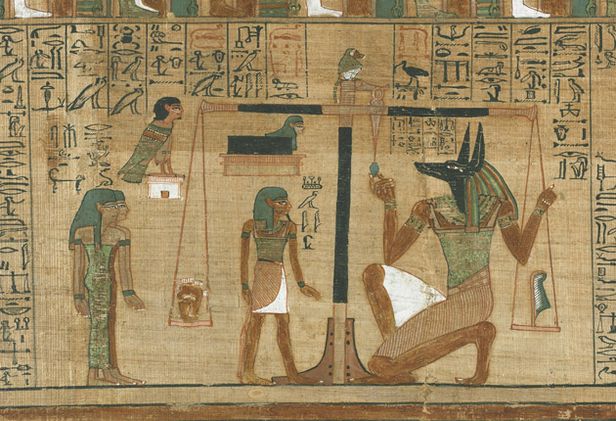
It could be considered very superficial and quite semplicistic imagine that Sweeney intended the track as a soundtrack of the main rite included in the book, one of the most terrific sequence of the book: the weighing of the heart.
But I think it can be very plausible. If it were so, we'd have an attractive appliance to imagine the atmosphere of the ritual and the structure of the track could be interpreted in a brand new way.


WHAT IT HAPPENS TO THE DECEASED
As Wikipedia states, "the path to the afterlife as laid out in the Book of the Dead was a difficult one. The deceased was required to pass a series of gates, caverns and mounds guarded by supernatural creatures. These terrifying entities were armed with enormous knives and are illustrated in grotesque forms, typically as human figures with the heads of animals or combinations of different ferocious beasts. Their names—for instance, "He who lives on snakes" or "He who dances in blood"—are equally grotesque. These creatures had to be pacified by reciting the appropriate spells included in the Book of the Dead; once pacified they posed no further threat, and could even extend their protection to the dead person. Another breed of supernatural creatures was 'slaughterers' who killed the unrighteous on behalf of Osiris; the Book of the Dead equipped its owner to escape their attentions. As well as these supernatural entities, there were also threats from natural or supernatural animals, including crocodiles, snakes, and beetles".

The TEB's "Experiences" (Harvest 1975) retro cover with clear references to the rite.
       
THE WEIGHING OF THE HEART
Again from Wikipedia: "If all the obstacles of the Duat could be negotiated, the deceased would be judged in the Weighing of the Heart ritual, depicted in Spell 125. The deceased was led by the god Anubis into the presence of Osiris. There, the dead person swore that he had not committed any sin from a liste of 42 reciting a text known as the "Negative Confession".

The weighing of the heart.
Then the dead person's heart was weighed on a pair of scales, against the goddess Ma'at, who embodied truth and justice. Ma'at was often represented by an ostrich feather, the hieroglyphic sign for her name. At this point, there was a risk that the deceased's heart would bear witness, owning up to sins committed in life; Spell 30B guarded against this eventuality. If the scales balanced, this meant the deceased had led a good life. Anubis would take them to Osiris and they would find their place in the afterlife, becoming maa-kheru, meaning "vindicated" or "true of voice". If the heart was out of balance with Ma'at, then another fearsome beast called Ammit, the Devourer, stood ready to eat it and put the dead person's afterlife to an early and unpleasant end".

Section of the Book of the Dead depicting the Weighing of the Heart.

AN INTERPRETATION OF THE THIRD EAR BAND'S TRACK
The beginning of the track, a suggestive (Stravinskian) prelude with wind chimes and a dreaming (Debussian) oboe is marked by the violin low notes in an incessant incisive contracpuntual pattern, until the hand drums start to play on a metronomical rhythm never changed.
Oboe and violin improvising on the bordone with progression of notes by the violin and oboe scales.
Here the deceased is going through the path of the afterlife and you can understand the journey is not so easy for him at all...
Around the minute 6:00 violin accords as ghosts flying around and high oboe notes, while at the 8:48 the tracks is stopped with a quiet almost relaxed end (an ironic Paul Minns about the track's coda in 1996: "I remember nothing of the production except that a few unnecessary effects were introduced, the worst at the end of "Egyptian Book of the Dead" sounding like a pyramid's bathroom...").
On "Necromanticus", after the first quite similar part, around 6:00 you can listen to a sort of interlude just before the track has a clear acceleration of the hand drums.
Listening to this version, around 7:25, the deceased is in front of Ma'at for the weighting of the heart and the pathos here is at its highest level on awaiting the result. 
At 8:49 the music stops but the result is not so clear...


Other versions, as like that played at Gorizia (one of my favourite ever!), are even more direct and powerful because the progression is clear and very speedy and the music stops abruptly leaving the listener absolutely shocked.

There, at 8:55, after a very long sequence of Carter's electronic effects, when Sweeney's hand drums start to beat his invariable pattern, you can listen a wall of sound of noise, electronics, strong electric guitar chords, Dobson's soprano free jazz improvisations build itself before you and you can just see the deceased terrified on awaiting the verdict.

Another excerpt with the weighing of the heart.

Anyway, as in the original studio version, TEB seems doesn't want to tell us what will happen to the deceased: the verdict is open to all interpretations because it seems more important to focalize that specific momentum, the state of consciousness where everyone knows inside himself if he lies or not... 

A POSSIBLE MEANING FOR THE BAND
The Weighing of the Heart step is one of the few parts of the Book of the Dead with an explicit moral content.
The judgement of the deceased and the Negative Confession were a representation of the conventional moral code which governed Egyptian society.

When Sweeney dead, I'm sure it wasn't a simple casuality or just an eccentricity his wife Carolyn decided to read excerpts from the Egyptian ancient text at the funeral. She wrote me on September 2005 about it: "(...) It was a beautiful ceremony rather than a conventional funeral, Steve Pank read from the "Egyptian Book of the Dead" and tracks from "Alchemy" were played, incense was burning, Glen was in a raffia coffin with sunflowers on top. Everyone said what a wonderful experience it was and some were reminded of being at an early Third Ear Band concert. I'm sure Glen would have approved".
I'm persuaded "Egyptian Book of the Dead" was the sign the TEB play to advise the people of their responsability into the life. No words, just sounds and emotions.
As a pagan, earthly prayer.


REFERENCES
Book of the dead on Wikipedia: http://en.wikipedia.org/wiki/Book_of_the_Dead
Book of the Dead (English version) download: http://it.kat.ph/the-egyptian-book-of-the-dead-translated-from-the-papyrus-of-ani-240-bc-h33t-ahmed-pdf-t2157400.html].

TEB's "EGYPTIAN BOOK OF THE DEAD" DISCOGRAPHY 
"Alchemy" (LP/CD - Harvest Records, UK 1969-2004)
"Live Ghosts" (LP/CD - Materiali Sonori, ITA 1987 live) as "Live Ghosts"
"Live Ghosts" (LP/CD - Materiali Sonori, ITA 1990 live/studio) as "Live Ghosts" and "Necromanticus" (studio bonus track)
"New Forecasts from the third ear almanac" (cassette - ADN Records, ITA 1989 live) 
"Live"(CD - Voiceprint, UK 1996 live)
"Hymn to the Sphynx" (2CD - Mooncrest Records, UK 2001 live/studio M)
"Raga Live" (2LPs - Turning Point, ITA 2002 live)

TEB's "EGYPTIAN BOOK OF THE DEAD" RADIO PERFORMANCES 
 BBC "Night Ride" (January 1st, 1969)

no©2011 Luca Ferrari